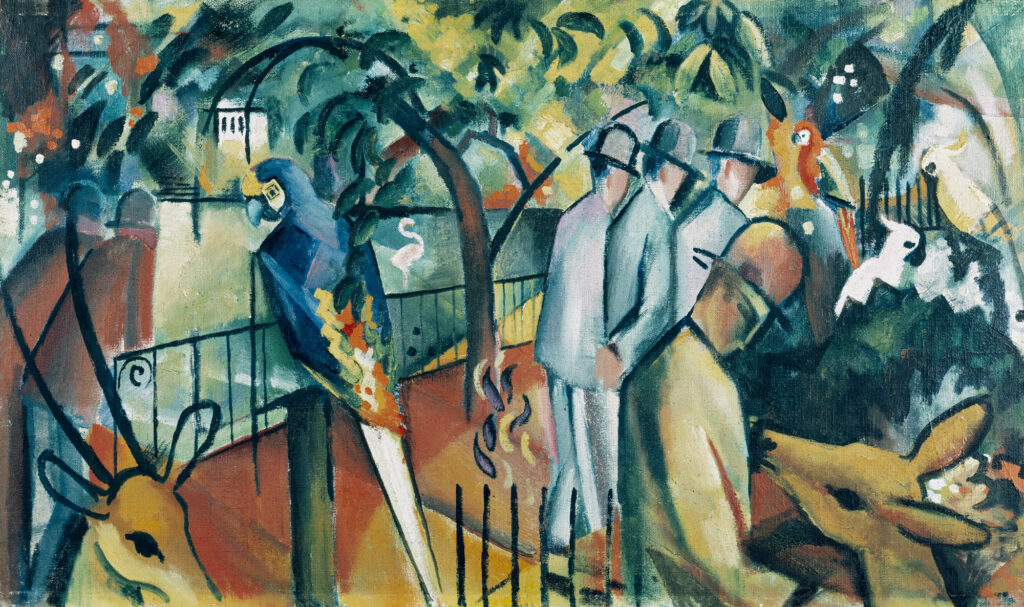
Munich, 1912. August Macke sets up his easel before the zoo enclosures. Around him, the German bourgeoisie strolls in their Sunday best. He wants to capture this moment: the urban escape, the spectacle of domesticated exoticism.
Colors that vibrate like life itself
The canvas explodes with pure hues. Cobalt blue dialogues with the oranges and acid greens of stylized trees. Macke applies paint in broad flat areas, almost without modeling. Forms are simplified. This technique reflects the influence of Fauvism. The oil on canvas captures the luminosity of a sunny afternoon. Each element—palm trees, railings, hats—is reduced to the essential. The composition juxtaposes planes without depth. The eye moves freely between the vivid brushstrokes that construct the space.
The zoo, mirror of modern contradictions
This painting captures a paradoxical era. German zoos, like the Hellabrunn Zoo inaugurated in 1911, embodied the colonial enterprise. They displayed fauna from conquered territories, transforming the elsewhere into bourgeois entertainment. For the artists of the Blue Rider, of which Macke was a member, the return to nature represented an escape from industrialization. But this nature remains codified, confined. The zoo becomes this “bourgeois paradise” where exoticism is consumed without danger. Macke captures this ambiguity.
August Macke
August Macke (1887-1914) explores modern life with a bold palette. Influenced by German Expressionism and Orphic Cubism, he develops a visual language where color structures emotion. Dying prematurely during World War I, he leaves behind a sunny and luminous body of work.
💭 In our perpetual quest for nature, where does true escape really lie? Behind the bars we contemplate, within ourselves, elsewhere?
About this work
- Zoological Garden I, August Macke, 1912
- Oil on canvas, 58.5 × 98 cm
- Städtische Galerie im Lenbachhaus und Kunstbau München, Bernhard and Elly Koehler Foundation 1965
- https://www.lenbachhaus.de/digital/sammlung-online/detail/zoologischer-garten-i-30021117