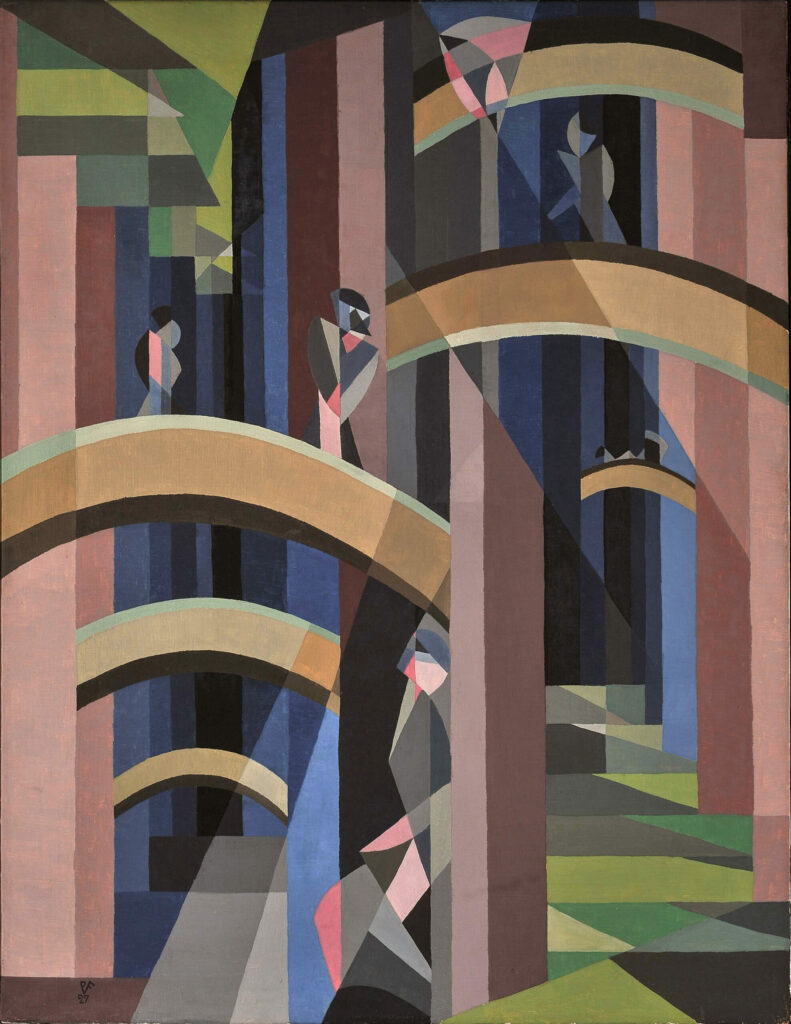
Berlin, 1927. Paul Fuhrmann has just broken with the Der Sturm circle. With the group “Die Abstrakten,” he seeks a new path between radical abstraction and figuration. On his canvas, a bridge takes form.
Between Architecture and Theater
Observe these vertical pillars. Bands of pink, blue, and mauve structure the composition like a stage set. Bridge arches connect them, golden and curved, traversed by stylized silhouettes. Below, green zones evoke grass or foliage. But is this truly an exterior? The oblique light falls like that of spotlights. The flat areas of color, soft and pastel, reinforce this artificiality. Paul Fuhrmann paints in oil on canvas with astonishing decorative precision. Each form interlocks with the next.
An Engaged Abstract Artist
This “Bridge Motif” emerges at a pivotal moment. In 1926, the group Die Abstrakten exhibited at the Große Berliner Kunstausstellung. There Fuhrmann defended a constructive abstraction that retained figurative elements. The work strikes with its elegance. Yet in October 1927, the painter joined the Communist Party. A few months later, he joined ASSO, the Association of Revolutionary Visual Artists. The contrast is striking between these refined tones and their author’s radical political engagement. This tension between decorative aesthetics and militant conviction makes the work fascinating.
Paul Fuhrmann
Paul Fuhrmann (1893-1952) remains an obscure figure of the Berlin avant-garde of the 1920s. Trained in the wake of Der Sturm, he developed a personal geometric style, midway between Cubism and decorative art. This canvas is its most accomplished expression.
Think about it
💭 And you, what do you see first: an urban landscape or a theatrical set?
About This Work
- Bridge Motif (Brückenmotiv)
- Paul Fuhrmann
- 1927/1928
- Oil on canvas
- 111 × 85 cm
- Neue Nationalgalerie, Staatliche Museen zu Berlin
- https://recherche.smb.museum/detail/959949/br%C3%BCckenmotiv
Architecture and Abstraction: The Bridge as Pretext
Bridge Motif is the best-known work by Paul Fuhrmann (1893-1952), a Berlin painter associated with the “Die Abstrakten” group at the turn of the 1920s and 1930s. The composition organizes the picture surface into rhythmic vertical and horizontal bands: slender pillars frame golden arches that open onto an indeterminate space, while stylized figures cross the scene in a light of pinks and mauves. The bridge here is not a picturesque motif but a constructive pretext, a structure that allows Fuhrmann to explore the tension between the geometric rigor inherited from constructivism and the coloristic warmth he shares with the expressionists of his generation.
Fuhrmann in Weimar Berlin
Fuhrmann painted Bridge Motif in a Berlin in the midst of intense cultural ferment, a few years before the rise of nationalism would bring that period of creativity to a close. An active participant in the city’s avant-garde circles, Fuhrmann joined the Communist Party shortly after completing this work, a political commitment that would prove decisive for the rest of his career, which was interrupted by the constraints imposed on the artistic milieu after 1933. Bridge Motif thus belongs to a pivotal moment when Berlin modernism still attempted to reconcile formal experimentation with social engagement, before that ambition was forcibly ended.
A Document of German Modernism
The Neue Nationalgalerie in Berlin holds an exceptional collection devoted to modern art, with particular attention to the currents of the Weimar Republic, that period from 1919 to 1933 during which Berlin became one of the most active centers of European creative life. Bridge Motif stands there as a witness to the moment when Berlin painters, architects, and graphic designers collectively sought a visual language equal to the transformations of their era. Its presence in a major public institution reflects the belated but lasting recognition of Fuhrmann’s place in the history of German modernism.