Bologna, circa 1575. Lavinia Fontana receives a commission: to paint the miracle of the Wedding at Cana on copper, a precious support reserved for works of intimate devotion. The young artist seizes the opportunity to demonstrate her technical virtuosity.
A Scene of Splendor and Miracle
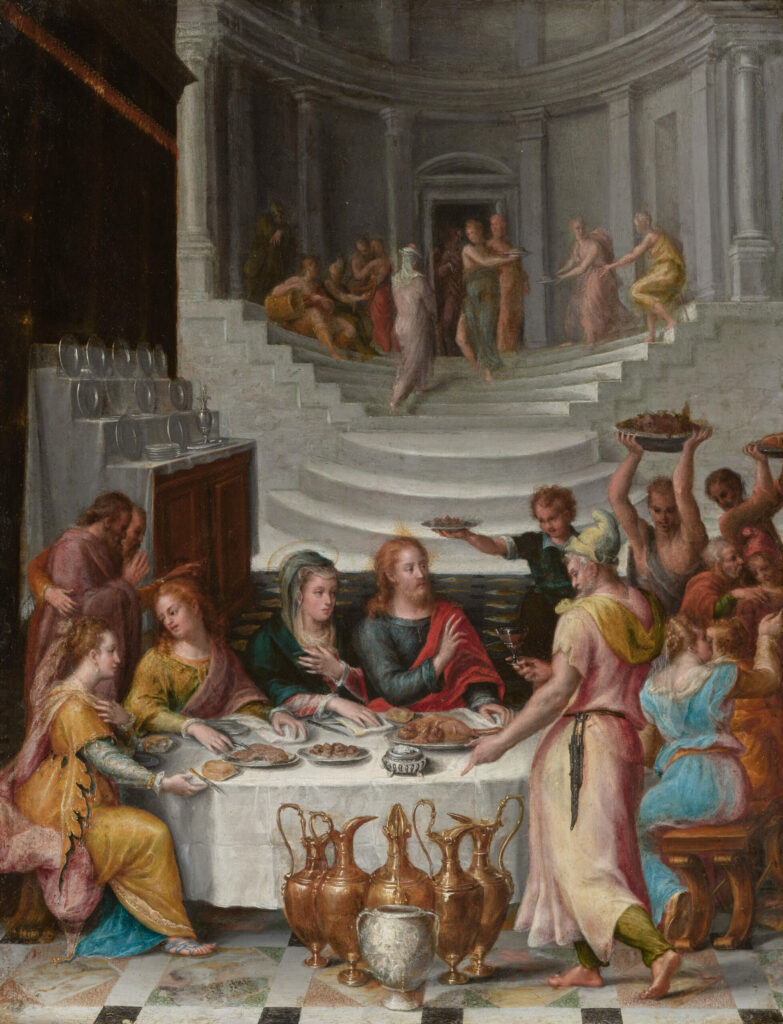
At the center of the composition, Christ raises his hand in a gesture of blessing. It is the precise moment of the miracle: water becomes wine. Mary is seated at his side. The guests crowd around the feast. Servants arrive, carrying dishes. In the foreground, six imposing golden jars attest to the accomplished wonder. Fontana applies the paint in thin, translucent layers, creating luminous glazes. On the polished copper, every detail gleams: shimmering fabrics, vessels displayed on the left buffet, and reflections on the jars. The precision is remarkable.
Architecture as Sacred Setting
An elegant peristyle structures the background, accessible by a double semicircular staircase with learned curves. This architecture is not gratuitous decoration: it inscribes the evangelical episode in a humanist tradition dear to the Renaissance. Fontana transforms a biblical narrative into a refined genre painting, adapted for private devotion. The reduced format invites intimate contemplation of the miracle.
Lavinia Fontana, Pioneer of Bolognese Painting
Born in Bologna, Lavinia Fontana (1552-1614) became the first professional woman painter in Italy. Trained by her father Prospero, she developed a meticulous and elegant style. She excelled in portraits and religious subjects, obtaining prestigious commissions as far as Rome.
Think about it
💭 And you, could you identify Christ among the guests without knowing the subject of the painting? What visual clues has Fontana planted?
About This Work
- The Wedding at Cana
- Lavinia Fontana
- circa 1575-1580
- Oil on copper
- 47.3 × 36.2 cm
- The J. Paul Getty Museum, Los Angeles
- https://www.getty.edu/art/collection/object/10NKF6