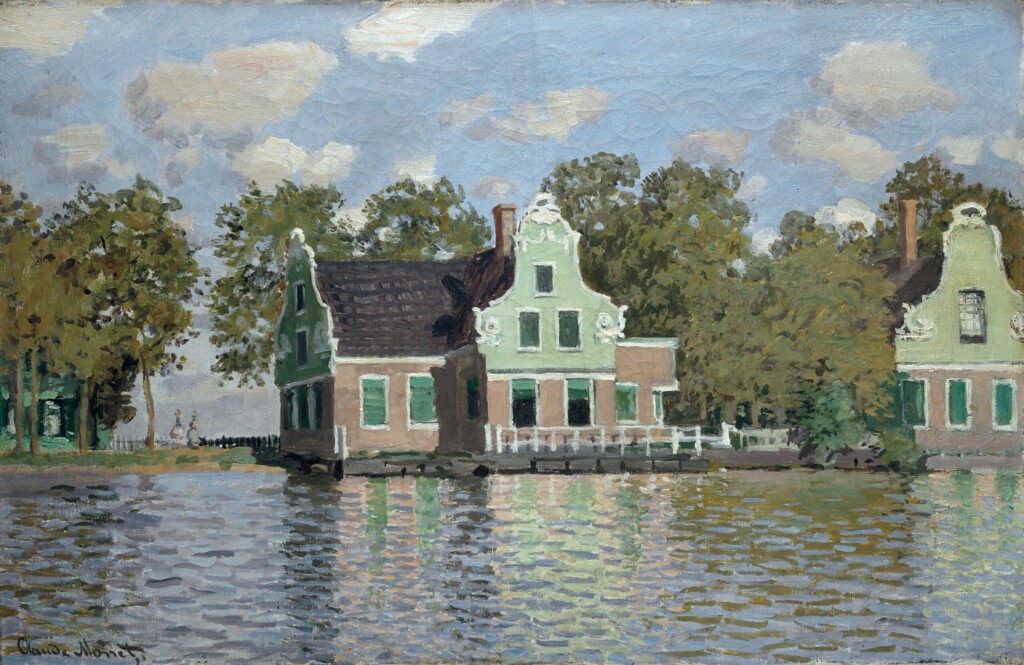
Zaandam, summer 1871. Claude Monet sets up his easel facing the calm waters of the Zaan. The Franco-Prussian War has just driven him from France. Here, in the Netherlands, he rediscovers light and serenity. Before him, houses with pale green façades stand at the canal’s edge. Their Baroque ornaments, typical of 17th-century Dutch architecture, captivate his gaze.
A Luminous Palette
Monet works quickly, in fragmented touches. The blue of the sky mingles with shades of white in the clouds. Reflections dance on the water’s surface in horizontal streaks of color. The pink and green façades break down into multiple nuances under the summer light. The trees form a dense mass of varied greens, treated in small, juxtaposed brushstrokes. This technique already heralds the Impressionism that would revolutionize painting.
Creative Exile After War
While Paris tends its wounds, Monet finds a haven of peace in Zaandam. This small town near Amsterdam attracts tourists with its picturesque landscapes. The artist stays there with his family and produces twenty-five canvases in a few months. He writes to Camille Pissarro that one could “occupy an entire painter’s lifetime” in this place. These houses by the water embody the carefree spirit regained after the traumas of war.
Claude Monet
Claude Monet (1840-1926) is now thirty-one years old. He refines his style by capturing the effects of light on water and architecture. This Dutch period marks a decisive stage toward the Impressionist maturity that would bring him worldwide renown.
Think about it
💭 How did this Dutch stay of 1871-1872 constitute a decisive laboratory for the Impressionist technique that Monet would develop the following year with Impression, Sunrise?
About This Work
- Houses by the Bank of the River Zaan
- Claude Monet
- 1871-1872
- Oil on canvas
- 47.7 × 73.7 cm
- Städel Museum, Frankfurt am Main
- https://sammlung.staedelmuseum.de/en/work/houses-by-the-bank-of-the-river-zaan
Zaandam After the War: A Productive Exile
Monet, who had spent part of the conflict in London with Pissarro, chose Zaandam, a small industrial town on the Zaan canal north of Amsterdam, as a place of refuge and work. He painted around twenty canvases there, struck by the particular atmosphere of the place: the timber-framed facades painted in pastel colours reflecting in the still canal waters, windmills dominating the horizon, boats gliding along the river. Writing to Camille Pissarro, he noted that a painter could spend “an entire painter’s life” working there, a measure of the abundance of motifs the Dutch landscape offered him. The canvas was sold to Paul Durand-Ruel in March 1872 and entered the Städel’s collection in Frankfurt in 1904.
The Lesson of Zaandam: Colour, Reflection, Immediacy
In Houses by the Bank of the River Zaan, Monet works with the fragmented, rapid touch that would become Impressionism’s hallmark. The house facades, pink, green, white, double themselves in the mirror of the canal through horizontal strokes that dissolve the boundary between the real and its reflection. The sky, rendered in broad passages of blue and white, reappears in the water with chromatic variations that attest to a sharp observation of light in motion. This Dutch stay, which precedes by one year the painting Impression, Sunrise (1872), is a decisive stage in the development of Impressionist technique: Holland offered Monet an ideal laboratory for observing light on water, a motif he would never stop exploring through to the Water Lilies of Giverny.
Monet and Holland: A Lasting Affinity
This was not the only time Monet painted Holland. He returned in 1886, this time to paint the tulip fields near Leiden. These two Dutch stays attest to a lasting affinity between Monet’s sensibility and the Dutch landscape: its diffuse light, its low horizons, its aquatic reflections. The Dutch tradition of landscape painting, from Rembrandt to Ruisdael, had also influenced the Barbizon painters from whom Monet descended directly before surpassing them in his own pictorial revolution.