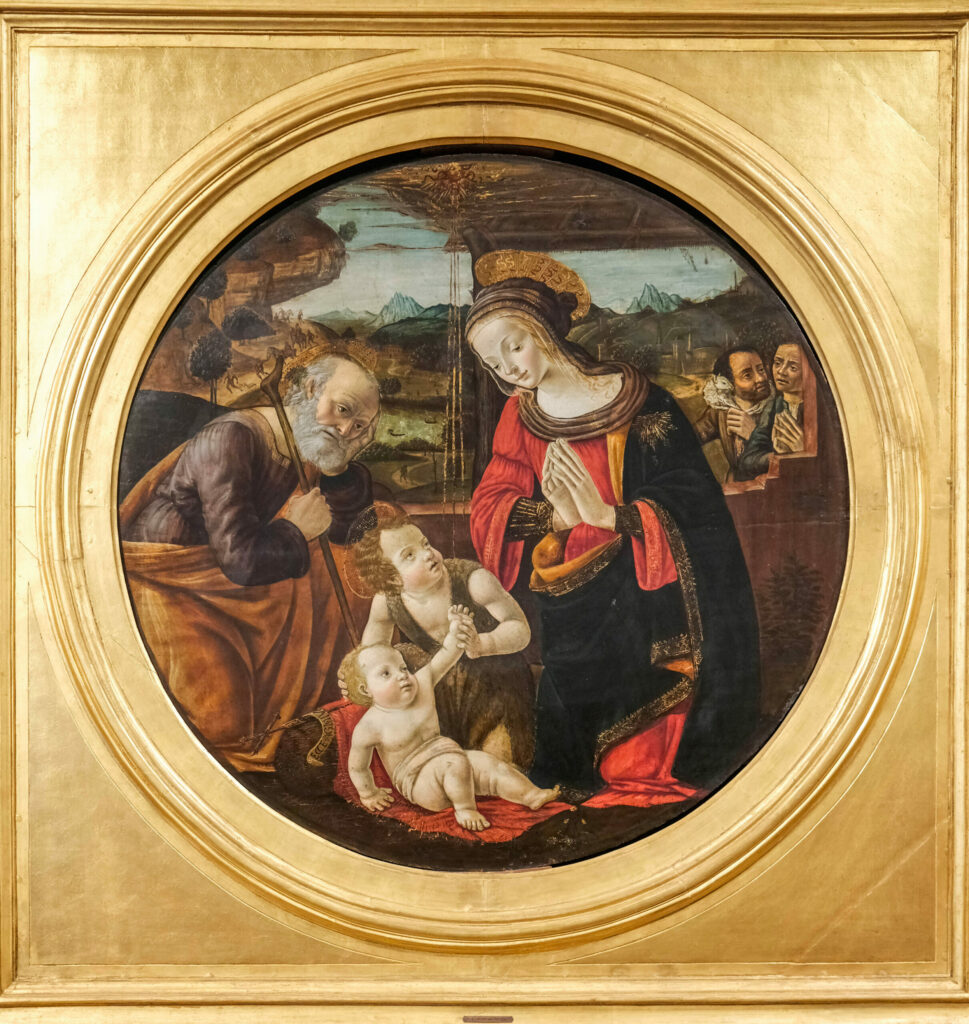
Florence, late 15th century. An anonymous painter composes a scene of moving intimacy: the Adoration of the Christ Child, where the sacred and humanity intertwine.
A Tempera of a Thousand Details
The tempera on panel reveals its delicacy in every brushstroke. The circular format, called a tondo, concentrates all gazes toward the Christ Child at the center. The Virgin in red and gold robes leans forward with infinite tenderness. Saint Joseph, his face marked, holds his staff with dignity. The young Saint John the Baptist, standing, holds the Christ in adoration. Two shepherds appear on the right: one carries a lamb on his shoulders. Beyond the rudimentary hut, an abundant mountainous landscape extends, populated with tiny figures. Joseph’s Nordic features contrast with Mary’s Florentine softness.
A Florentine Artistic Mystery
This work bears the name of an unknown artist: the Master of the Borghese Tondo. Scholars today lean toward Jacopo del Tedesco, a pupil of Domenico Ghirlandaio, active in Florence around 1503. The attribution has long oscillated between Pollaiolo and Girolamo di Benvenuto. The tempera testifies to the artistic effervescence of Florentine Quattrocento. Northern influences blend with Tuscan grace, creating a fascinating hybrid style.
Master of the Borghese Tondo
The Master of the Borghese Tondo, active in Florence between the late 15th and early 16th century, draws from Ghirlandaio his manner of painting female faces. His personal style marries Florentine rigor and Flemish realism. This work preserved at the Galleria Borghese perfectly illustrates his art.
A Question for You
💭 And you, what do you think of Renaissance artists who chose to paint the Nativity not as a triumphant celebration, but as this fragile moment in a stable?
About This Work
- Adoration of the Child
- Master of the Borghese Tondo
- late 15th century
- Tempera on panel
- diameter 78 cm
- Galleria Borghese, Rome
- https://www.collezionegalleriaborghese.it/opere/adorazione-del-bambino-3
The Tondo: A Form, a Programme
Adoration of the Child, held at the Galleria Borghese in Rome, is painted in tempera on panel in a circular format, the tondo, with a diameter of 78 cm. The tondo is an emblematic form of Florentine painting in the Quattrocento and early Cinquecento: associated with private domestic commissions, it decorated the bedchambers of newlyweds and newborns in prosperous Florentine households. Its circularity is not merely aesthetic, it concentrates the gaze on the centre of the composition (the Child lying in light) and encloses the figures in a bounded space that encourages devotional meditation. Adoration of the Child gathers around the Infant the Virgin, Saint Joseph, the young Saint John the Baptist, and two shepherds, one carrying a lamb — traditional figures of the Nativity transposed into a register of human tenderness and intimacy characteristic of private commissions of this type.
Attribution to Jacopo del Tedesco and the Question of Identity
The author of this work is designated by scholarly convention as the “Master of the Borghese Tondo”, a name that acknowledges the impossibility of certain identification while grouping under one designation a corpus of works sharing a style and a hand. Researchers have proposed identifying him as Jacopo del Tedesco, a pupil of Domenico Ghirlandaio active around 1503, though this attribution remains debated. Earlier attributions had suggested the names of Pollaiolo and Girolamo di Benvenuto. Such attributive uncertainty is not unusual for late 15th-century Florentine works, a period of proliferating workshops many of which operated from circulating compositions that were adapted and reinterpreted.
Crossed Influences: Flanders and Tuscany
What distinguishes Adoration of the Child from the Borghese Tondo is precisely the coexistence of two pictorial traditions. The grace of the faces and the pyramidal composition inherited from Ghirlandaio and the Florentine tradition sit alongside a precision in the rendering of materials and textures, fabrics, skin, natural settings, that betrays a familiarity with contemporary Flemish painting, particularly its tradition of meticulous observation of the real world. These exchanges between Flanders and Tuscany are well documented and frequent in the Florence of the Medici, a city open to northern influences from the late 15th century onward.