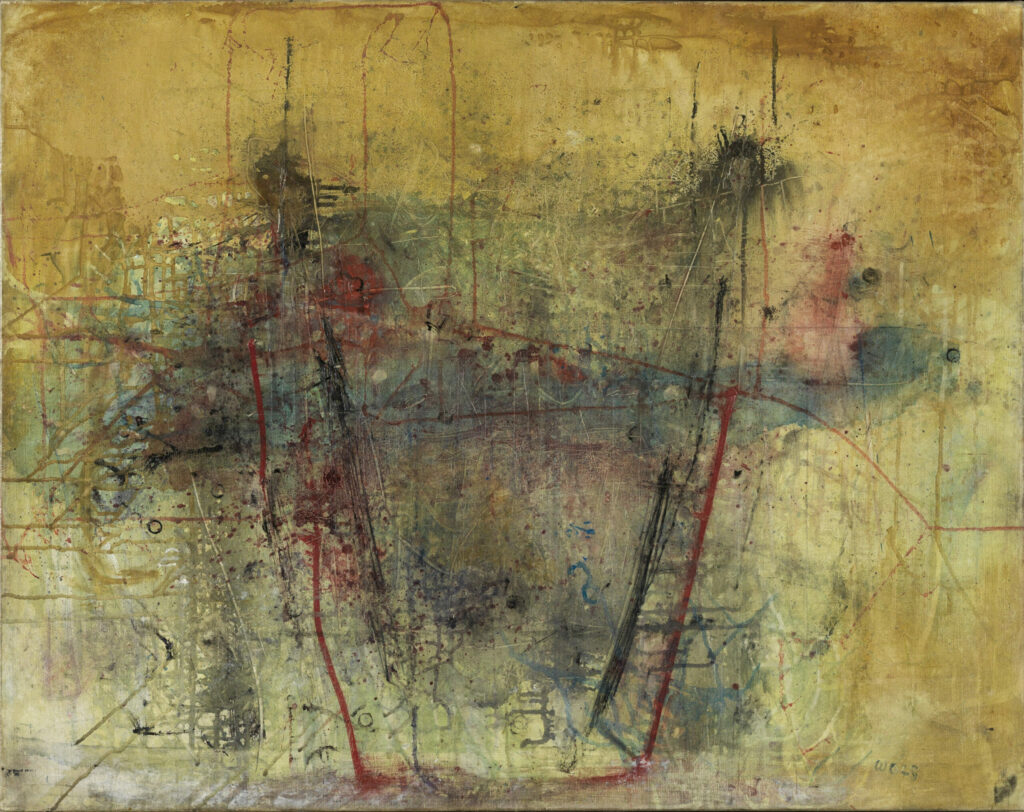
Paris, 1947. In Wols’s studio, paint flows, splatters, and claws at the canvas. The artist works urgently, almost in a trance. Against the ochre background of “Yellow Composition,” something organic takes shape, or loses it.
A Painting That Breathes
Observe this tormented surface. Red lines traverse the canvas like raw nerves. Black stains burst forth, drips descend, scratches reveal successive layers of matter. Wols does not seek to represent: he lets the paint live its own existence.
The diffuse forms evoke a fragmented skull, a decomposed face, perhaps a torn animal head. Every gesture counts. Each brushstroke, each contact with the still-wet paint recounts the creative process itself. The yellowish, earthy background amplifies this impression of living, almost biological matter.
Pioneer of Art Informel
In 1952, critic Michel Tapié christened this new pictorial language: Tachisme, a major branch of Art Informel. Wols was one of its essential precursors. After World War II, abstraction reinvented itself simultaneously in Europe and the United States. In 1946, dealer René Drouin, captivated by Wols’s wartime watercolors, provided him with canvases and oil paints. “Yellow Composition” emerged from this dazzling creative period, where gesture replaced figuration.
Wols
A recognized photographer before becoming a painter, Alfred Otto Wolfgang Schulze, known as Wols (1913-1951), brought to his canvases a particular sensitivity to texture and detail. His radical approach influenced an entire generation of Lyrical Abstraction artists.
Think about it
💭 Faced with this controlled chaos, what emotion arises in you: fascination or unease before this fragmented beauty?
About This Work
- Yellow Composition
- Wols
- circa 1947
- Oil on canvas
- 73 × 92 cm
- Nationalgalerie, Neue Nationalgalerie, Berlin
- https://recherche.smb.museum/detail/960263/composition-jaune
A Berliner in Paris: The Trajectory of Wols
Yellow Composition is one of the major works of Wols, the pseudonym of Alfred Otto Wolfgang Schulze (1913-1951), born in Berlin into a prosperous family whose father was a senior civil servant and arts patron. Wols’s biography is that of a voluntary exile: on the advice of László Moholy-Nagy, he settled in Paris in 1932, learned photography, moved among the Surrealists, and formed friendships with Max Ernst and Jacques Prévert. When war broke out, he was interned as a German national, first at the Camp des Milles, then in other facilities, where he continued drawing and painting in watercolour under precarious conditions. Released, he went into hiding in the unoccupied zone before returning to Paris at the Liberation. It was in the two years that followed, between 1946 and 1948, that Wols produced the bulk of his work in oil, supplied with materials by gallerist René Drouin, who had exhibited him as early as December 1945.
Existentialism in Paint: Sartre and Recognition
Yellow Composition belongs to this decisive postwar corpus. The warm ochre ground is traversed by red lines “like raw nerves,” black stains, and drips that stratify the surface into successive layers of living matter. The forms vaguely evoke organic life, skull, organism, wound, without anything being named. Wols, who had discovered phenomenology and moved in the circles of Jean-Paul Sartre and Simone de Beauvoir, painted an abstraction that Sartre would theorise as an existential shaping of the experience of the world: the brushmark does not illustrate, it testifies. In 1952, the critic Michel Tapié would coin the term “Art Informel” to designate this current, to which Wols belonged alongside Fautrier and Dubuffet. Wols died in Paris in September 1951, aged thirty-eight, of food poisoning, leaving a concentrated but foundational body of work whose importance was confirmed by his presence at the first editions of documenta in Kassel (1955, 1959, 1964).