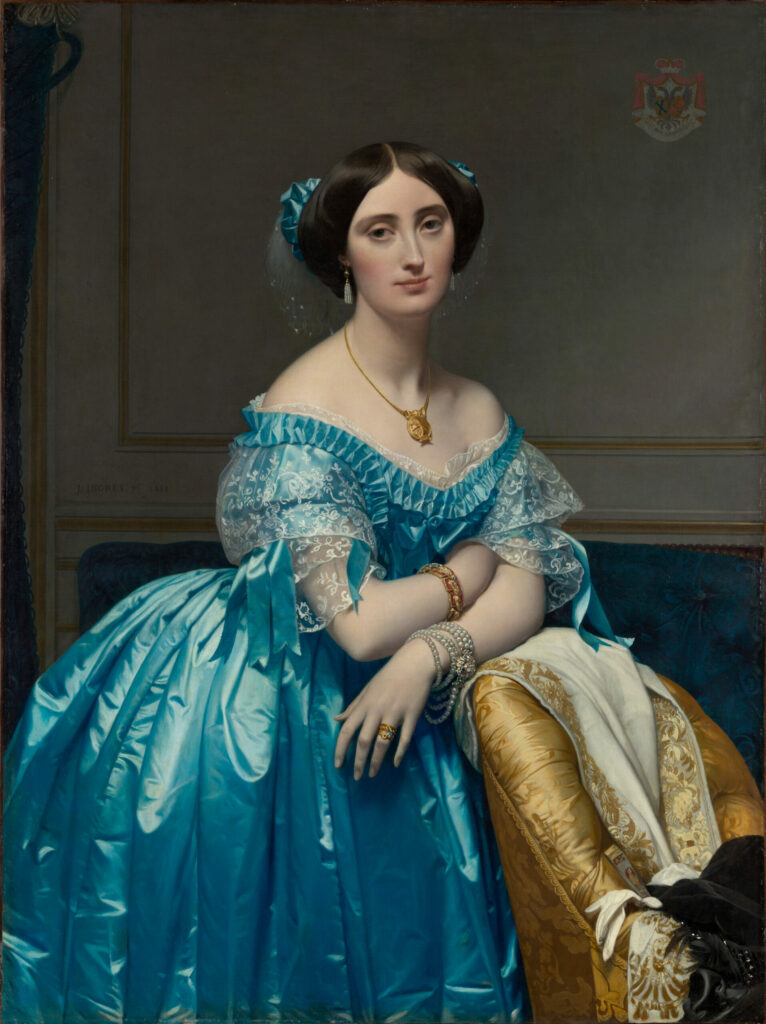
Paris, early 1850s. Ingres, past seventy years old, accepts a final commission: to immortalize the young Princess de Broglie. In the studio, Pauline poses, reserved, while the master of Neoclassicism prepares what will become one of the most poignant portraits of the 19th century.
Dazzling Technical Virtuosity
The turquoise blue of the dress explodes on the canvas. Ingres multiplies textures with a jeweler’s precision: the satin of the garment, the delicate lace, the golden damask of the armchair. Observe the jewelry. Each pearl captures the light. The pendant shines like a Byzantine treasure. The painter works the reflections with infinite patience. But beyond this technical demonstration, it is the gaze that strikes. Pauline stares at us with a contained melancholy, a presence both majestic and vulnerable.
The Weight of an Aristocratic Marriage
Pauline embodies the aristocracy of the Second Empire. Ingres, official portraitist of this elite, captures more than an appearance: he seizes a solitude. Four years after the work’s completion, tuberculosis takes the young woman’s life. She leaves behind five children and a devastated husband who will have the painting veiled. The portrait will remain hidden in the family home, too painful a testimony to an impossible happiness.
Jean-Auguste-Dominique Ingres
Jean-Auguste-Dominique Ingres (1780–1867), pillar of French Neoclassicism, worshipped Raphael and the pure line. A fierce opponent of Romanticism, he built his glory on portraits of icy exactitude and restrained sensuality. With Pauline de Broglie, he signs his artistic testament.
Think about it
💭 What if this sumptuous dress concealed one of the best-dressed solitudes of her era?
About This Work
- Joséphine-Éléonore-Marie-Pauline de Galard de Brassac de Béarn (1825–1860), Princess de Broglie
- Jean-Auguste-Dominique Ingres
- 1851-1853
- Oil on canvas
- 121.3 × 90.8 cm (47 3/4 × 35 3/4 in.)
- The Metropolitan Museum of Art, New York
- https://www.metmuseum.org/art/collection/search/459106