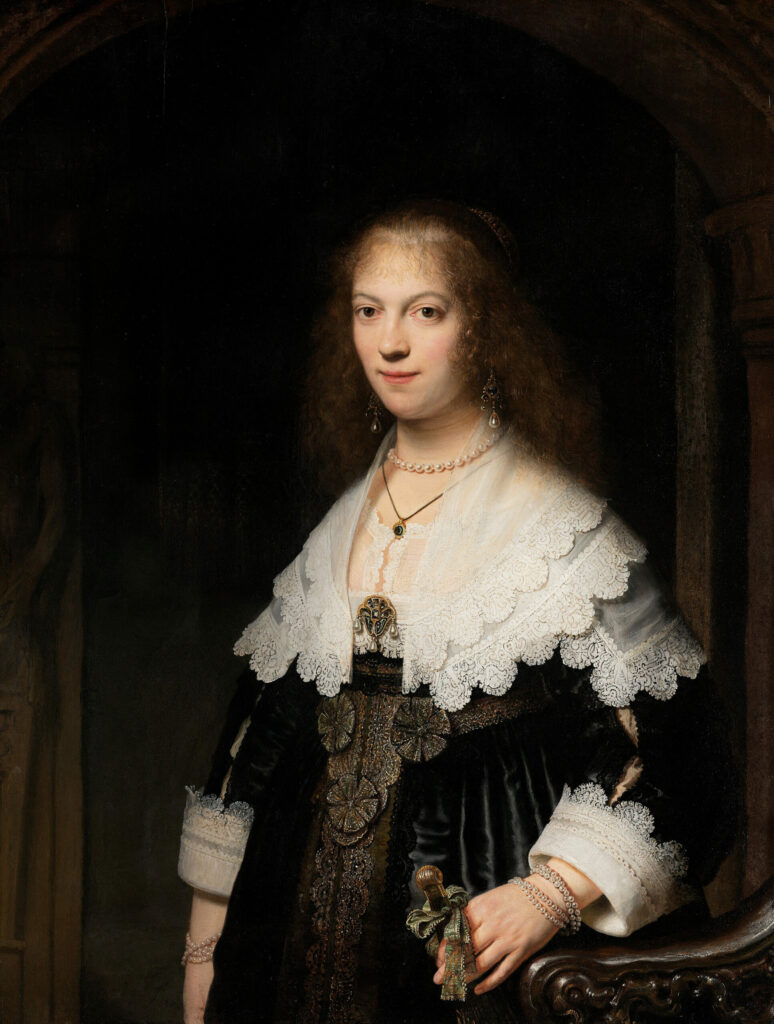
Amsterdam, 1639. Rembrandt paints Maria Trip, a young twenty-year-old heiress. She poses in all her splendor, embodying the power of a Dutch merchant dynasty built on the arms trade.
The Radiance of Fortune
Observe this young woman who looks at you with confidence. Her face is illuminated by Rembrandt’s characteristic light. The lace of her immense white collar captures every ray of light. Pearls adorn her neck in tight rows. Earrings matching a precious brooch shimmer on her black dress embroidered with gold. Her hand holds a Chinese fan, an extremely rare object at the time. Every detail proclaims her wealth. The textures compete in precision: the transparency of the lace, the luster of the pearls, the matte finish of the fabric.
The Portrait as Social Statement
Maria Trip belongs to one of the most powerful families in Amsterdam during the Dutch Golden Age. The Trips control the arms trade and accumulate a colossal fortune. Commissioning her portrait from Rembrandt represents a considerable investment and a marker of social status. These bourgeois portraits gradually replace religious painting in the Protestant United Provinces. They celebrate the economic success of a new merchant elite.
Rembrandt’s Genius
Rembrandt van Rijn (1606-1669) revolutionizes the art of portraiture in the 17th century. He captures the psychology of his subjects beyond their appearance. His chiaroscuro technique sculpts faces and creates dramatic depth. This portrait combines technical virtuosity with captivating human presence.
Think about it
💭 That giant lace collar that seems to float around her neck: was Maria wearing the equivalent of today’s haute couture piece that’s impossible to wear in everyday life?
About This Work
- Portrait of a Woman, probably Maria Trip (1619-1683)
- Rembrandt van Rijn
- 1639
- Oil on panel
- 107 × 82 cm
- Rijksmuseum, Amsterdam
- https://www.rijksmuseum.nl/en/collection/object/Portrait-of-a-Woman-Probably-Maria-Trip-1619-1683–6f7272f48fb3fbb02ceecf7aa897f1a7