This captivating work illustrates the art of official portraiture at the dawn of the 20th century, combining aristocratic tradition with modern sensibility.
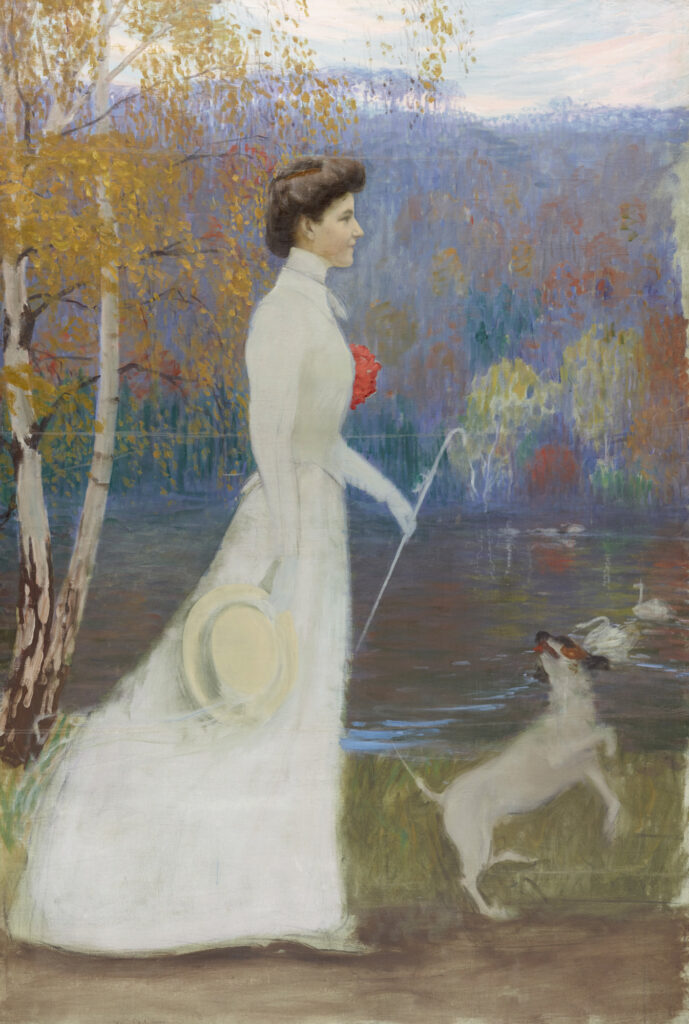
Hans Olde represents Caroline of Saxe-Weimar-Eisenach in an autumnal bucolic setting, bathed in the golden light characteristic of late Impressionism. The grand duchess, dressed in an immaculate white gown, stands with natural elegance at the edge of a pond. Her noble profile and upright posture express the dignity of her rank, while the white greyhound at her feet, traditional symbol of fidelity and nobility, completes this refined image.
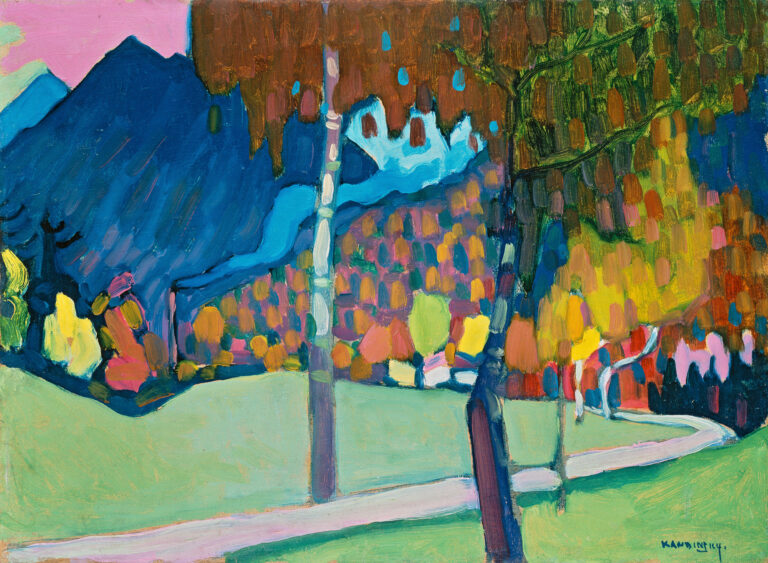
The pictorial technique reveals the influence of plein air painting: the golden foliage of the birch stands out against a background of bluish hills, creating remarkable atmospheric depth. The shimmering reflections on the water and the autumnal chromatic palette—ochres, blues, and violets—testify to a mastered Impressionist approach, where natural light structures the composition and unifies the whole in subtle harmony.
Further information
- Hans Olde, Caroline, Grand Duchess of Saxe-Weimar-Eisenach, c. 1903
- oil on canvas, 198 cm x 134 cm
- Städtische Galerie im Lenbachhaus und Kunstbau Munich
- https://www.lenbachhaus.de/en/digital/collection-online/detail/caroline-grossherzogin-von-sachsen-weimar-eisenach-30006631
Hans Olde (1855-1917) embodies the transition between traditional German academicism and the pictorial innovations of nascent modernity. Trained at the Weimar Academy then perfected in Munich and Paris, this versatile painter excelled in both portraiture and landscape painting. Director of the Weimar Art School from 1902, he played a role in German artistic education of his era. Official portraitist to the court of Saxe-Weimar-Eisenach, Olde developed a personal style blending the rigor of classical drawing with modern chromatic freedom. His production, marked by sure technique and fine psychology, testifies to his ability to capture the social and human essence of his models, making him a privileged witness of his time.