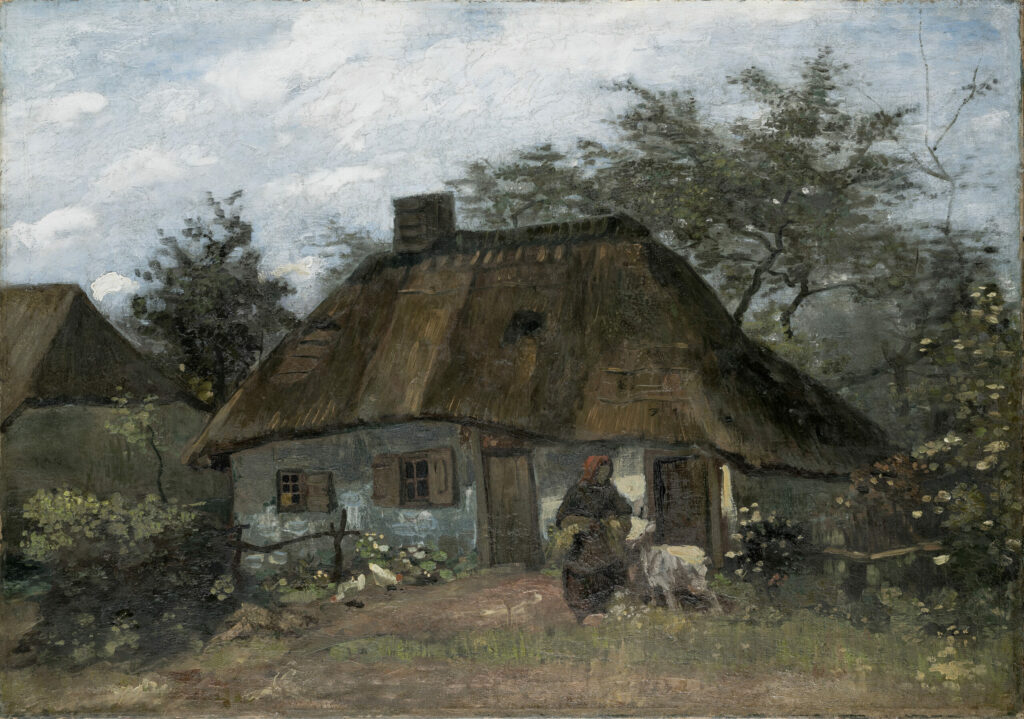
Nuenen, 1885. Vincent van Gogh sets up his easel facing a Brabant farm. Thatched roofs sag, walls lean, a woman works. Nothing in this painting hints at the nascent industrialization then transforming rural Netherlands.
A Palette of Earth and Authenticity
Van Gogh paints with deep browns, muted grays, dull greens. His touch is dense, applied in thick layers that give substance to the fragile architecture. The pale blue sky barely contrasts with the dominant earthy tones. Observe the trees framing the scene: their dark foliage creates a natural setting around the dwelling. The balanced composition captures the humility of this peasant life. Each architectural detail testifies to meticulous observation of rural daily life.
A Monument to Peasant Life
This painting belongs to Van Gogh’s Dutch period, before his departure for Paris and his discovery of the Impressionists. Here the artist honors the workers of his homeland, those peasants whose weathered faces he would soon paint in “The Potato Eaters.” He refuses embellishment, favoring raw truth. This authenticity would strike a critic who, visiting the Städel in 1923, would recognize in these dark canvases “the lion’s claws” heralding the dazzling genius to come.
Vincent van Gogh, an Artist in Training
Vincent van Gogh (1853-1890) was then going through a period of intense apprenticeship in Nuenen, his father’s native village. He experimented with oil on canvas, developed his social vision of art. Though still far from his famous sunflowers and starry skies, he built here the foundations of his unique pictorial language.
Think about it
💭 How does Van Gogh already announce, in these dark tones and dense touch, the revolution he would unleash a few years later in Paris?
About This Work
- Farm at Nuenen
- Vincent van Gogh
- 1885
- Oil on canvas
- 60 × 85 cm
- Städel Museum, Frankfurt am Main
- https://sammlung.staedelmuseum.de/en/work/farmhouse-in-nuenen