In Brief
Vincent van Gogh transformed Western art in the span of barely a decade. Initially employed as an art dealer and later driven by a religious vocation, he turned fully to painting at the age of twenty-seven. His artistic language evolved from a somber naturalism toward a luminous palette and an expressive brushwork that would anticipate both Fauvism and Expressionism.
Financially supported by his brother Theo, Van Gogh passed through several decisive creative phases: The Hague and Nuenen (his dark period), Paris (where he discovered Impressionism), Arles, birthplace of many of his most celebrated works, including Starry Night Over the Rhône (1888), Saint-Rémy (during his voluntary confinement), and finally Auvers-sur-Oise, where he painted nearly eighty canvases in seventy days before taking his own life at the age of thirty-seven.
Misunderstood during his lifetime, only a single painting is known to have been sold, his posthumous recognition was secured largely through the efforts of Johanna Bonger, Theo’s widow. Today, his oeuvre of more than two thousand paintings and drawings continues to fascinate through its emotional force and chromatic intensity.
The first time I encountered Starry Night Over the Rhône at the Musée d’Orsay, I understood that Van Gogh could never be reduced to reproductions. The impasto casts actual shadows; the Prussian and ultramarine blues vibrate with physical intensity; the orange glow of the gas lamps of Arles flickers across the surface of the Rhône. That experience profoundly altered the way I approached the study of his life and work.
This biography draws upon established historical sources, a close reading of Van Gogh’s correspondence, notably the 652 letters addressed to Theo, and direct observation of his paintings in European and American collections. Each period is illustrated through works that may be examined in detail on VMuseum.
Origins and Formation (1853-1880)
Van Gogh was born on 30 March 1853 in Groot-Zundert, in the Netherlands, into a cultivated middle-class Protestant family. His father was a minister, while several of his paternal uncles were art dealers, among them a partner in the firm Goupil & Cie.
At sixteen, in 1869, he entered the Hague branch of Goupil & Cie, managed by one of his uncles. This international firm enabled him to develop an early familiarity with the art world. His career took him to London and later Paris, yet his dismissal in 1876 redirected him toward a spiritual calling.
In 1878 he became a lay preacher in the Borinage mining district of Belgium, living among miners whose precarious conditions he shared with uncompromising sincerity. His mission was eventually terminated, considered excessively radical by ecclesiastical authorities. In 1880, at the age of twenty-seven, he resolved to devote himself entirely to art. Theo, by then an art dealer in Paris, became his steadfast financial support.
The Emergence of an Artist (1880-1886)
Van Gogh trained first in Brussels and later in The Hague, where he received guidance from his cousin, the painter Anton Mauve. During these years his palette remained dark, indebted to the Barbizon School and to the Dutch masters he deeply admired.
The Potato Eaters (1885) marks the culmination of this formative period. Before the painting itself, one understands that Van Gogh sought neither elegance nor convention. Rather, he wished to convey the harshness of peasant labor through the very substance of paint. The faces are deliberately coarse, the tones earthy and dense.
Already, the work reveals the quality that would define his genius: the transformation of painterly technique into emotional language.
Paris: The Chromatic Revolution (1886-1888)
In February 1886, Van Gogh joined Theo in Paris. There he encountered Impressionism and Neo-Impressionism, while also collecting Japanese prints. His palette brightened dramatically.
What Paris Truly Changed
It is often said that Paris “lightened his palette.” This is true, though insufficient. In studying works such as Terrace of the Luxembourg Gardens, one perceives a more profound transformation: the very conception of the brushstroke itself changes.
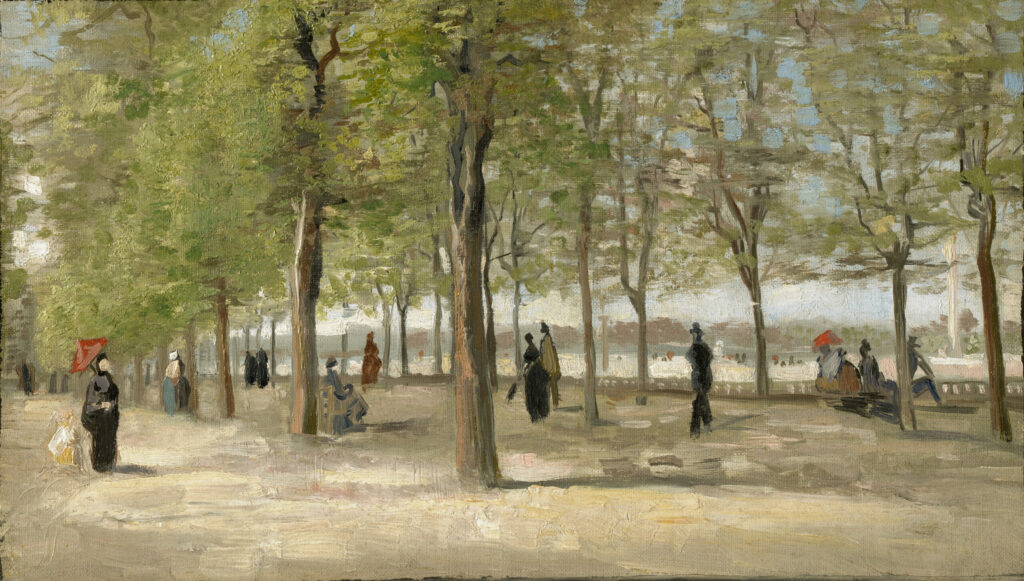
Each touch of paint becomes an autonomous event of light. Van Gogh no longer merely depicts illumination, he constructs it. Seurat introduced him to divisionist principles, yet Van Gogh carried them further: every brushstroke was also to bear an emotional charge.
This double revolution, optical and expressive, explains everything that would follow in Arles.
Arles: The Creative Explosion (1888-1889)
On 20 February 1888, Van Gogh settled in Arles. This period of extraordinary fertility gave rise to The Bedroom, Sunflowers, and The Night Café.
Starry Night Over the Rhône (September 1888)
Standing before this painting at the Musée d’Orsay, one senses the culmination of an obsession. In September 1888, Van Gogh wrote: “It often seems to me that the night is more richly colored than the day.”
Blues dominate the composition, Prussian, ultramarine, cobalt, set against the intense orange reflections of the gas lamps of Arles shimmering upon the Rhône. The presence of the lovers in the foreground lends the scene a serenity absent from the later, more cosmic version painted at Saint-Rémy.
What strikes one most in the original is the impasto itself: thick enough to cast shadows across the canvas. Van Gogh does not paint a nocturnal sky; he sculpts light.
The Three Obsessions of Arles
A close reading of his Arles production reveals three recurring themes.
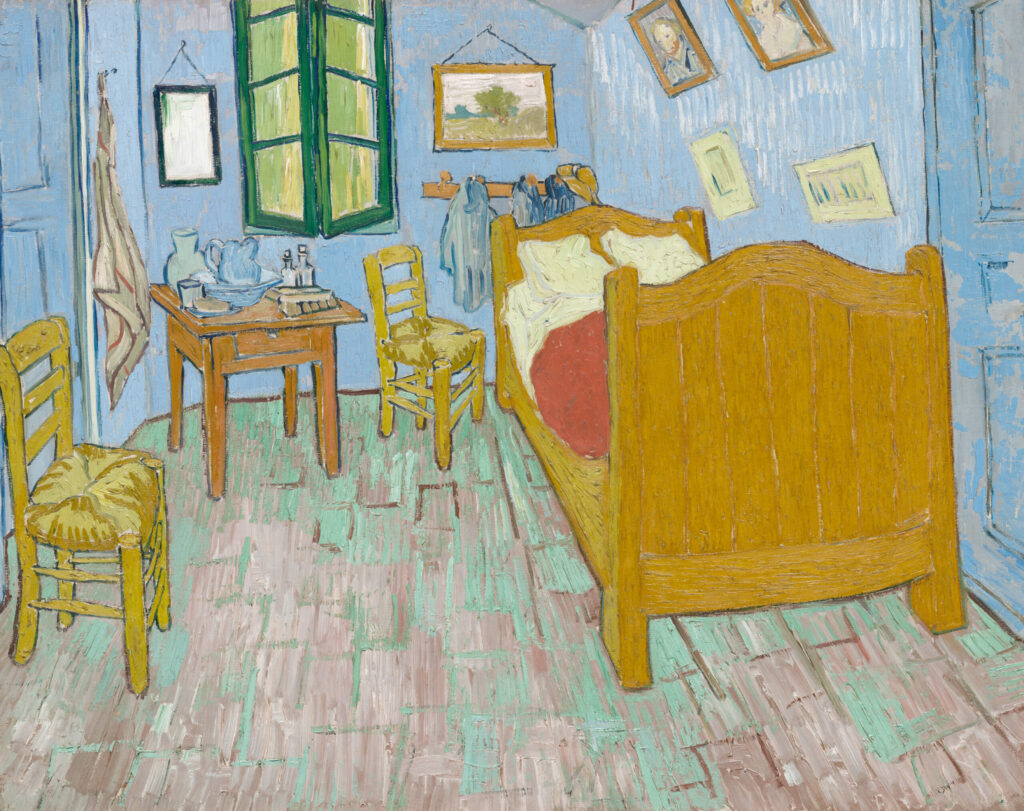
Southern light as an absolute. In The Bedroom, it is not the furniture that matters, but the luminous tension between yellows and blues. Van Gogh sought to paint light itself, not merely what it illuminated.
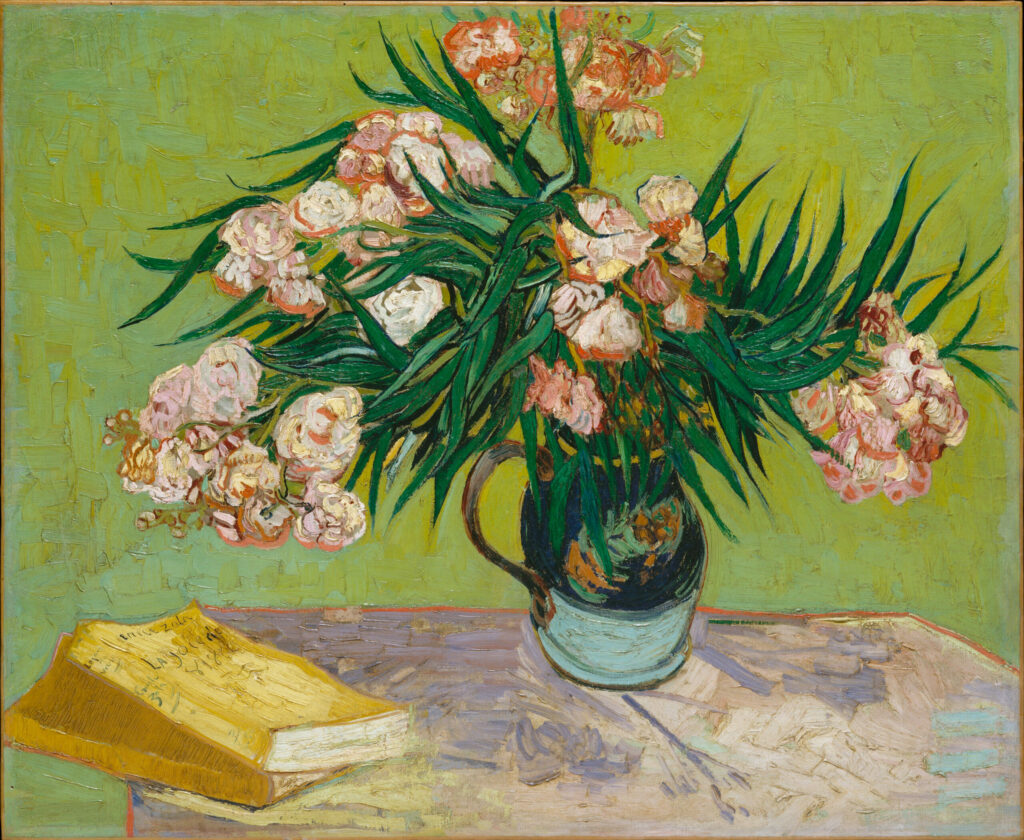
An imagined Japan. Oleanders pays direct homage to Hiroshige through its flat planes of color, compressed space, and unconventional framing. In Arles, Van Gogh believed he had found his own Japan.
The impossible artists’ community. His Yellow House was conceived as a utopian space where painters might live and work together, sharing discoveries and ideas. The failure of this dream with Paul Gauguin, culminating in the episode of the severed ear on 23 December 1888, represented not merely a quarrel, but the collapse of his ideal of life itself.
Saint-Rémy: Creation Amid Crisis (1889-1890)
Under pressure from the inhabitants of Arles, Van Gogh voluntarily entered the asylum of Saint-Paul-de-Mausole in Saint-Rémy-de-Provence in May 1889. During this year of confinement, punctuated by recurrent crises, he continued to paint relentlessly.
In June 1889, he painted a second treatment of the starry night theme, today in the Museum of Modern Art in New York, in which the heavens become cosmic, forms spiraling into a hallucinatory vision that contrasts sharply with the relative calm of the Arles composition.
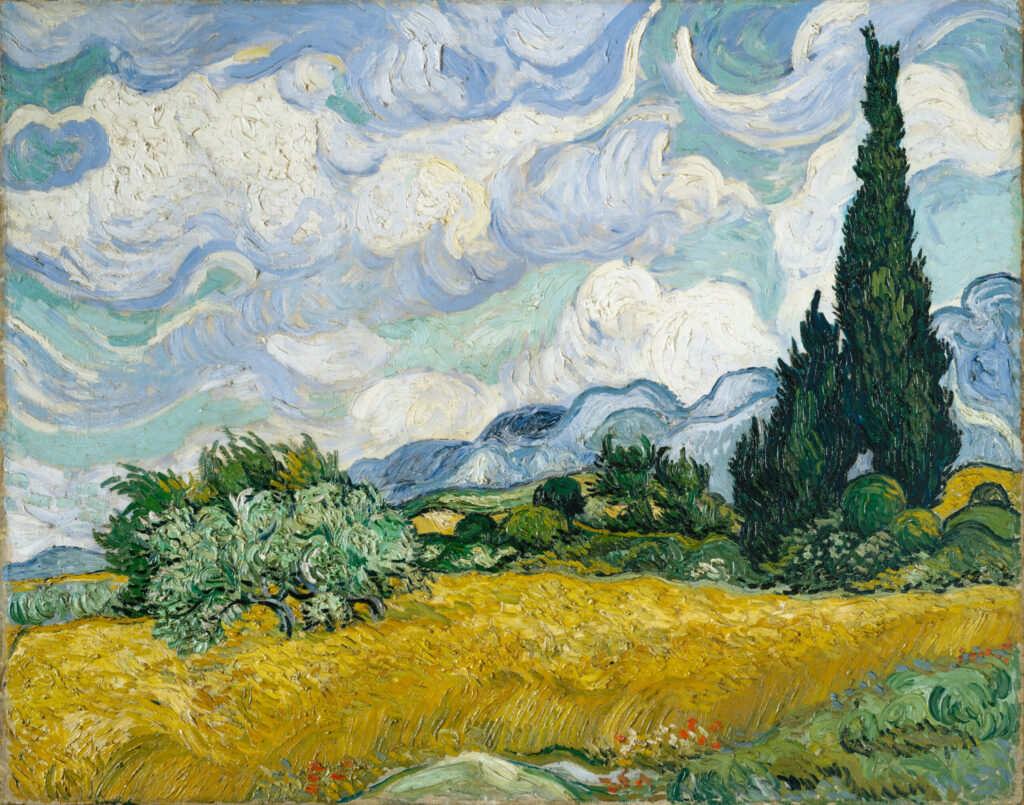
Cypresses with Wheat Fields synthesizes the essential features of this period: swirling brushwork, chromatic intensity, and heightened emotional force. The cypress ceases to be a tree; it becomes a black flame rising toward the sky.
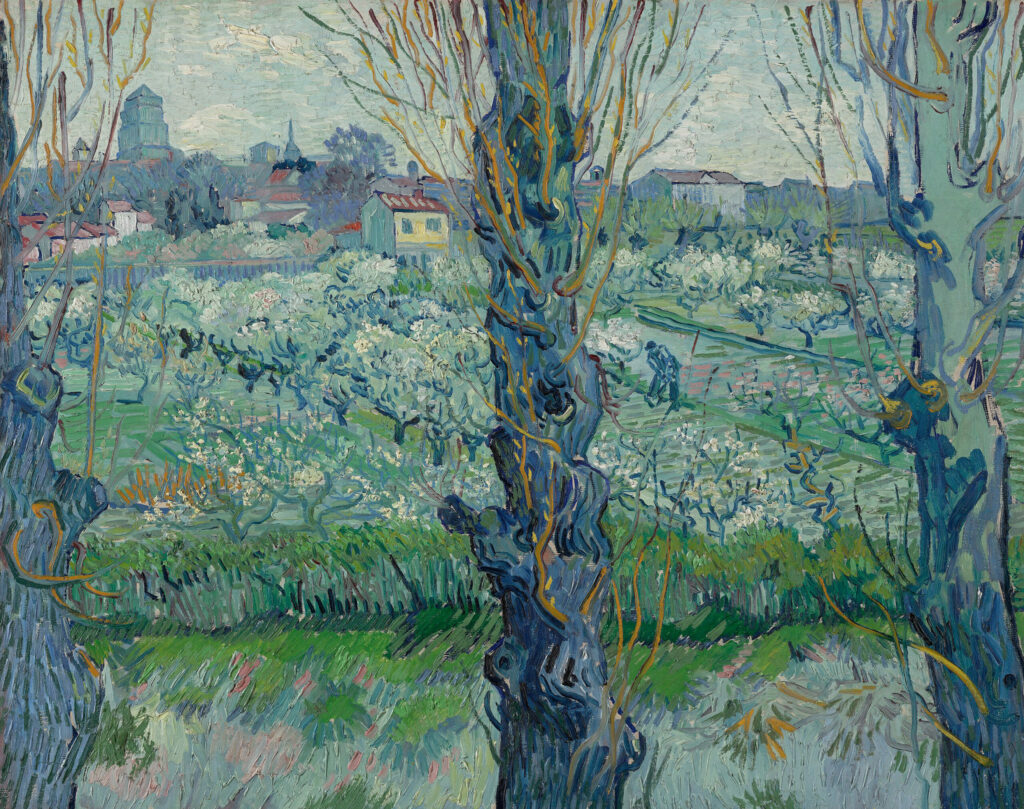
In View of Arles, the city is seen from Saint-Rémy, that is, reconstructed through memory and imagination. The colors are impossible, the composition nearly delirious, yet the painting holds together with astonishing coherence. Here, Van Gogh reinvents landscape itself.
Auvers-sur-Oise: The Final Days (May-July 1890)
In May 1890, Van Gogh left the asylum and settled in Auvers-sur-Oise near Paris, under the care of Doctor Paul Gachet. During the final seventy days of his life, he produced nearly eighty paintings.
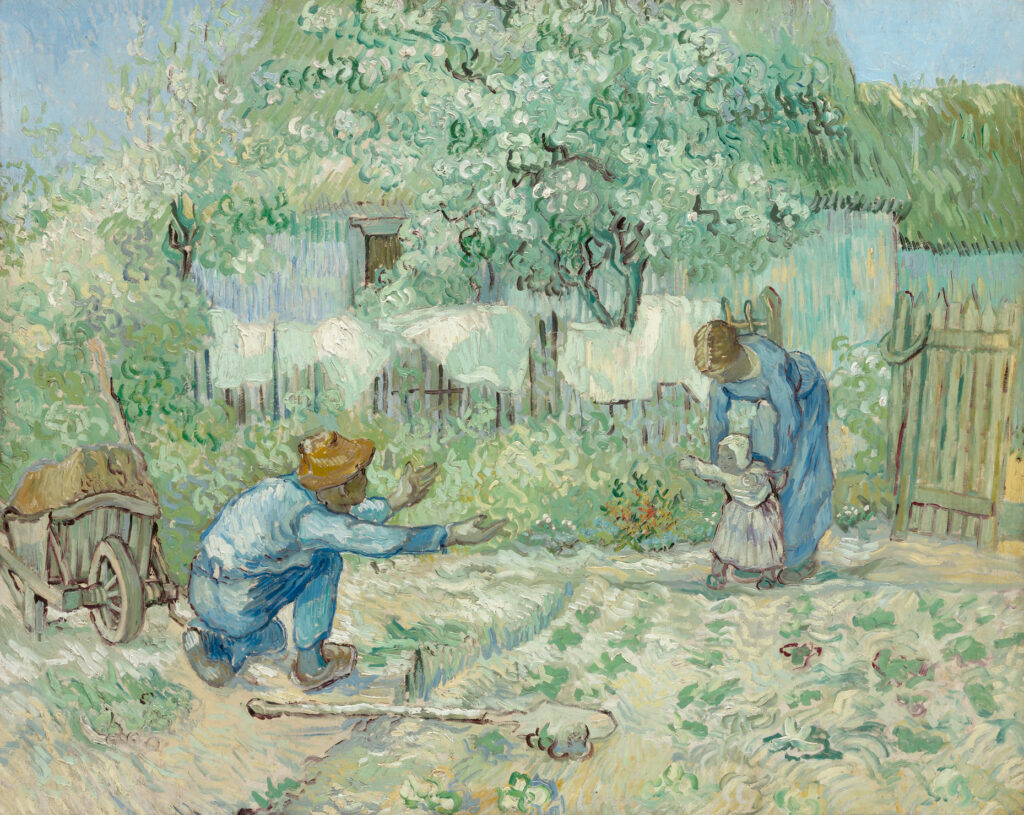
First Steps, after Millet, painted two months before his death, is deeply moving. Van Gogh revisits a scene he cherished, a child learning to walk, transforming it into an explosion of color. Perhaps it represented his final hope: to learn, himself, how to move forward once again.
On 27 July 1890, after painting Tree Roots, he shot himself in the chest. He died two days later, on 29 July, at the age of thirty-seven, with Theo at his bedside. Theo himself died only six months later, in January 1891.
Major Works to Explore on VMuseum
For a deeper examination of each period, VMuseum offers detailed entries on the following works:
- Irises (1889), Getty Museum, Los Angeles – perhaps the least “Van Gogh” of his paintings, remarkable for its serenity.
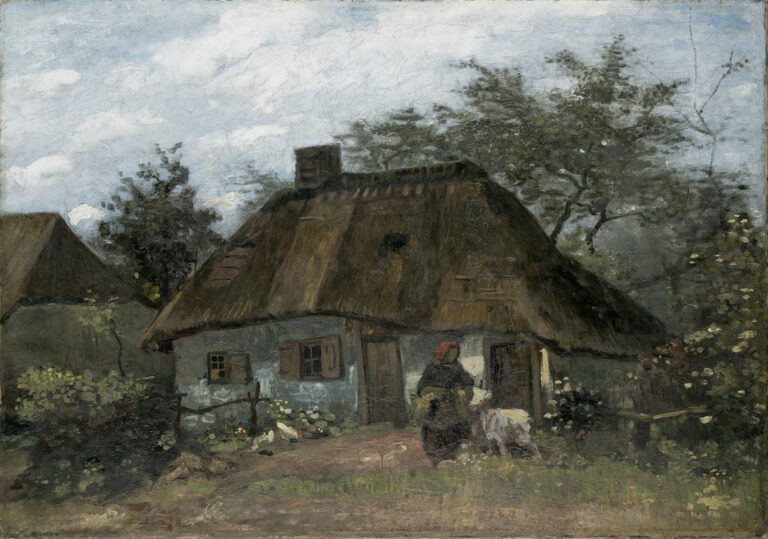
- Farmhouse in Nuenen (1885), Städel Museum, Frankfurt – essential to understanding his origins: those dense browns, that deliberately “dirty” paint surface.
- The Bedroom (1889), Art Institute of Chicago – a perfect demonstration of his ability to transform a modest interior into an aesthetic manifesto.
- View of Arles (1889), Neue Pinakothek, Munich – a synthesis of paradise and its impossibility.
- First Steps (1890), Metropolitan Museum of Art, New York – painted two months before his death, perhaps his final gesture of hope.
- View all the Van Gogh’s artworks analysed by Vmuseum.
Frequently Asked Questions
Was Van Gogh truly “mad”?
The question itself is troubling. After reading the entirety of his correspondence, one can affirm that Van Gogh suffered acute psychological crises, likely linked to temporal lobe epilepsy exacerbated by malnutrition and alcohol.
Yet between these episodes, he displayed astonishing intellectual lucidity. His reflections on color theory and his analyses of Delacroix and Millet reveal a mind of extraordinary rigor and discipline.
The myth of the “mad artist” obscures the reality of relentless labor. Van Gogh did not produce eighty paintings in seventy days at Auvers through divine inspiration, but through disciplined persistence.
Why did he sell only one painting during his lifetime?
Because he was decades ahead of his contemporaries. In 1888, audiences favored either academic painting or an Impressionism softened for bourgeois taste. Van Gogh offered violent brushstrokes, dissonant color, and distorted perspective.
One must imagine entering an exhibition in 1889 after viewing the polished canvases of the Salon, only to encounter View of Arles with its impossible pinks and destabilized composition. It was simply too much, too early.
Why are his paintings worth millions today?
Largely because of Johanna Bonger. When Theo died in 1891, she inherited more than two hundred of Vincent’s works. She might easily have dispersed them. Instead, she devoted twenty-five years to organizing exhibitions, publishing the correspondence, and persuading critics and museums of Van Gogh’s significance.
Without this patient and methodical effort, Van Gogh might have remained a marginal figure. Johanna Bonger constructed the legend intelligently: avoiding overexposure, curating selective exhibitions, and pursuing a long-term vision.
Which Is His Most Important Work?
From a historical perspective, The Starry Night (MoMA, 1889) exerts perhaps the most profound influence on the development of modern art.
My own choice, however, would be Cypresses with Wheat Fields (1889). Within this single canvas, one perceives all the Van Goghs at once: the swirling brushwork of Saint-Rémy, the luminous intensity of Arles, the structural rigor acquired in Paris, and already the underlying anxiety that would culminate at Auvers. It is, in many ways, a synthesis of his entire artistic journey.
His Influence on Modern Art?
The influence of Vincent van Gogh on twentieth-century art is immeasurable. He is regarded as a crucial precursor to several major artistic movements.
Expressionism. His emotional use of color and highly expressive brushwork directly inspired artists such as Ernst Ludwig Kirchner and Oskar Kokoschka.
Fauvism. His radiant, non-naturalistic palette profoundly influenced Henri Matisse, Maurice de Vlaminck, and André Derain.
Abstraction. Van Gogh’s conception of art as the expression of an inner reality foreshadows the emergence of Abstract Expressionism in the twentieth century.
Conclusion
Vincent van Gogh embodies one of the most compelling artistic destinies in the history of art. In scarcely ten years of creative activity, the last four marked by extraordinary intensity, he forged a revolutionary pictorial language that transformed Western painting.
Situated at the intersection of tradition and modernity, his oeuvre forms an essential bridge between nineteenth-century Impressionism and the avant-gardes of the twentieth century. The expressive power of his paintings, their chromatic intensity, and their emotional sincerity continue to resonate deeply with viewers today.
Beyond his artistic genius, it is perhaps this unique ability to communicate directly with the spectator, to convey an intensely personal vision of the world, that explains the enduring fascination of his work. As he wrote in one of his final letters: “Truly, we can only make our paintings speak.”
Bibliography
Primary Sources
- Correspondance complète, Vincent van Gogh, translated by M. Beerblock and L. Roelandt, 3 vols., Gallimard, Paris, 1960.
- Vincent Van Gogh. Souvenirs personnels, Elisabeth du Quesne van Gogh, F. Hazan, Paris, 1982.
Critical Studies
- Van Gogh par Vincent, Pascal Bonafoux, Denoël, Paris, 1986.
- Van Gogh, ou l’Enterrement dans les blés, Viviane Forrester, Seuil, Paris, 1983.
- La Vie de Van Gogh, Henri Perruchot, Hachette, Paris, 1955.
- Van Gogh en Arles, Ronald Pickvance, Skira, Geneva, 1985.
- Van Gogh et Gauguin : l’atelier du Midi, Electa, Milan, 2002.
Further Reading
Further analyses of his work, accompanied by high-resolution images and detailed catalogue entries, may be consulted in Van Gogh’s page on VMuseum.