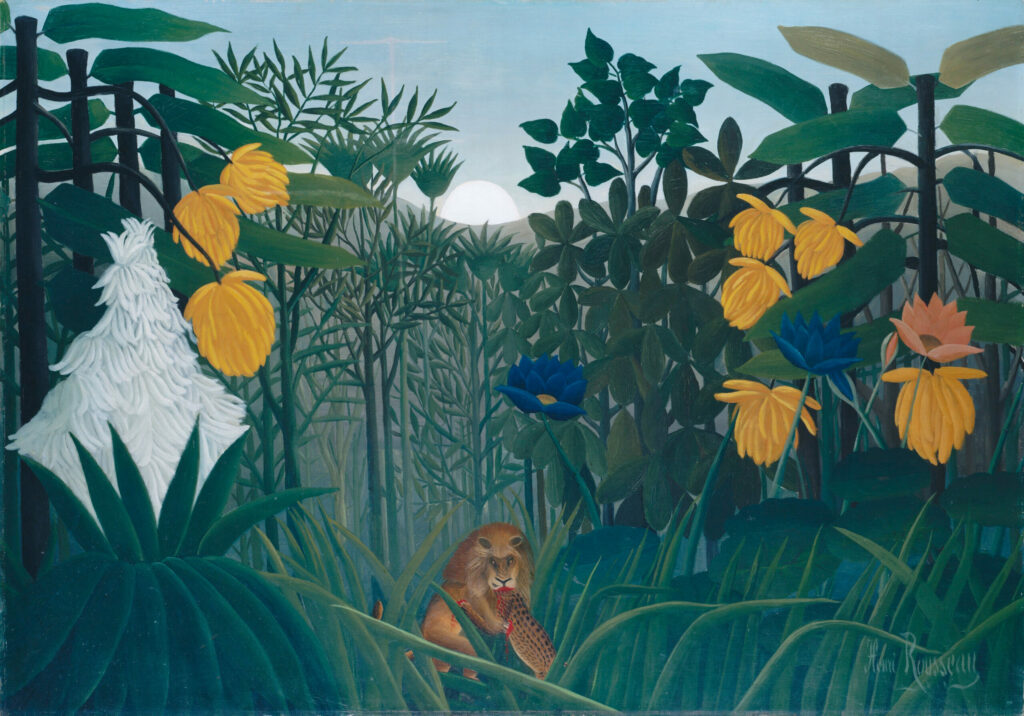
In this enchanting vegetal theater, the Douanier Rousseau does a phantasmagorical vision of the jungle, where nature reigns as absolute sovereign.
The profoundly dreamlike composition plunges us into a lush universe where each leaf seems to have been meticulously drawn. At the center of this symphony of deep greens, a lion devours its prey with strange serenity. The moon, a perfect disc positioned on the horizon, bathes the scene in a bluish light that confers upon the whole an atmosphere of nocturnal fairy tale. Exotic flowers, touches of immaculate white, cobalt blue, and solar yellow, punctuate this dense vegetation like melodic notes in a sylvan score. Here, Rousseau succeeds in transmuting a scene of natural predation into metaphysical vision, where the serene beauty of the wild world transcends its intrinsic violence.
Additional Information
- Title: “The Repast of the Lion” by Henri Rousseau, known as Le Douanier, 1907
- Dimensions: 44 3/4 in. × 63 in. (113.7 × 160 cm)
- Location: The Metropolitan Museum of Art, Fifth Avenue, New York, exhibited in Gallery 825
- https://www.metmuseum.org/art/collection/search/438822
Henri Rousseau, known as Le Douanier (1844-1910), embodies one of the most singular artistic trajectories in the history of modern art. A complete autodidact, having never received academic training nor traveled outside France, this former Paris customs employee began painting late in life.
His painting, initially mocked for its apparent naivety, progressively fascinated the artistic avant-garde for its extraordinary imaginative power and formal freedom. Rousseau developed a deeply personal style, characterized by meticulous execution, bright flat colors, and an idiosyncratic vision of the world. At his death in poverty, Rousseau left a body of work that, through its radical authenticity and visionary poetry, stands as one of the most original of his time.
The Nocturnal Jungle as Interior Stage
The Repast of the Lion (1907) belongs to the series of large jungle canvases that Rousseau produced in the last decade of his life, between 1897 and 1910. The scene is nocturnal: a lion devours its prey in a clearing lit by a full moon, surrounded by dense, frontal vegetation that forms a wall of leaves. Rousseau never set foot in Africa, nor anywhere outside France. His sources were the exotic greenhouses and menagerie of the Jardin des Plantes in Paris, along with albums of colonial lithographs and the illustrations of popular magazines circulating at newsstands. The large canvas (113.7 × 160 cm) is held in Gallery 825 of the Metropolitan Museum of Art in New York. What strikes the eye is the solemnity of the scene: the lion is not violent but sovereign, posed in a frontal composition that recalls Egyptian paintings or icons rather than academic animal painting.
The Foliage Plane as Visual Grammar
The composition of The Repast of the Lion is characteristic of the approach Rousseau developed across his jungle works: vegetation planes are stacked like theatrical backdrops, each layer of leaves partially covering the one below, creating a scenic rather than spatial depth. The flowers, here red and white tropical blooms, are arranged with a regularity that owes nothing to botany but everything to ornamental grammar. The full moon, round and milky, lights the scene from above with an unreal glow that amplifies the dreamlike quality of the image. This visual construction, frontal, decorative, rhythmic, is what the Surrealists would later recognize as an anticipation of the represented dream.
Late Recognition and Legacy
In 1907, Rousseau was known within avant-garde circles but not yet celebrated. Picasso paid tribute to him with the famous “Rousseau Banquet” of 1908, an evening organized at his Bateau-Lavoir studio to celebrate the purchase of a Rousseau portrait found at a dealer’s for almost nothing. Apollinaire and his circle publicly defended the work of the “Douanier”, a nickname derived from the Paris toll-collector post Rousseau held from 1871 to 1893. International recognition came after his death in 1910, the very year he completed his last great jungle canvases, of which The Repast of the Lion stands as one of the most accomplished.