Key facts
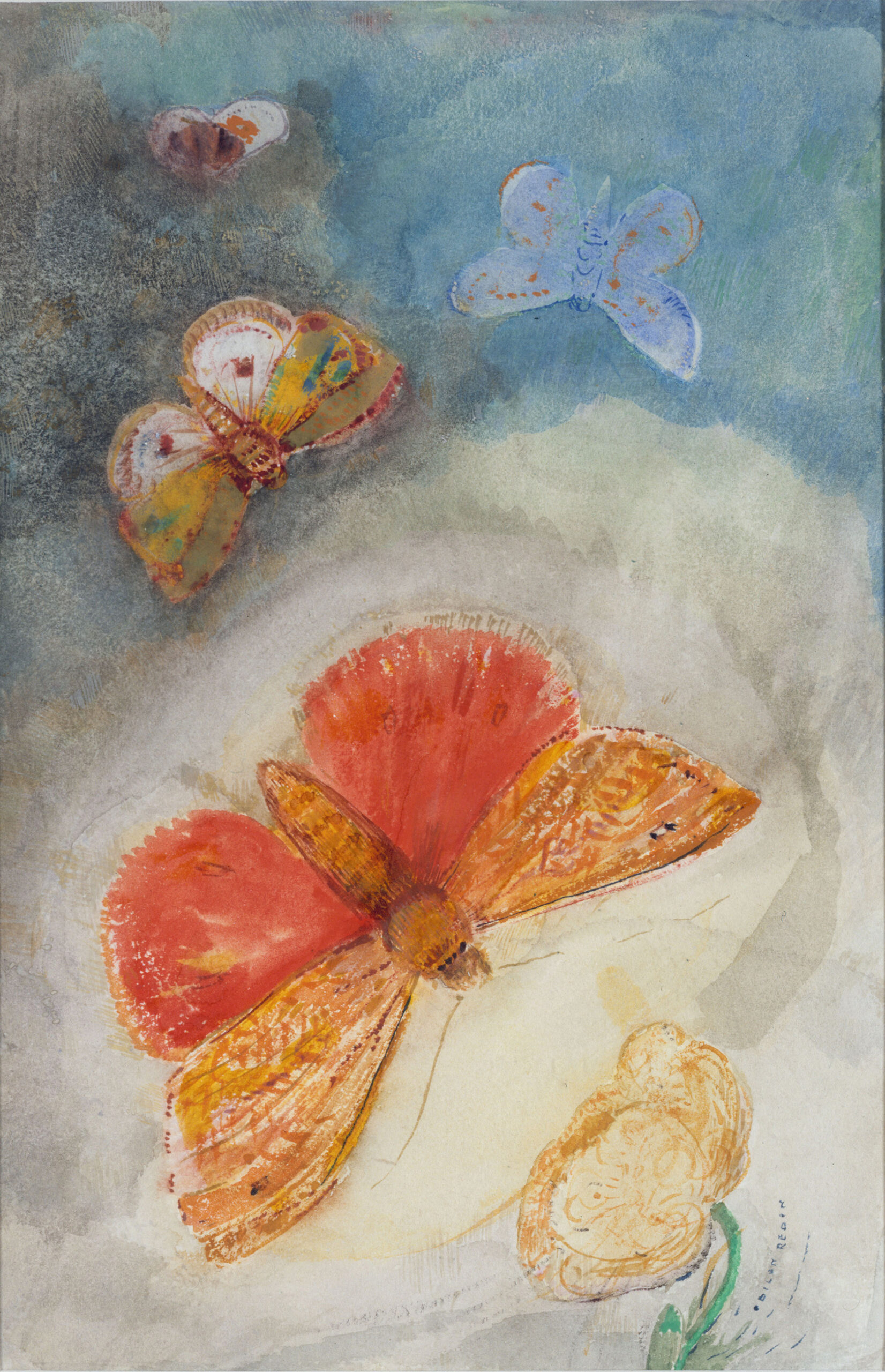
Painted between 1910 and 1914, Butterflies and Flower is a watercolour on paper by Odilon Redon (1840–1916), held at the Petit Palais, Musée des Beaux-Arts de la Ville de Paris. Four brightly coloured butterflies rise toward a barely sketched flower against a hazy ground. The work belongs to the artist’s final period, that of a leading figure of French Symbolism. After 1900, Redon set aside his celebrated Noirs, the shadowy charcoals and lithographs, in favour of a luminous, colour-filled art. These butterfly watercolours, imbued with joy and reverie, embody his decisive turn toward colour, one that would influence the Nabis and the Fauves.
I set out to find one of Odilon Redon’s Noirs, the dark charcoals and lithographs that made his name, to round out our presentation of his work. But I’ll admit it: hard to settle on one to brighten the day, so shadowy is their mood! Passing once again through the collections of the Petit Palais, in Paris, I came upon the very opposite: a small, luminous watercolour, barely larger than a postcard (24 × 15.7 cm), that I couldn’t resist sharing. It breathes joy. Against a ground left soft and hazy, butterflies flit above a lone flower, in touches of colour that seem to float. We are worlds away from the torments of his early years: this is the late Redon, the one who crossed over into colour. What better company for a summer’s day?
See
A coral red, almost translucent. It is the upper wing of the large butterfly, at the centre. Look closer. The lower wings shift to orange, to saffron yellow. Around it, three more butterflies drift: a lavender blue, a spotted yellow, a tiny brown one. The ground stays hazy, blue-green, undecided. Four butterflies, then. And the flower promised by the title? Lower right. Barely traced. A ghost of pale gold.
Understand
Odilon Redon long painted in black. Charcoals, lithographs: his famous Noirs. Monsters, eyes, nightmares. The master of Symbolism, on its dark side. Then, after 1900, everything changes. He gives up charcoal. He turns to colour. Pastels, oils, watercolours flood his work. The butterflies arrive with this late period. Redon dies in 1916. These watercolours are among his final gestures. The handling stays light, wet, without hard contours. Look at the washes: water carries the colour. Symbolism has not disappeared for all that. These insects are not insects. An unreal fauna, rather. A dream set down on paper.
Feel
And so we smile. Hard to resist. The butterflies climb, weightless, toward a flower we can only half make out. Nothing heavy. Nothing sad. The man of nightmares ends in the light. Look again at the flower of the title. Named, then all but erased. The announced subject slips away. The butterflies, meanwhile, dance in the foreground. Joy wins out. A fragile joy, watercolour, ready to evaporate.
In the News – Redon Celebrated in 2026
Interest in Odilon Redon (1840–1916) shows no sign of fading: from 14 July to 18 October 2026, the Getty Center in Los Angeles devotes an exhibition to the artist, Odilon Redon: Otherworldly Visions, tracing his path from the shadowy Noirs to the chromatic outpouring of his maturity. This late period, given over to flowers, butterflies and vegetal reveries, is precisely the one to which our Butterflies and Flower (c. 1910–1914) belongs.
Source: Getty Musuem
A Question for You
💭 Symbolist in theme, almost abstract in touch: to which side of art history do these butterflies tip Redon?
About This Work
- Butterflies and Flower
- Odilon Redon
- between 1910 and 1914
- Watercolour on paper
- 24 × 15.7 cm
- Petit Palais, Musée des Beaux-Arts de la Ville de Paris (Paris Musées)
- https://www.parismuseescollections.paris.fr/fr/petit-palais/oeuvres/papillons-et-fleur