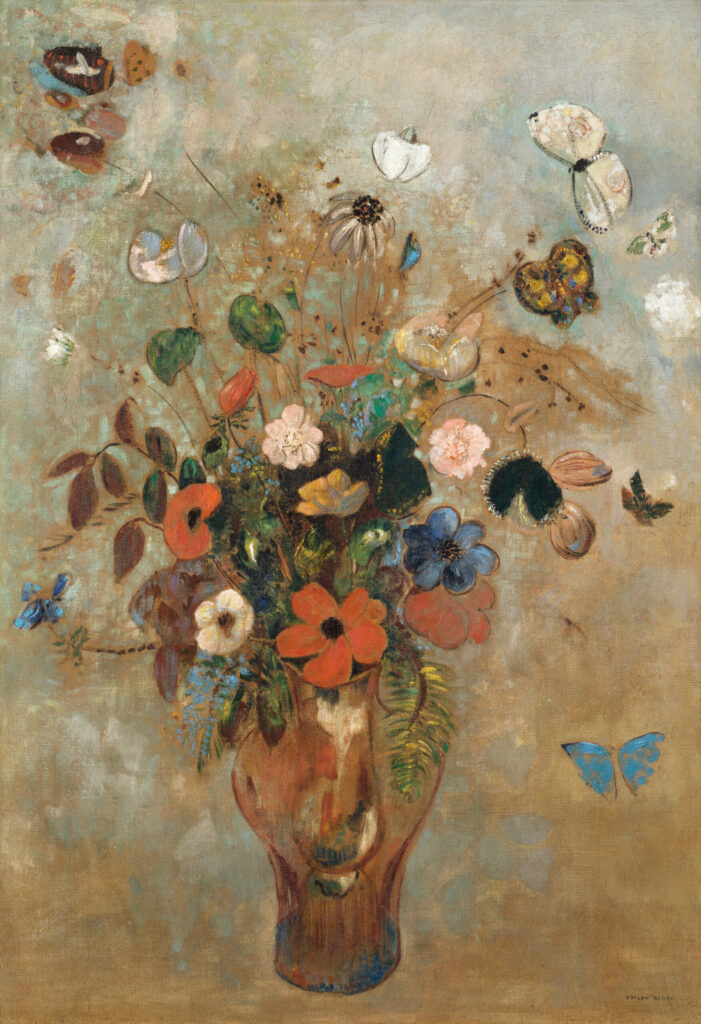
“Still Life with Flowers” by Odilon Redon is a chromatic symphony where reality and imagination intertwine with delicacy.
In a vase with indistinct contours, a lush bouquet blooms against an atmospheric background of ochre and celadon tones. The flowers, scarlet poppies, immaculate daisies, and blue corollas, seek not so much realism as the evocation of a transfigured nature. Here, Redon liberates vegetal forms to let them float in a dreamlike space, populated by diaphanous butterflies that seem to emerge from the canvas itself.
The brushwork is sometimes precise, sometimes vaporous, creating a striking contrast between substance and apparition. Vibrant colors emerge from a misty background, like thoughts taking form in a dreamer’s mind. The artist transcends the traditional genre of still life to offer us a visual meditation where each flower becomes a symbol, each hue an emotion.
Additional Information
- Title: Still Life with Flowers by Odilon Redon, 1905
- Dimensions: 92.7 x 65.5 cm (36 1/2 x 25 3/4 in.)
- Location: The Art Institute of Chicago, exhibited in Gallery 245, European Paintings and Sculpture
- https://www.artic.edu/artworks/110982/still-life-with-flowers
Odilon Redon (1840-1916) had an atypical career, transitioning from his “noirs”, charcoal drawings and dark lithographs populated with strange creatures, to a late period brilliant with color.
This 1905 painting belongs to this second phase when, after the age of fifty, the artist discovered the chromatic magic of pastel and oils. Influenced by Symbolism but escaping any school, Redon developed a unique pictorial language at the crossroads of reality and fantasy. His work, rediscovered by the Surrealists, celebrates the power of imagination and the exploration of inner worlds.
From Darkness to Colour: Redon’s Conversion
During the first two decades of his career, Redon was known primarily for his “noirs”, charcoal drawings and lithographs in black and white peopled with fantastic creatures, floating eyes, severed heads, and menacing plant forms. This Symbolist phase, lasting into the 1890s, earned him the admiration of Huysmans and decadent circles. Then, around the age of fifty, Redon made a radical turn toward colour: pastels, oils, stained glass. Flowers became his preferred motif — not naturalistic flowers like those of Jan de Heem or Fantin-Latour, but transfigured ones, whose colour exceeds the botanical referent to become pure emotion.
Flowers as Symbolist Vocabulary
In Still Life with Flowers, Redon arranges red poppies, white daisies, and blue blooms in a vase set against an ochre and celadon background. Butterflies float around the bouquet. The brushwork alternates between precise passages and atmospheric zones, creating a tension between the solidity of form and its dissolution in light. What distinguishes Redon from his contemporaries who painted flowers is that his bouquets are not demonstrations of technical virtuosity: they are interior states, Baudelairean correspondences materialized in paint. The red of the poppy is not the description of a colour but the expression of an intensity; the blue of the small flowers is not botanical but musical. Redon had read Schopenhauer and was close to the literary Symbolists — this theoretical culture fed a pictorial practice in which colour becomes language.
Redon Collected and Recognized
By 1905, Redon was already recognized in European avant-garde circles. Matisse and the Fauves admired his chromatic freedom, some critics saw in his bouquets an anticipation of Fauvism. Marcel Proust invoked him as one of the pictorial references for Elstir, the fictional painter of In Search of Lost Time. In 1913, the landmark Armory Show in New York presented several of his works, introducing him to an American public. Still Life with Flowers at the Art Institute belongs to this period of full international recognition, when Redon was at last perceived not as a marginal figure of Symbolism but as one of the most decisive precursors of pictorial modernity.