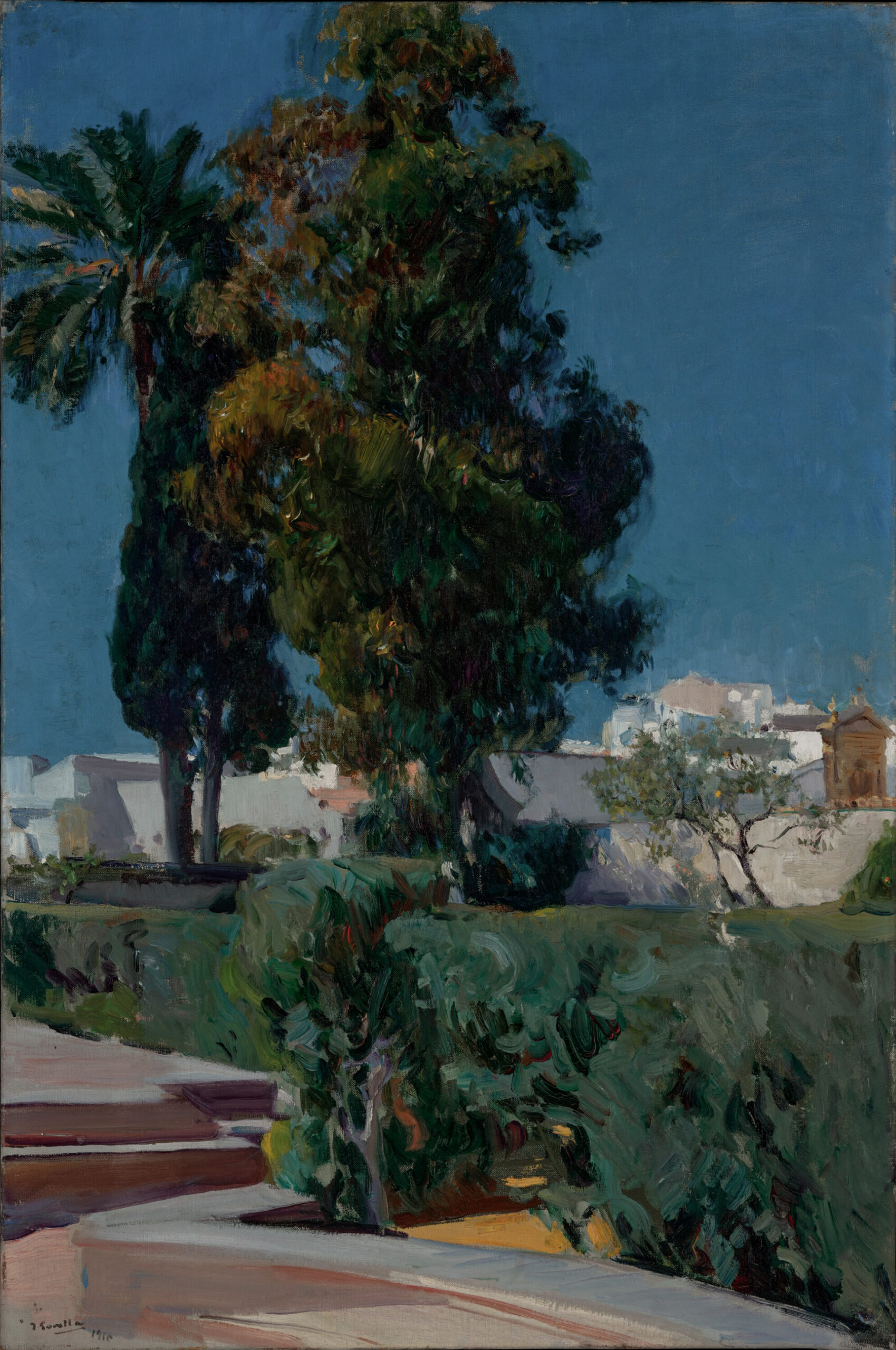
Sevilla, 1910. Sorolla sets up his easel in the gardens of the Alcázar. Around him, the Andalusian light strikes the foliage with an almost brutal intensity. He paints quickly, outdoors, seized by the geometry of the place.
Light as architecture
Look at that monumental tree splitting the cobalt blue sky. To its left, a palm tree spreads its russet fronds. Below, steps divide the space into clean, distinct planes. Sorolla works with broad, vigorous strokes, laying dense impasto onto the canvas. The greens range from deep shadow to a luminous, almost acid brightness in the full sun. The cast shadows on the path are cool, tinged with blue. No human figure. Just the dry heat of an Andalusian morning.
A return to Sevilla
In 1910, Sorolla came back to Andalusia to complete a first series begun in 1908 around the urban landscapes and gardens of Sevilla. This second series marks an evolution: less spontaneity, more formal construction. The composition relies on geometry rather than the shimmer of water or the movement of bodies. Sorolla’s luminist Impressionism reaches here a kind of architectural serenity. In 1933, J. Paul Getty acquired ten of these canvases at auction, captivated by this singular treatment of Mediterranean sunlight.
Sorolla
Joaquín Sorolla y Bastida (Valencia, 1863 – Cercedilla, 1923) is the undisputed master of Spanish light. Trained in Rome and Paris, he developed a personal luminist style, poised between Impressionism and solar realism. His Andalusian gardens rank among his most fully realised works.
A question for you
💭 Balanced between Impressionist freedom and geometric rigour, this canvas marks a turning point in Sorolla’s work. Does it take a lifetime to learn the art of simplification?
About this work
- Corner of the Garden, Alcazar, Sevilla
- Joaquín Sorolla y Bastida
- c. 1910
- Oil on canvas
- 95.3 × 63.5 cm
- The J. Paul Getty Museum, Los Angeles (79.PA.155)
- https://www.getty.edu/art/collection/object/103RET