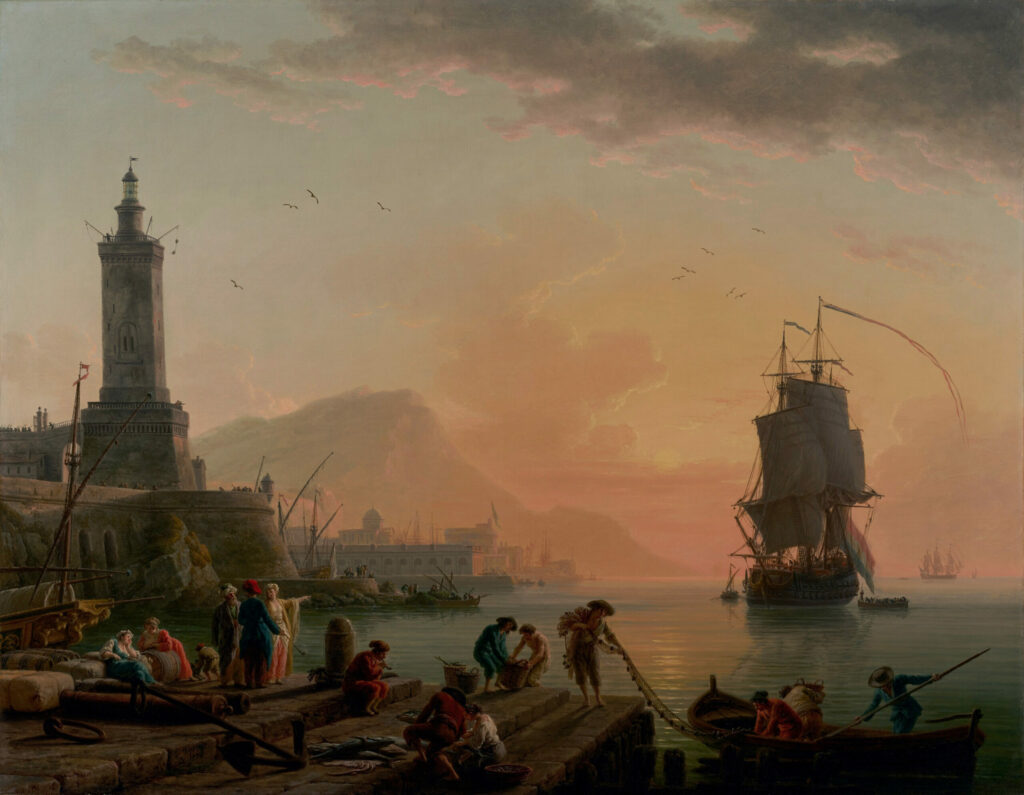
Mediterranean port, 1770. The sun declines over the bay while fishermen complete their day’s labor.
On a stone quay, men clean their catches. A fisherman savors his pipe. Claude-Joseph Vernet captures these suspended moments with luminous precision. Warm tonalities dominate: golden yellows, deep oranges, delicate reds. Twilight bathes the scene in a vaporous atmosphere. On the left, a lighthouse stands, guardian of the port. The ship’s sails cut across the sky. Vernet’s technique reveals his absolute mastery: subtle glazes, blended chromatic transitions, exceptional atmospheric rendering.
A Peaceful Vision of the Mediterranean
This canvas embodies maritime serenity. Vernet composed this work as a pendant to “Storm on a Mediterranean Coast.” Together, these paintings illustrate nature’s duality: soothing benevolence on one side, destructive fury on the other. In the 18th century, these contrasting pairs fascinated collectors. They testified to the nascent pre-Romantic sensibility, where man confronts his condition against natural forces. The Mediterranean port becomes here an idealized theater, where human activity harmonizes with the environment.
Claude-Joseph Vernet, Master of French Maritime Painting
Claude-Joseph Vernet (1714-1789) remains the most celebrated maritime painter of the Age of Enlightenment. Trained in Italy for twenty years, he developed a recognizable style: balanced compositions, sophisticated lighting, lively port scenes. Louis XV commissioned from him the monumental series of the Ports of France. Vernet combines naturalistic observation with picturesque vision, creating landscapes that still enchant today.
A Question for You
💭 What sensation does this golden evening light evoke in you?
About This Work
- A Calm at a Mediterranean Port
- Claude-Joseph Vernet
- 1770
- Oil on canvas
- 113 × 145.7 cm
- The J. Paul Getty Museum, Los Angeles
- https://www.getty.edu/art/collection/object/108J7V
Vernet and the Royal Commission for the Ports of France
Claude-Joseph Vernet (1714-1789) was the most celebrated marine painter of his era in France. His most famous work remains the series of the Ports of France, commissioned by Louis XV in 1753: Vernet travelled to the principal French coastal cities to paint 15 large canvases, now held at the Musée national de la Marine in Paris. This royal commission brought him European fame and established his style as the reference for port and marine painting for several decades. A Calm at a Mediterranean Port, painted in 1770, extends that same manner: the luminous composition, the scenes of port labour, and the atmospheric effects of a Mediterranean dusk are the recognisable signatures of his mature style.
A Twenty-Year Italian Formation
Born in Avignon in 1714, Vernet left for Rome at the age of 20 and remained there for nearly twenty years, until 1753. This long Italian immersion is fundamental to understanding his art: he absorbed the lessons of Claude Lorrain, the great master of idealised landscape, and developed his mastery of raking light effects, reflections on water, and nuanced skies. The Italian tradition of the “porto,” a pictorial genre depicting animated Mediterranean port scenes, directly nourished his compositions. The painting at the Getty Museum, with its stone quay, its lighthouse, and its ships with billowed sails, is the direct heir of this visual culture.
At the Getty Museum in Los Angeles
A Calm at a Mediterranean Port entered the collections of the J. Paul Getty Museum in Los Angeles in 2002 (reference number 2002.9.2). The Getty, which holds one of the most important collections of European painting in the United States, has made Vernet one of the best-represented 18th-century French painters in its galleries. The imposing dimensions of the painting (113 × 145.7 cm) confirm that it was conceived as a work of display, intended to adorn an aristocratic or noble interior.