Munich, 1912. Franz Marc picks up a brush and paints his horses in electric blue. In just a few centimetres of cardboard, he transforms the way we see the animal world.
A Living, Vibrating Matter
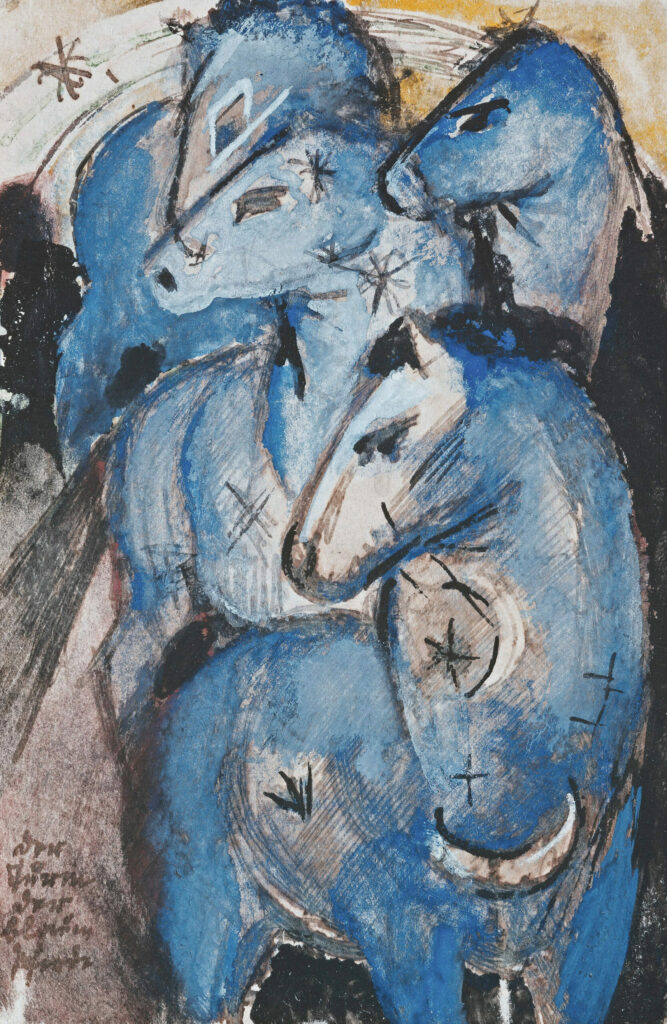
Look at these intertwined bodies. Four horses press together, merging into one another, forming a tower. An intense blue dominates. Franz Marc works in ink and gouache on cardboard, in a small format. The brushstrokes are nervous, rapid. Stars and crosses traced in black ink punctuate the coats like cosmic tattoos. The background oscillates between deep black and luminous ochre. The composition rises, climbs, compresses space.
Expressionism as Manifesto
In 1912, Franz Marc co-founded Der Blaue Reiter — The Blue Rider — with Vassily Kandinsky. This German Expressionist movement rejected academic realism in search of an inner, spiritual truth. For Marc, blue embodied masculinity, depth, and the absolute. Painting blue horses was no mere fantasy. It was a philosophical act. The animal becomes a symbol of purity, of a nature still intact that industrial modernity threatens to destroy. This work concentrates the full force of a visual manifesto.
Franz Marc
Franz Marc was born in Munich in 1880. Fascinated by animals, he devoted the greater part of his work to them. Co-founder of the Der Blaue Reiter movement in 1911, he developed a personal chromatic language in which each colour carries a precise symbolic charge. He died at Verdun in 1916, at the age of 36. The Pinakothek der Moderne holds several of his masterworks.
Think about it
💭 Before Expressionism, painting a blue horse was unthinkable. Which other artist, in your view, most radically broke with faithful representation of reality?
About this work
- The Tower of Blue Horses
- Franz Marc
- 1912
- Ink and gouache on cardboard
- 14.1 × 9.4 cm
- Pinakothek der Moderne, Munich — Bayerische Staatsgemäldesammlungen
- https://www.sammlung.pinakothek.de/de/artwork/Qlx28O0GXq/franz-marc/der-turm-der-blauen-pferde