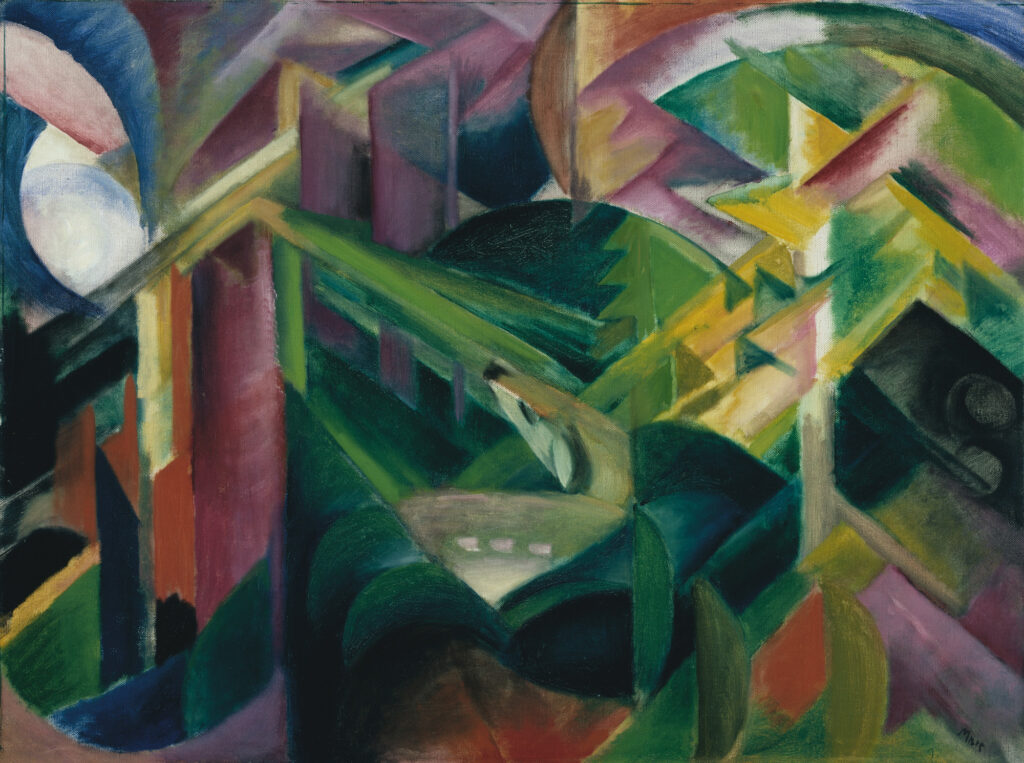
Munich, 1912. Franz Marc transforms a nocturnal walk into a mystical vision. A deer emerges in the moonlight in a monastic garden, perhaps at Benediktbeuern.
A Geometry of Nature
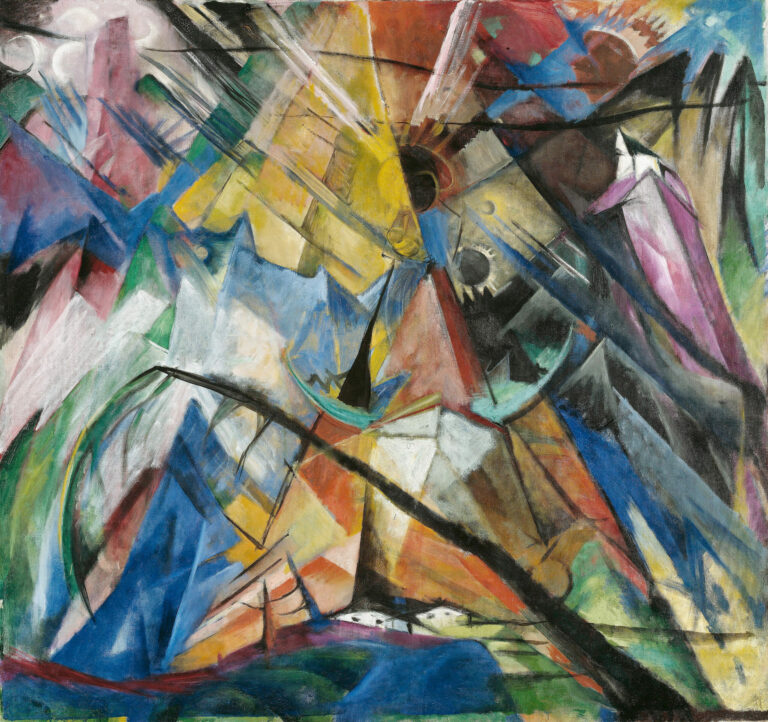
Observe reality fragmenting into colored facets: Marc breaks down the landscape into angular segments, grid structures, and circular arcs. Forms overlap, belonging simultaneously to multiple elements. At the center, a deer stands upright, head raised toward a moon enveloped in blue and orange. Its body remains intact despite the surrounding deconstruction. Vegetation transforms into vibrant beams. Expressionist chromaticism explodes: deep greens, brilliant yellows, mysterious mauves. Marc uses the Futurist fragmentation technique he discovered in May 1912 at the “Sturm” exhibition in Berlin.
Between Futurism and Spiritual Transcendence
This work marks Franz Marc’s stylistic maturity. It synthesizes two major influences: the metaphors of Italian Futurist movement and the prismatic rhythm of Robert Delaunay, whom he met in Paris in October 1912. But unlike Delaunay, who makes luminous color his sole subject, Marc uses it as a mirror of inner contemplation. “To see things through the eyes of the animal”: this quest permeates the painting. Rays traverse the composition, creating a mysterious tension.
Franz Marc
Franz Marc (1880-1916), co-founder of the Blue Rider (Der Blaue Reiter) with Kandinsky, seeks the spiritual essence behind appearances. His search for a higher reality shows through in each colored facet. The nocturnal landscape vibrates with cosmic energy.
Think about it
💭 How does Marc reconcile here the Futurist fragmentation and the spiritual quest of German Expressionism?
About This Work
- Deer in the Monastery Garden
- Franz Marc
- 1912
- Oil on canvas
- 75.7 × 101 cm
- Städtische Galerie im Lenbachhaus und Kunstbau, Munich, Bernhard und Elly Koehler Foundation 1965
- https://www.lenbachhaus.de/en/digital/collection-online/detail/reh-im-klostergarten-30019620
The Animal, the Sacred, and the Night
Deer in the Monastery Garden is among the most intense nocturnal paintings of Franz Marc (Munich, 1880 – Verdun, 1916). A deer stands beneath moonlight in a monastic garden, possibly that of the monastery at Benediktbeuern, in a composition that fractures natural forms into angular facets of deep green, brilliant yellow, and mysterious mauve. For Marc, this was not mere stylistic fragmentation: painting was a means of revealing the hidden soul of things, and the animal, more spontaneous, more deeply embedded in nature than the human figure, was his preferred subject for reaching that inner truth. The deer, a figure carrying both wild energy and medieval Christian symbolism, condenses the union of natural and sacred that is the defining theme of his work.
The Blaue Reiter and the Futurist Encounter
Deer in the Monastery Garden was painted in the year Marc co-founded the Blaue Reiter almanac with Wassily Kandinsky in Munich, a movement united by the conviction that painting must pass beyond visible appearances to reach spiritual reality. 1912 was also the year of the Italian Futurists’ touring exhibition at the Der Sturm gallery in Berlin, which Marc attended; the simultaneous fragmentation of movement in space that he encountered there is legible in the fractured planes of this canvas. The two impulses, Expressionist intensity of colour and Futurist multiplication of form, fuse in a single vibrant nocturnal vision. Marc was killed at Verdun in 1916 at the age of thirty-six, leaving a body of work notable for its brevity and its exceptional coherence of vision.