Key facts
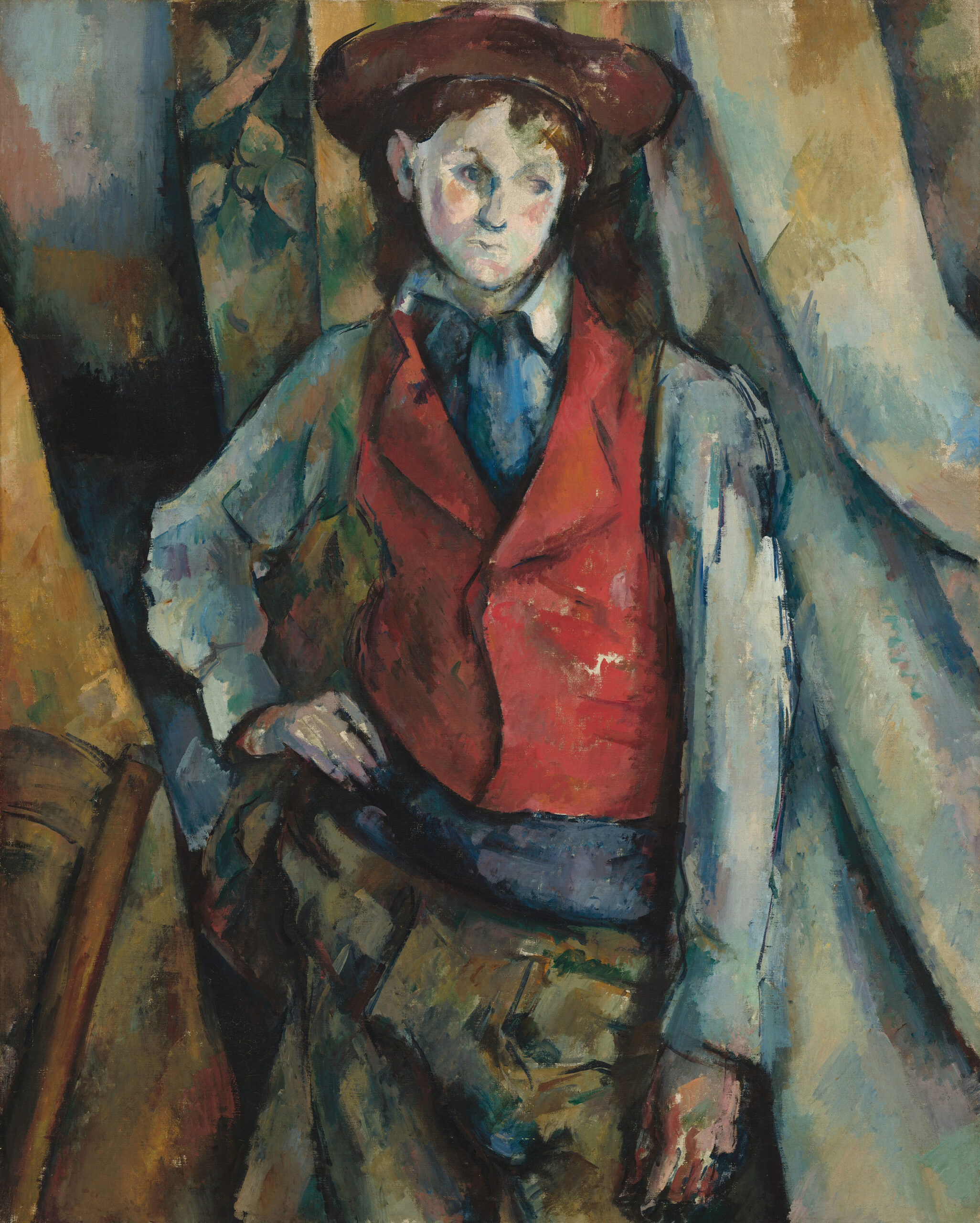
Boy in a Red Waistcoat is an oil on canvas painted by Paul Cézanne in Paris between 1888 and 1890. A leading figure of Post-Impressionism, the artist depicts Michelangelo di Rosa, a young professional Italian model. Cézanne painted him four times in oil and twice in watercolor. This standing version, the largest in the series, borrows the pose of sixteenth-century Italian aristocratic portraits. It departs from them through its green and mauve flesh tones and a background broken into planes. The painting questions the very purpose of portraiture. It is held at the National Gallery of Art in Washington, in the Collection of Mr. and Mrs. Paul Mellon.
I love this painting by Cézanne. It is powerful and goes far beyond a simple portrait of a young boy. The model sat for the painter in his Paris studio, and Cézanne depicted him several times in different poses. Here, standing, hand on hip and elbow thrust forward, he strikes an attitude that makes me think of art history and the great aristocratic portraits of the sixteenth or seventeenth century. Cézanne applies this prestigious pose to an anonymous studio model, and it is this mismatch that moves me. But what draws me most to this portrait is its density: the background richly hung with drapery, which hems the figure in rather than setting it apart; the flesh, built from unexpected colors, greens, blues and mauves where one would expect pink; the complex texture of the fabrics, made of broad brushstrokes laid side by side, which construct volumes rather than describe them. The overall tonality of the canvas is rather muted and restrained, which makes the red waistcoat all the more striking: it holds the composition together and immediately catches the eye. Looking at this painting, one understands why so many twentieth-century artists saw Cézanne as a starting point.
You are standing before a scratch of light. A few white flecks score the red of the waistcoat, at the lower right. Step closer. The paint seems almost raw. The whole picture starts there, from this rough warmth placed at its center.
What Boy in a Red Waistcoat tells us
Look at the face. Cool greens hollow out the eye sockets. A warm mauve rises toward the cheekbone. Now observe the arm hanging on the right. It stretches far longer than nature allows. The painter favors the balance of the surface over anatomical accuracy. Behind the boy, the floral-patterned curtain breaks into slanting planes, like cracked stained glass. On the waistcoat, the brushwork advances in broad, parallel facets. It builds volume the way one builds a wall. At the lower left, the back of a chair emerges, barely sketched. All of this is still oil on canvas, and yet everything has weight.
What Paul Cézanne’s era tells us
We are in Paris, between 1888 and 1890. Cézanne hires a professional model, something he rarely did. He is a young Italian, Michelangelo di Rosa. Cézanne paints him four times in oil and twice in watercolor. In the version held in Zurich, the boy sits, head resting in his hand. Here, he stands in contrapposto, like a sixteenth-century Italian aristocrat. The National Gallery of Art’s canvas is the largest in the series. Same model, same waistcoat: the mood changes, the enigma does not. A face that gives nothing away. Have look to the MoMA’s Boy in a Red Vest.
A leading figure of Post-Impressionism, Paul Cézanne (1839–1906) was long rejected by the Salon. In the late 1880s, painters discovered his canvases at Père Tanguy’s shop. Boy in a Red Waistcoat was born in those very years.
News: Cézanne at the Grand Palais
This autumn, Cézanne takes center stage in Paris: the exhibition “Cezanne et nous” (Cézanne and Us) runs at the Grand Palais from September 23, 2026 to January 17, 2027. It is co-produced by the GrandPalaisRmn, the Centre Pompidou and the public institution of the Musée d’Orsay and Musée de l’Orangerie. Rather than a classic retrospective, it is an inquiry into the painter’s legacy: the exhibition brings together 174 works, including 69 paintings by Cézanne and 105 paintings by 78 international artists, from Gauguin to Matisse, Picasso, Mondrian, Joan Mitchell, Bridget Riley and Peter Doig.
Source: Grand Palais.
A question for you
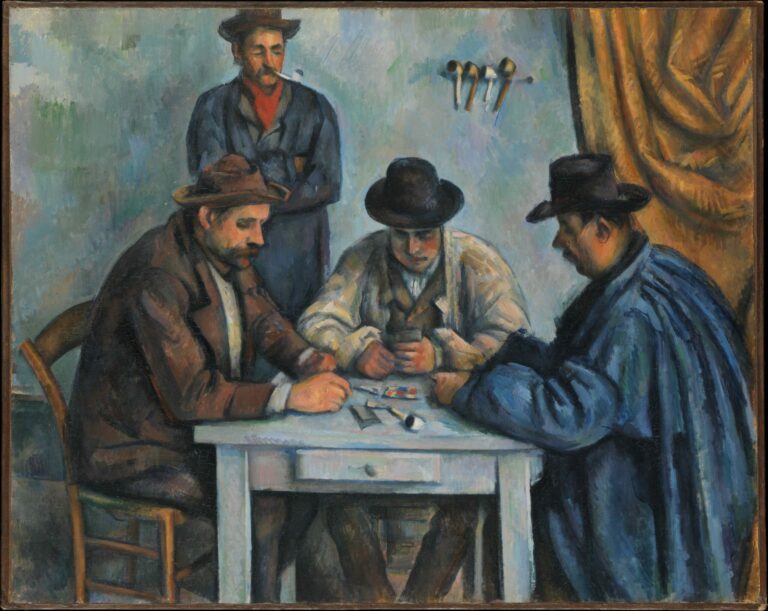
Around the same time, Claude Monet was painting his haystacks and cathedrals over and over; Cézanne, for his part, painted the same boy four times and returned again and again to Mont Sainte-Victoire: why do artists keep repeating the same motif?
About this work
- Boy in a Red Waistcoat
- Paul Cézanne
- 1888–1890
- Oil on canvas
- 89.5 × 72.4 cm (35 1/4 × 28 1/2 in.)
- National Gallery of Art, Washington, D.C.
- Collection of Mr. and Mrs. Paul Mellon
- https://www.nga.gov/artworks/93044-boy-red-waistcoat