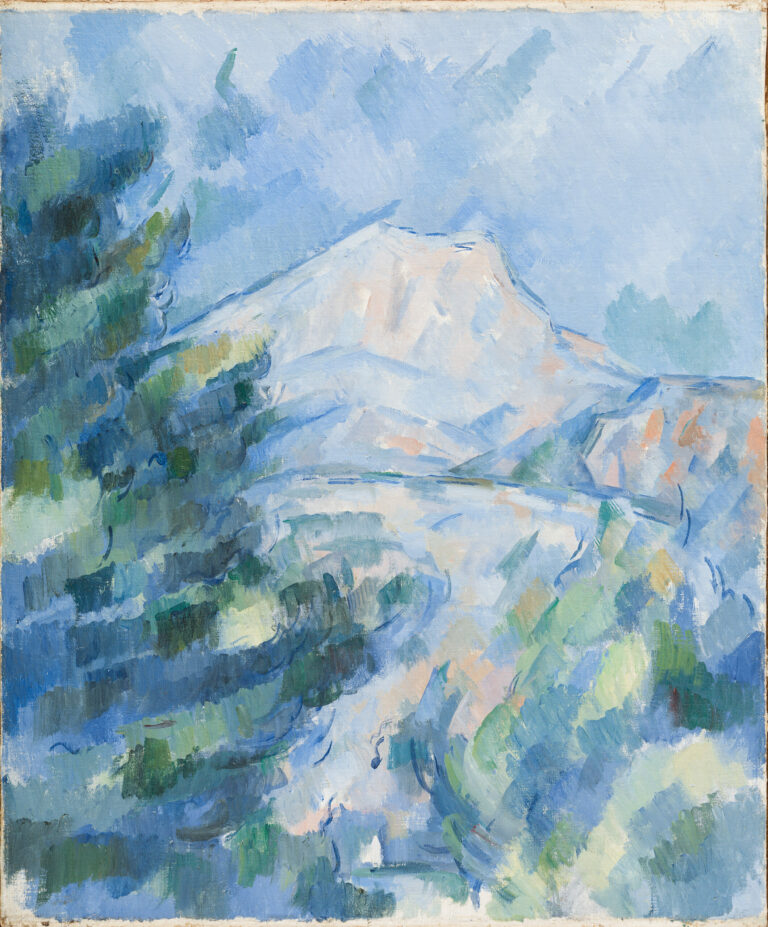
We’ve seen this Mont Sainte-Victoire by Cézanne again and again, and yet, personally, I never tire of it. Each time, something new comes forward. What draws me here is the palette: the warm tones, that near-turquoise blue cutting through the composition, those generous ochres. A rather different vision from the one presented a few weeks ago on VMuseum, where the same mountain seemed carried by an entirely different light. This is perhaps what fascinates me most about Cézanne: eighty views of a single mountain, and never twice the same gaze.
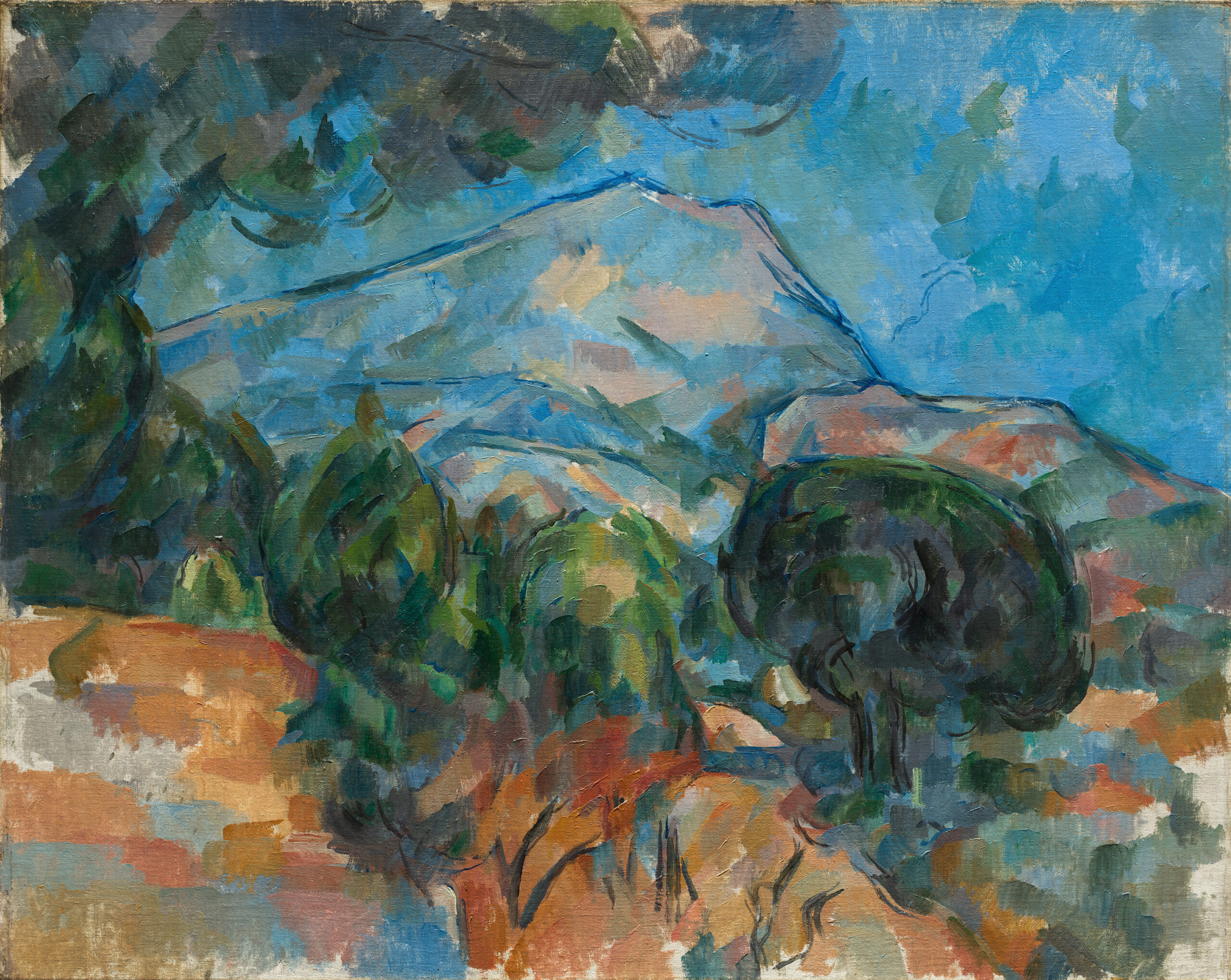
Look first at this blue. Not the blue one expects of a Provençal sky. An almost turquoise blue, laid in dry, flat strokes across the rock. Beneath the summit, ochres and pinks answer one another. Two dark pines frame the scene, nearly black against this mineral light.
What the surface conceals
Cézanne set up his easel at the edge of a road east of Aix-en-Provence. From there, he could see two umbrella pines and the mountain dominating the entire scene. A branch extends toward the sky at the left of the canvas, echoing the slope of Mont Sainte-Victoire and linking near to far. The brushwork remains visible, built from juxtaposed planes rather than blended passages. Each plane of color constructs volume, without ever seeking perfect illusion. This oil on canvas dates from around 1904, during the last two decades of the painter’s life. Cézanne painted this mountain dozens of times. The Cleveland Museum of Art now holds the canvas. Mont Sainte-Victoire becomes here a pretext, a motif for questioning the very solidity of landscape.
The artist and his time
Paul Cézanne was born in Aix-en-Provence in 1839. He moved away early from the conventions of Impressionism, opening the path toward Post-Impressionism. What concerned him was structure beneath color. An entire generation of painters, from Matisse to Picasso, would owe him a considerable debt. Provence remained his true subject, pursued almost to the point of obsession. Toward the end of his life, he worked mainly around Aix, declining travel, declining Paris. The motif was enough.
Cézanne today
In Paris, this mountain that Cézanne painted and repainted to the point of obsession takes on a particular resonance. From September 23, 2026, to January 17, 2027, the Grand Palais presents “Cézanne et nous,” a retrospective organized with the Musée d’Orsay and the Centre Pompidou. The exhibition does more than retrace his career: it places his canvases in dialogue with those of the artists he shaped, from the late nineteenth century to contemporary art. A look into the “Cézanne myth” that made him, in the well-known phrase, the father of all modern painting.
Source: musee-orsay.fr/fr/programme/agenda/expositions/cezanne-et-nous
A question for you
💭 Picasso and Matisse called Cézanne “the father of us all.” What if it was not the Provençal motif they admired, but this way of constructing a mountain the way one constructs volume?
About this work
- Mount Sainte-Victoire
- Paul Cézanne
- c. 1904
- Oil on canvas
- 87.5 x 106.5 cm
- Cleveland Museum of Art
- https://www.clevelandart.org/art/1958.21