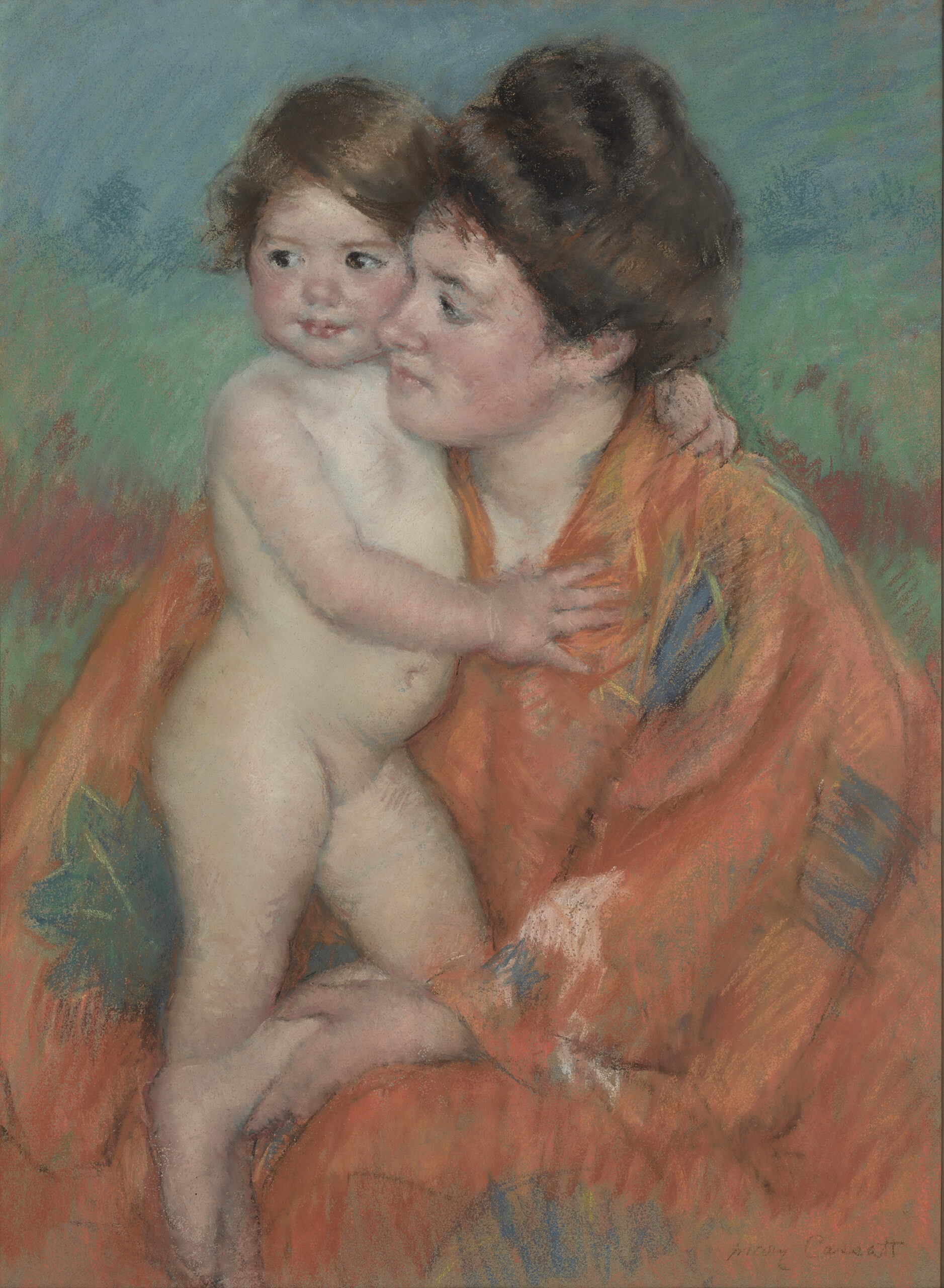
Paris, early 20th century. Mary Cassatt captures a suspended moment between two beings. A cook, Reine LeFebvre, holds a naked child against her. The gesture is natural, almost involuntary. And yet, everything here is art.
Tenderness in its purest form
Look at this pastel: the child gazes sideways, a faint smile on his lips. The woman also looks into the distance, seen in lost profile. Their cheeks are almost touching. The child’s body is rendered with sensuous precision, pearlescent skin, chubby limbs, genuine weight. The pastels are blended with subtlety to distinguish the textures of skin and hair. And then that orange kimono explodes. Blue, green, ochre: the colours vibrate, overflow, and echo through the leafy background. The work radiates light.
A fresh eye on motherhood
Mary Cassatt painted this scene at the height of her most accomplished Impressionist period. She drew her models from her own daily life, here, her own cook. That choice is a statement. Motherhood does not belong to great ladies. It is universal, physical, real. In 1902, portraying a household employee with such tenderness was a powerful artistic act. Cassatt refuses social hierarchy in her compositions. She asserts a modern vision: the intimate as a worthy subject.
Mary Cassatt
Mary Cassatt (1844–1926) was an American painter based in Paris, close to Degas and the Impressionist movement. She devoted a large part of her work to women in their everyday lives. This painting perfectly illustrates her mastery of pastel and her quiet humanism.
A question for you
💭 Cassatt is one of the few women accepted into the Impressionist circle. She paints women, through a woman’s eye. Does that perspective change the way you see this work?
About this work
- Woman with Baby
- Mary Cassatt
- c. 1902
- Pastel on grey paper
- 72.1 × 53 cm
- Clark Art Institute, Williamstown
- https://www.clarkart.edu/ArtPiece/Detail/Woman-with-Baby
The Cook, the Child, and the Kimono: Domestic Fiction
Woman with Baby is one of the most luminous compositions of Mary Cassatt’s (Allegheny, Pennsylvania, 1844 – Le Mesnil-Théribus, Oise, 1926) late period. The apparent subject, a woman holding a naked child, evokes maternity, but the reality is more complex: the woman depicted is Reine LeFebvre, Cassatt’s cook and one of her preferred models; the child is not hers. Cassatt constructs a scene of fictional tenderness, an image of maternal bond that nothing in her subjects’ actual lives justifies, but which art alone can produce through the force of composition and colour. It is a statement about painting as much as about motherhood: the emotional truth of an image can be entirely independent of the biographical truth of its subjects.
Pastel as Mother Tongue
What strikes in Woman with Baby is the mastery of pastel that Cassatt had developed through her friendship with Degas, her mentor since the late 1870s. The vivid orange kimono worn by Reine LeFebvre, a japonisant garment that reflects the enthusiasm for Japan that had marked the entire Impressionist generation since the 1867 Universal Exhibition, radiates its colour across the whole picture, subtly tinting the background and inflecting the blues and greens that surround it. The child’s flesh is modelled in a way that dissolves progressively into the fluidity of the pastel medium: no sharp contour, but a texture that simulates the actual softness of skin. The brushstrokes of the pastels are, as the Clark notes, “subtly blended to represent the varying textures of flesh and hair”, a naturalism of sensation rather than of line, and one of the most accomplished expressions of Cassatt’s mature Impressionist technique.