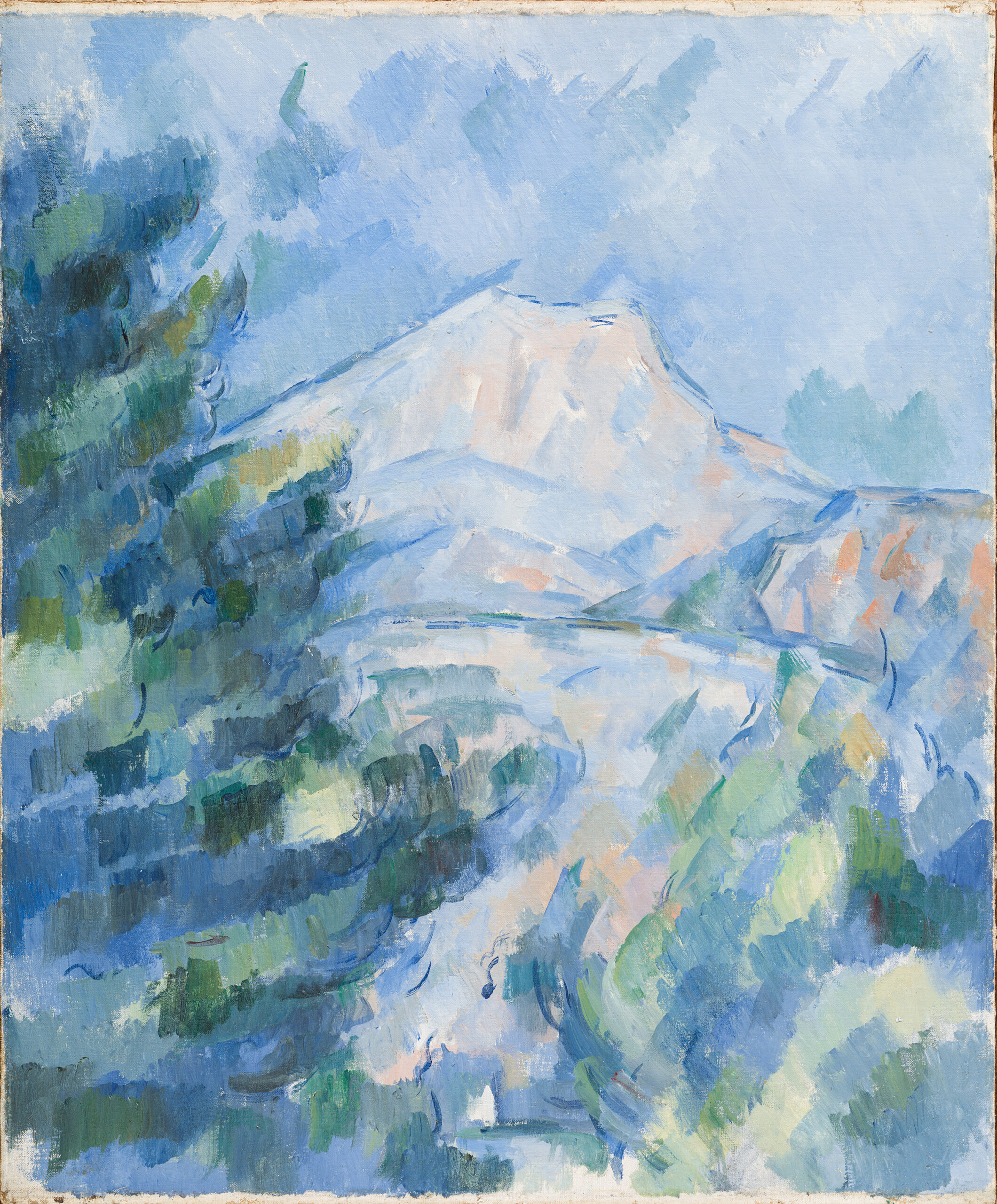
What I love about Cézanne’s Mont Sainte-Victoire series is his ability to endlessly renew the same subject. More than eighty times, he set up his easel before this limestone massif. And yet, each canvas is a surprise. This one, painted between 1904 and 1906, is among his final versions. The motif almost dissolves into a vibration of colored marks, as if the mountain were breathing. That is precisely what captivates me about his technique. Cézanne does not describe Provençal light, he builds it. With small patches of blue, ochre and green placed side by side, color itself takes on the role of shadows and relief, without resorting to traditional chiaroscuro. The eye must do the work, assembling the fragments. And it is in that effort that the feeling is born. Standing before this canvas, I do not need to close my eyes to imagine Provence. I hear the crackling of cicadas in the afternoon heat. I feel the light, fragrant breeze of thyme and lavender drifting up from the plain. Cézanne did not paint a landscape. He captured an entire atmosphere, and it travels through time intact.
See
A limestone massif rises from the canvas. Sky and earth merge in patches of blue, ochre and green. Look: no single line dominates. No shadow carves depth. The brushstrokes are laid down with equal intensity across the entire surface. The mountain vibrates. It seems to breathe. The eye searches for an anchor point and finds none. That is precisely where Cézanne is waiting for us.
Understand
Paul Cézanne (1839–1906) paints the Sainte-Victoire from the heights of his Lauves studio, in Aix-en-Provence. The years are 1904 to 1906. He is over sixty. Each morning he returns to face the same limestone massif, fifteen kilometers from his home. This is not the stubbornness of a man running out of ideas. It is a search. Cézanne juxtaposes warm and cool colors to suggest depth without constructing it. He abolishes any sense of hour or shifting light. The uniformity of his surface treatment suspends time. Post-Impressionism tips toward something unprecedented. Picasso would later say: “He was the father of us all.”
Feel
Standing before this canvas at the Detroit Institute of Arts, analysis falls away. You listen. The crackling of cicadas in the afternoon heat. The scent of thyme and lavender on the breeze. Cézanne did not paint a landscape. He captured an entire atmosphere. It travels through time intact. Look once more at those patches of color placed side by side. This is not a mountain. It is a sensation.
Now : Reimagine Modern Art at the Detroit Institute of Arts
The Detroit Institute of Arts is reinstalling its modern art galleries in their entirety for the first time in nearly twenty years. The Reimagine Modern Art project, opening in fall 2026, will place Cézanne at the heart of a newly conceived journey. A rare opportunity to discover this painting in a brand-new setting.
Source: dia.org/events/exhibitions/reimagine-modern-art
A question for you
💭 Among all the versions of this mountain that Cézanne painted more than eighty times — which one would you choose to hang on your wall?
About this work
- Mont Sainte-Victoire
- Paul Cézanne
- between 1904 and 1906
- Oil on canvas
- 55.6 × 46 cm
- Detroit Institute of Arts Museum
- https://dia.org/collection/mont-sainte-victoire/36720