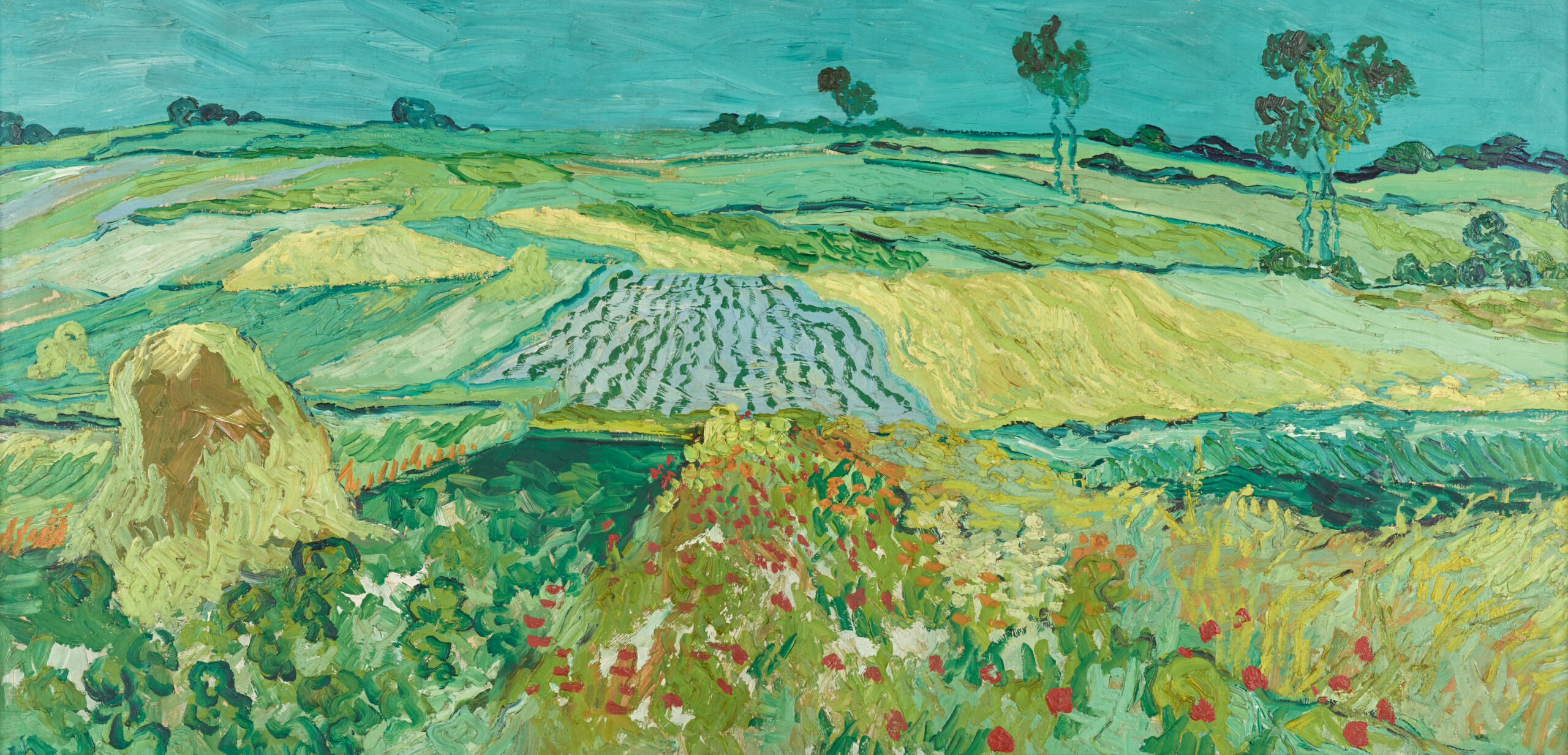
If you ever find yourself in Auvers-sur-Oise, do not miss the walk up to the plateau above the village: the open farmland there has remained remarkably faithful to what Van Gogh painted in 1890. The landscape still speaks. The Plain of Auvers is one of the works from this period that moves me most. Its panoramic format, unusually elongated, imposes an immediate sense of breathing room, a soothing horizontality the eye traverses slowly. The summer colours, intense yellows and greens carried by a nervous, vibrant brushstroke, give the canvas an almost physical energy: one feels the heat, the wind moving through the wheat, the full summer light of the Val-d’Oise. Everything seems in motion, and yet the composition holds, solid, rooted in the earth. It is precisely this paradox, the tension between restlessness and fullness, that makes this work one of the quiet summits of the Auvers period.
See
Red poppies in the foreground. Their brilliance is almost aggressive. Around them, the yellow of the wheat fields vibrates beneath a summer light. The eye drifts, almost involuntarily, toward the low horizon. A narrow strip of blue-green sky sits compressed above the plain. The elongated format enforces this horizontality. The brushwork is impetuous, heavily loaded. Each stroke sculpts rather than describes.
Understand
Summer, 1890. Van Gogh arrives in Auvers-sur-Oise after a year spent at the Saint-Paul-de-Mausole asylum. His brother Theo finally sends him canvases and paint. What follows is a creative frenzy without precedent: more than seventy paintings in seventy days. The Plain of Auvers is born within this surge. Van Gogh paints the plateau above the village, the open landscape he walks through every day. Post-Impressionism reaches here a new form of urgency. Colour no longer illustrates: it presses, it overflows. The painter will die shortly after completing this canvas. The plain remains.
Feel
Stand before this canvas at the Belvedere Museum in Vienna. Set aside comparisons, references. Feel first: the warmth rising from the yellows, the unexpected coolness of the green sky, the red of the flowers like a pulse. Van Gogh is not painting a calm landscape. He is painting something that beats. And yet the composition holds, solid, grounded. Restlessness and fullness inhabit the same rectangle of canvas, never resolving.
News from Auvers-sur-Oise
Painted during Van Gogh’s final weeks in Auvers-sur-Oise, this plain resonates with immediate relevance. The Château d’Auvers-sur-Oise is currently presenting a new exhibition devoted to the painter, Van Gogh Influencer – Heritages in Motion, on view from 18 April 2026 to 3 January 2027, curated by Wouter van der Veen, a leading specialist in Van Gogh’s life and work. A rare opportunity to extend the contemplation of this panoramic landscape in the very village where it was painted.
Source: chateau-auvers.fr
A question for you
💭 If you were to choose a single word to describe Van Gogh’s brushwork in this plain, urgency, joy, vertigo, serenity, which would it be, and why? Share your thoughts in the comments below.
About this work
- The Plain of Auvers – Wheat Fields
- Vincent van Gogh
- 1890
- Oil on canvas
- 50 × 101 cm
- Belvedere Museum, Vienna
- https://sammlung.belvedere.at/objects/9/die-ebene-von-auvers