Key Facts
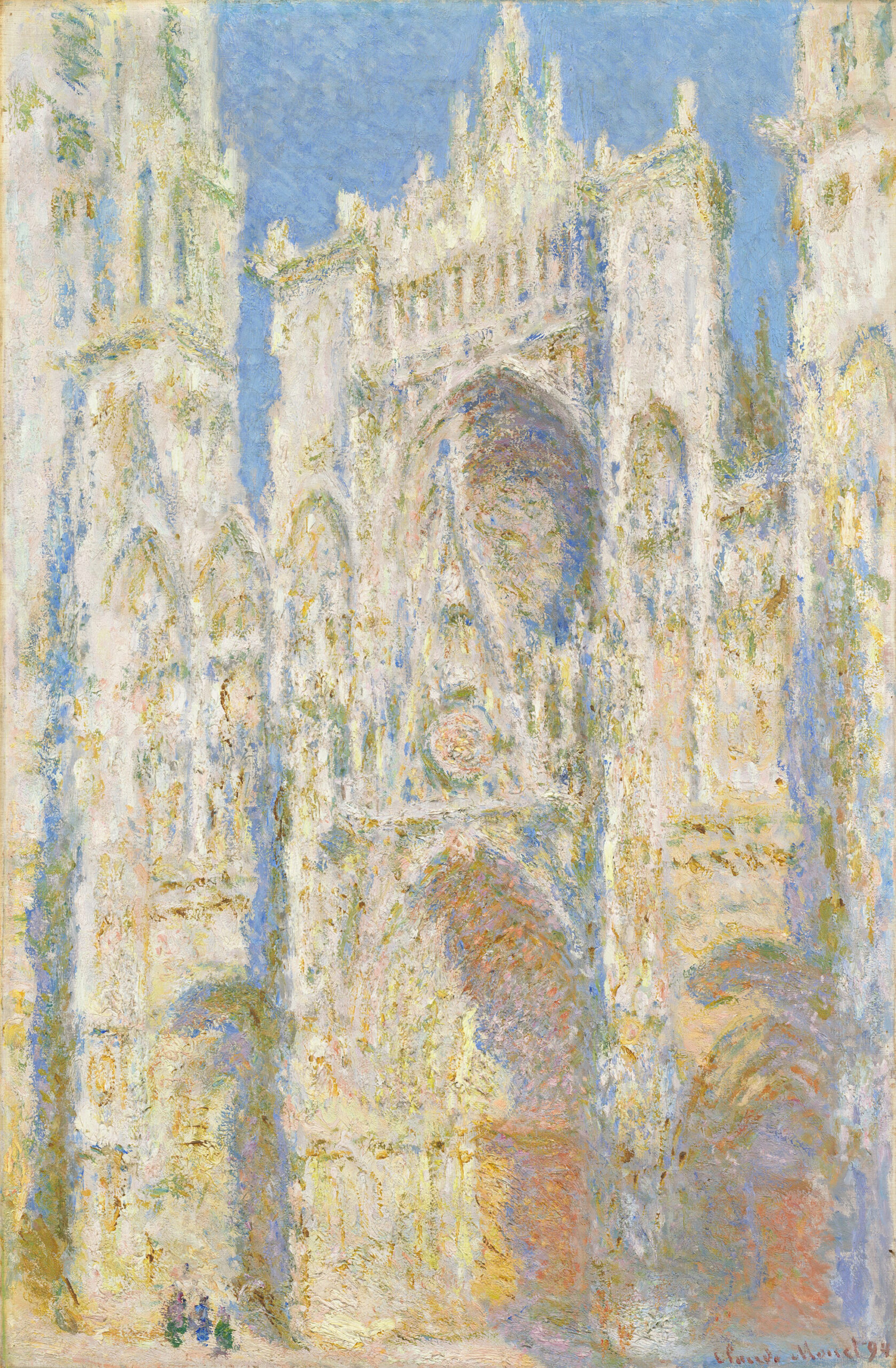
Painted in 1894 by Claude Monet, Rouen Cathedral, West Façade, Sunlight belongs to a series of more than thirty views of the same Gothic monument, produced between 1892 and 1893 and completed in the artist’s studio at Giverny. A leading figure of Impressionism, Monet studied here the changing effects of light and atmosphere on a single façade, hour after hour. His thick, fragmented brushwork makes the stone shift, depending on the viewer’s distance, between the impression of solid masonry and its dissolution into patches of colour. This serial approach marks a decisive moment in late Impressionism. The oil on canvas is held at the National Gallery of Art in Washington.
I would so love to show you this work in person! I saw one only recently at the Musée d’Orsay, and what a sensation it is. Here we have only a first glimpse, yet already a deeply moving one.
This particular cathedral is bathed in full light. It differs from Rouen Cathedral, the Sunlit Façade, which we have already encountered on VMuseum: that one is darker and more richly coloured. In our “full sunlight” version, the tone of the stone verges on white. It is the middle of the day, under a blazing sun, and the façade holds together as one block, massive, almost monumental. But step closer to the detail: the surface then breaks apart into a multitude of luminous flecks, and the composition seems to dissolve before your eyes.
Georges Clemenceau was not mistaken. In his article “Révolution de cathédrales” (La Justice, 20 May 1895), the statesman, future President of the Council and close friend of Monet, had already grasped the full significance of the painter’s work in series, and the break it introduced into the history of art.
So go to a museum and see a Claude Monet cathedral for yourself. You will not be disappointed. (He painted around thirty of them…)
See
At the foot of the portal, three dabs of blue and green. Passers-by, reduced to a few strokes of the brush. Raise your eyes: the Gothic façade rises up, pale, almost white. The blue sky cuts it out with sharp precision. The stone drinks in the full midday sun. Grains of pink, gold and green surface everywhere across the limestone. The spires lose themselves in the light. The cathedral of Rouen vibrates without ever moving an inch.
Understand
Claude Monet painted this series between 1892 and 1893. He set several canvases side by side, facing the monument. He moved from one to the next as the hour and the light changed. Each moment of the day received its own canvas. The whole comprises more than thirty views of the same west façade. Monet completed these paintings in 1894, in his studio at Giverny, close by. The technique is as striking as the chosen motif. The paint is thick, worked, almost sculpted by the eye’s own trowel. From a distance, the oil on canvas gives the cathedral a dense, solid mass. Up close, everything comes apart into fragments of pure colour. The illusion of stone cracks open beneath your steps. This paradox pushes Monet’s Impressionism to its outer limit. The painter no longer fixes a building on the canvas. He fixes the light passing through it, minute by minute.
Feel
Come closer still to the surface. The façade dissolves before your eyes. Step back three paces: it becomes stone once more. This back-and-forth never quite comes to rest. Monet captured a monument built for eternity in the most fleeting instant of the day. The paradox is left standing, unanswered. Look at the light rather than the Gothic stone. You will then see what Monet was truly looking at. A cathedral of Rouen made of colour, held up by the midday sun alone. Nothing more fragile. Nothing more enduring.
In the News: The 2026 Monet Centenary
In 2026, France marks the centenary of Claude Monet’s death. The Musée de l’Orangerie presents the exhibition Monet, peindre le temps (Monet, Painting Time), from 30 September 2026 to 29 March 2027. The exhibition brings together his great series, among them the Rouen Cathedrals, around the changing effects of light and time.
Source: Musée de l’Orangerie,
A Question for You
💭 In reducing a Gothic monument to a study of light, was Monet already opening the door to the abstraction of the century to come?
About This Work
- Rouen Cathedral, West Façade, Sunlight
- Claude Monet
- 1894
- Oil on canvas
- 100.1 × 65.8 cm
- National Gallery of Art, Washington D.C.
- https://www.nga.gov/artworks/46654-rouen-cathedral-west-facade-sunlight