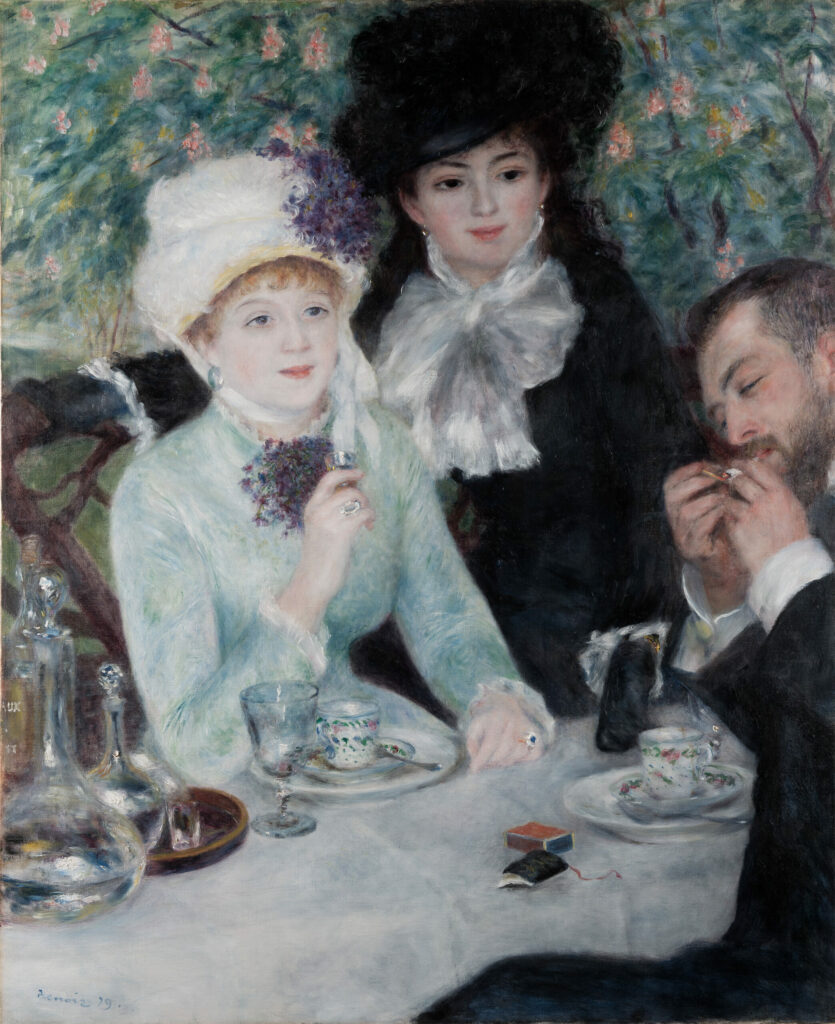
Paris, 1879. In the veranda of a restaurant, the meal draws to a close. The atmosphere is suspended. Renoir captures this fleeting moment: the actress Ellen Andrée, lost in thought, lingers over her digestif.
Light as Living Matter
Look at Ellen Andrée’s dress: a harmony of pale green and white, almost immaterial. Renoir’s Impressionist touch vibrates across the canvas. Short brushstrokes dissolve the outlines. The white tablecloth reflects a soft, diffused light. The floral porcelain cups gleam quietly. To the right, Renoir’s brother lights a cigarette. Behind, a third figure surveys the scene with quiet satisfaction. Notice the silence that has settled between the diners — it is almost audible.
An Impressionist Snapshot
In 1879, Impressionism is upending academic conventions. Renoir paints modern life: its cafés, its open-air guinguettes, its ordinary moments elevated to art. After the Luncheon captures an ephemeral impression — that of time suspended between two conversations. This freedom of subject matter was revolutionary. The Parisian bourgeoisie recognised itself in these scenes. Renoir submitted this canvas to the Salon of 1879, seeking official recognition while fully embracing his modernity.
Auguste Renoir
Auguste Renoir (1841–1919) began as a porcelain painter before entering the studio of Gleyre. A co-founder of Impressionism, he distinguished himself through his luminous palette and his tenderness toward people. This work distils his genius: capturing the grace of the everyday.
Think about it
💭 This painting entered the Salon of 1879 at the height of the Impressionist adventure. Renoir plays a double game: modernity of touch, conformism of bourgeois subject. Is this tension between subversion and seduction the secret of his timeless popularity?
About this work
- After the Luncheon
- Auguste Renoir
- 1879
- Oil on canvas
- 100.5 × 81.3 cm
- Städel Museum, Frankfurt am Main
- https://sammlung.staedelmuseum.de/en/work/after-the-luncheon