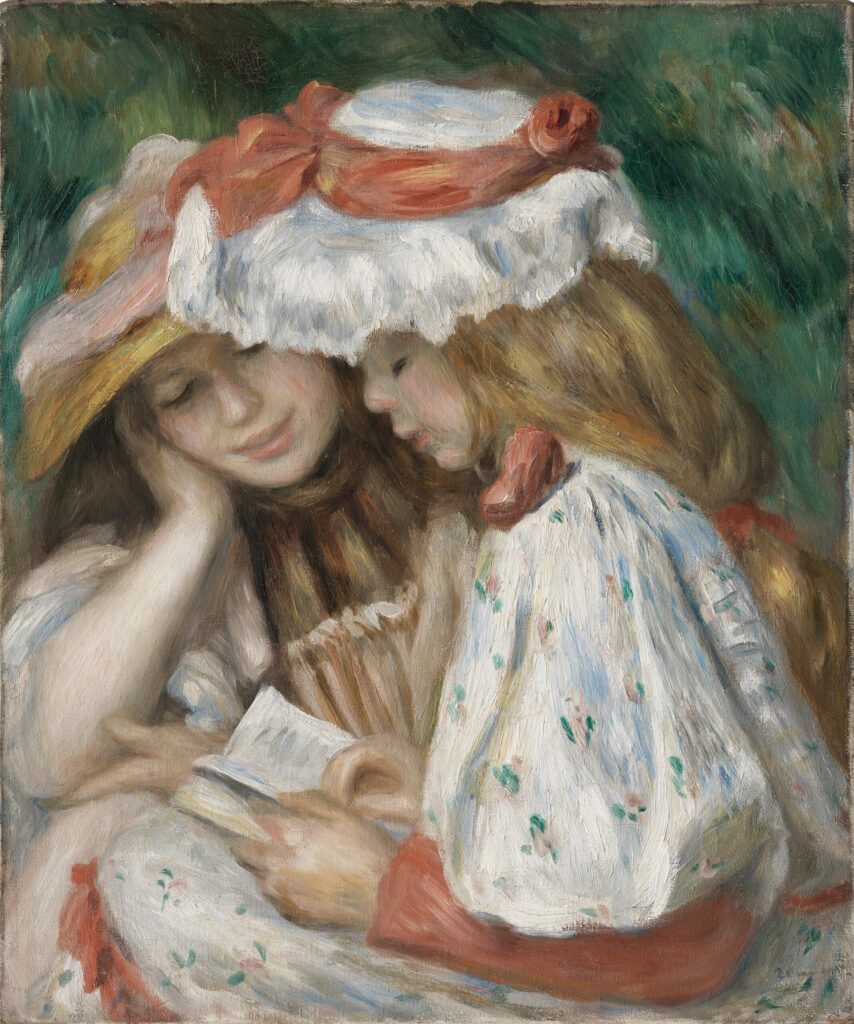
Paris, 1890. Renoir captures a perfect moment: two young girls absorbed in their reading, complicit and tender. Their faces lean toward one another, creating a bubble of intimacy. The Impressionist painter captures here the very essence of friendship and the shared pleasure of reading.
Impressionist Softness Embodied
Observe these fluid and vibrant brushstrokes, Renoir’s signature. Colors blend with remarkable delicacy. Light seems to caress the faces, illuminating cheeks and blonde hair. The touch is light, almost tender. Contours dissolve into a cottony atmosphere. The white hat punctuated with coral red draws the eye toward the upper composition. The floral patterns of the dresses add a delicate note, almost Japoniste. The oil on canvas creates that distinctive texture, between blur and precision.
The Era of Bourgeois Leisure
This work bears witness to the Belle Époque and its social transformations. Reading became a valued leisure activity in the French bourgeoisie. August Renoir immortalizes these moments of shared culture, far from the constraints of work. Impressionism then celebrated modern life, fleeting instants, the beauty of everyday existence. These young girls represent a new generation, educated and refined. The painter rejected historical subjects in favor of intimate and luminous scenes.
Pierre-Auguste Renoir
Pierre-Auguste Renoir (1841-1919) revolutionized painting with the Impressionists. He favored female portraits imbued with softness and sensuality. His style evolved toward greater classicism in the 1890s, the period of this work held at LACMA.
Think about it
💭 How does this reading scene differ from academic feminine representations of the 19th century?
About This Work
- Two Girls Reading
- Pierre-Auguste Renoir
- circa 1890-1891
- Oil on canvas
- 56.52 × 48.26 cm (22 1/4 × 19 in.)
- Los Angeles County Museum of Art (LACMA)
- https://collections.lacma.org/node/236306
Intimacy as Subject: Renoir and Shared Reading
Two Girls Reading (c. 1890-1891, Los Angeles County Museum of Art, 56.52 × 48.26 cm, oil on canvas) belongs to the pivotal period in which Pierre-Auguste Renoir (1841-1919) was gradually moving away from the Impressionism of the previous decade toward more stable forms and more deliberately structured compositions. During the 1880s, after a journey to Italy where he rediscovered Raphael and Pompeiian frescoes, Renoir had passed through a pictorial crisis, the so-called “sour manner”, seeking to discipline his brushwork. Two Girls Reading marks a return to the lightness and warmth of his palette, but with increased formal control: the two figures lean toward each other, their inclined heads forming a bubble of intimacy that the vaporous treatment of the background wraps around them. The white hat accented with coral red, the floral patterns of the dresses, and the light playing across blonde hair convey a sense of feminine elegance that Renoir, throughout his career, sought less to analyse than to celebrate.
The Belle Époque and Reading as Bourgeois Leisure
Around the 1890s, women reading, alone or together, became a recurring motif in French Impressionist and Post-Impressionist painting. Renoir, Berthe Morisot, and Mary Cassatt returned to it regularly, because the image said something essential about Belle Époque society: women’s access to culture, the new status of the book in the bourgeoisie, the legitimacy of female intellectual pleasure. Renoir does not illustrate these social shifts — he breathes them. His treatment of the scene favours immediate sensation over analysis: the warmth of bodies brought close together, the softness of the light, the silent complicity of two people sharing the same page. The painting is held at LACMA, which holds one of the most important collections of French Impressionism outside Europe.