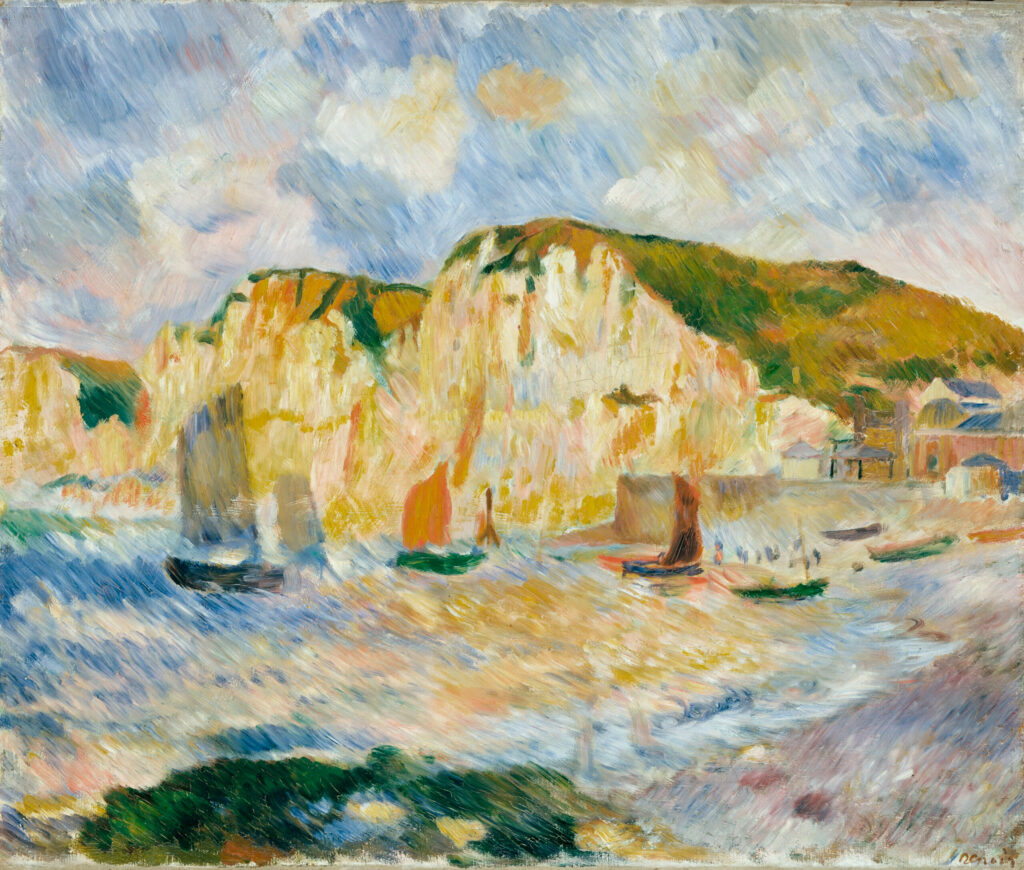
Sea and Cliffs: A Normandy Symphony. This splendid canvas by master Impressionist Pierre-Auguste Renoir instantly transports us to the Normandy coast.
This brilliant composition captures with virtuosity the invigorating power of the cliffs, those majestic cathedrals of chalk that rise proudly beneath a sky animated by shifting clouds. The artist deploys his full chromatic virtuosity: golden ochres of the rocky walls dialogue with vibrant blues of the sea, while touches of pink and mauve soften this luminous symphony.
The work pulsates with life. Colorful sails of boats dancing on the waves, modest buildings nestled at the foot of the cliffs, and the beach one imagines trodden by strollers, all contribute to create an atmosphere of summer effervescence. Renoir’s supple and generous brushwork masterfully conveys the shimmer of light on the waters and the trembling of the sea air. It is a veritable hymn to the joy of living expressed through warm palette and spirited brushstrokes!
Object Information
- Title: Sea and Cliffs (Mer et falaises)
- Artist: Pierre-Auguste Renoir (French, 1841-1919)
- Date: c. 1885
- Dimensions: 51.4 x 63.5 cm (20¼ x 25 in.)
- Location: The Metropolitan Museum of Art, Fifth Avenue, New York, not currently on view
- https://www.metmuseum.org/art/collection/search/459111
Pierre-Auguste Renoir (1841-1919), an emblematic figure of Impressionism, began his career as a porcelain painter before entering the École des Beaux-Arts. A friend of Monet and Sisley, he participated in the first Impressionist exhibition of 1874 and quickly became one of the most sought-after portraitists of his time.
His painting celebrates beauty, youth, and the simple pleasures of life, with a shimmering palette and sensual touch uniquely his own.
Renoir and the Cliff: The Ambivalence of Plein Air
Sea and Cliffs was painted at a pivotal moment in Pierre-Auguste Renoir’s career. In the early 1880s, following a trip to Italy in 1881-1882, he passed through a period of self-questioning he would later call his “manière aigre”, or sour manner, a turn toward more rigorous construction of form, characterised by harder contours and a more disciplined palette, that temporarily distanced him from pure Impressionism. Sea and Cliffs belongs to his gradual emergence from this crisis: the vibrant brushwork and luminous whites of the coloured sails on the water signal a confident return to Impressionist sensibility, while the treatment of the cliffs retains a structural solidity that his paintings of the 1870s had not sought.
The Norman Coast as Laboratory of Whites
The Norman coastline, with its chalk cliffs, shifting skies, and the particular quality of Atlantic light, had drawn Impressionist painters ever since Monet established his studio at Giverny in 1883. The cliffs at Étretat, immortalised by Courbet and then by Monet, had become by the 1880s an emblematic motif of French plein-air painting. What Renoir sought there differs from Monet’s approach: less the meteorological instant than chromatic construction — how to make the white of the chalk vibrate against the blue-green of the sea, how the fishermen’s sails and the buildings at the foot of the cliffs organise the composition without rigidifying it. The dense vegetation at the top of the cliffs creates a dark, vegetal counterweight that gives the marine light its depth. Now held at the Metropolitan Museum of Art in New York, the canvas stands as evidence of a mastery of light reflected on water that would place Renoir, alongside Monet, among the great Impressionist painters of the sea.