Key facts
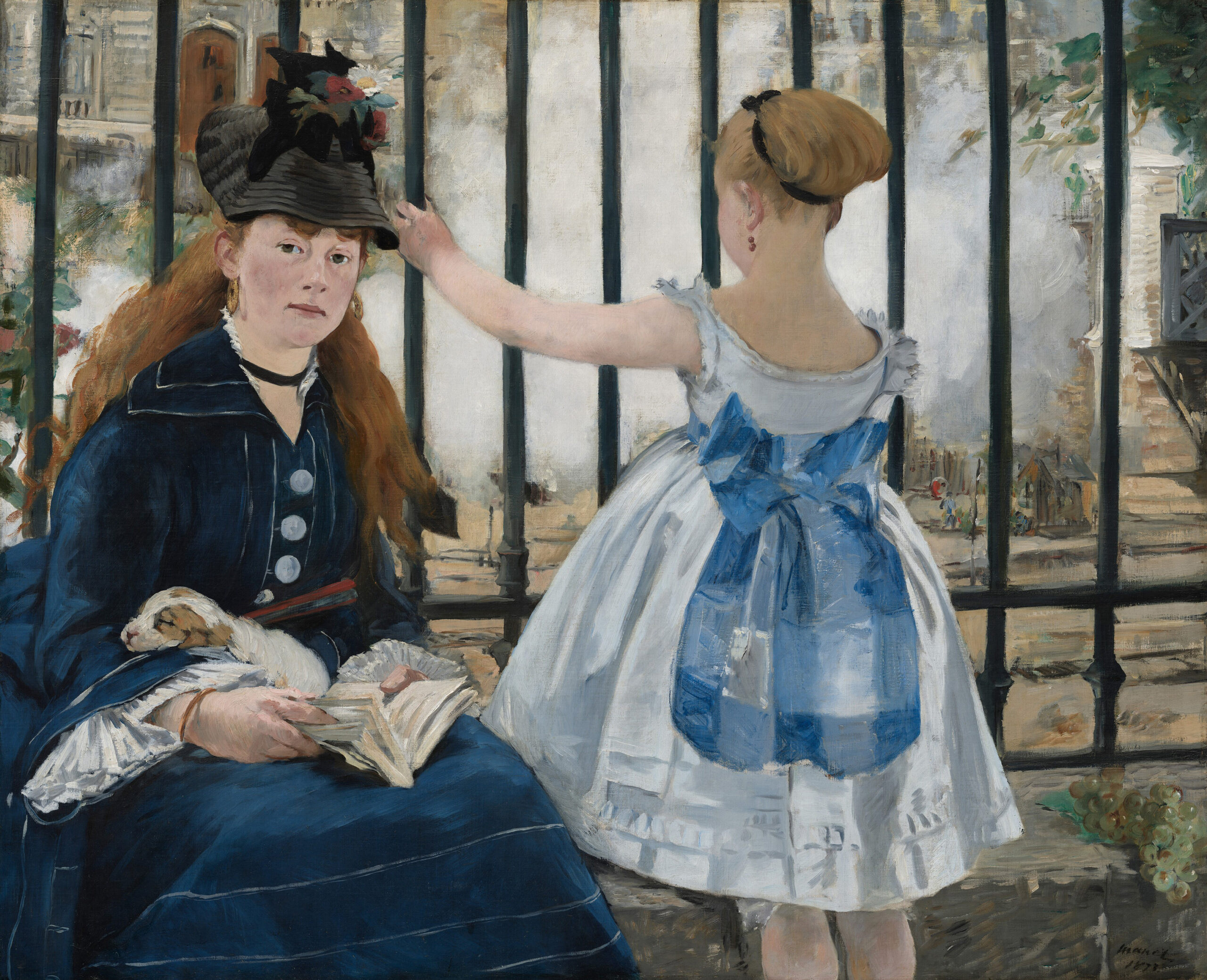
Painted by Édouard Manet in 1873, The Railway depicts a woman and a young girl before the iron railings of the Gare Saint-Lazare in Paris. Executed in oil on canvas, the composition is associated with the early stirrings of Impressionism, though Manet never exhibited officially with the movement. The woman is Victorine Meurent, the artist’s recurring model since Olympia. Shown at the Salon of 1874, the work reflects Manet’s engagement with modern life and the transformation of Paris under Haussmann. Held today at the National Gallery of Art in Washington, D.C., it remains one of the artist’s most studied canvases, not least for the lasting ambiguity between its two figures.
I see a painting built entirely on contrast and opposition. The two figures sit side by side, one facing us, the other turned away. A railing cuts the view in two, dividing one world from another. The railway itself is only suggested, through the smoke of passing locomotives. Even their gazes oppose each other. So many details draw the eye from one figure to the other, keep it moving. The scene is dense, packed with details Manet places there deliberately, like that small fragment of the Pont de l’Europe, tucked in the far right corner. And still, we never learn what these two figures are to one another. That is what makes this painting so compelling. It offers itself to the eye, and the eye has work to do.
Who are these two figures to each other? Mother and daughter? A governess and her charge? Manet never says.
The Railway, a scene split in two
Look first at the iron railing. Its black bars cut the canvas into two, almost like a repeating musical measure. On the left, a seated woman looks straight at us, a dark hat trimmed with somber flowers, a navy dress edged in white braid. On her lap rest a sleeping puppy, a closed fan, and an open book, a finger marking the page. On the right, a young girl in a white dress with a large blue sash turns her back to us entirely. Her hair is pinned up with a black ribbon, while the woman’s falls loose along her neck. Behind them, a dense white cloud of steam almost swallows the railway tracks. The light falls hard, almost photographic, characteristic of a Parisian summer. Far to the right, a fragment of the Pont de l’Europe barely emerges, nearly erased.
Manet and the Gare Saint-Lazare
In 1873, Édouard Manet set up his studio on the rue de Saint-Pétersbourg, steps from the Gare Saint-Lazare. Passing trains shook his windows. He painted The Railway in the garden of his neighbor, Alphonse Hirsch, whose daughter posed for the young girl. Victorine Meurent, his favorite model since Olympia and Le Déjeuner sur l’herbe, appears here for the very last time. Shown at the Salon of 1874, the canvas unsettled critics. Some judged it unfinished, the station itself too indistinct behind the steam. Manet never exhibited officially with the Impressionists. And yet this scene of modern life, caught in passing at the edge of a railway construction site, already shares their fascination with a Paris remade by Haussmann’s renovations.
Édouard Manet was born in Paris in 1832. Trained in the academic studio of Thomas Couture, he broke from it early, drawn instead to Velázquez and the Spanish masters. Baudelaire saw in him the painter of modern life, one who captured his era without flinching. Manet died in 1883, a precursor to Impressionism only belatedly recognized as such.
Current news: Manet on loan through September 2026
Manet continues to travel, even without leaving public collections. Through September 20, 2026, the Musée d’Orsay has loaned La Serveuse de bocks to the Musée de l’Abbaye in Saint-Claude, in the Jura, as part of the national program “100 œuvres qui racontent le travail.” The same eye for everyday life that animates The Railway is on view there too, in a scene just as simple, and just as charged. Two museums, two canvases, one painter of modern life.
Source: Musée de l’Abbaye de Saint-Claude
A question for you
Can we speak of Impressionist painting when its own maker refused to claim the name?
About this work
- The Railway
- Édouard Manet
- 1873
- Oil on canvas
- 93.3 × 111.5 cm (36¾ × 45⅛ in)
- National Gallery of Art, Washington, D.C.
- https://www.nga.gov/artworks/43624-railway