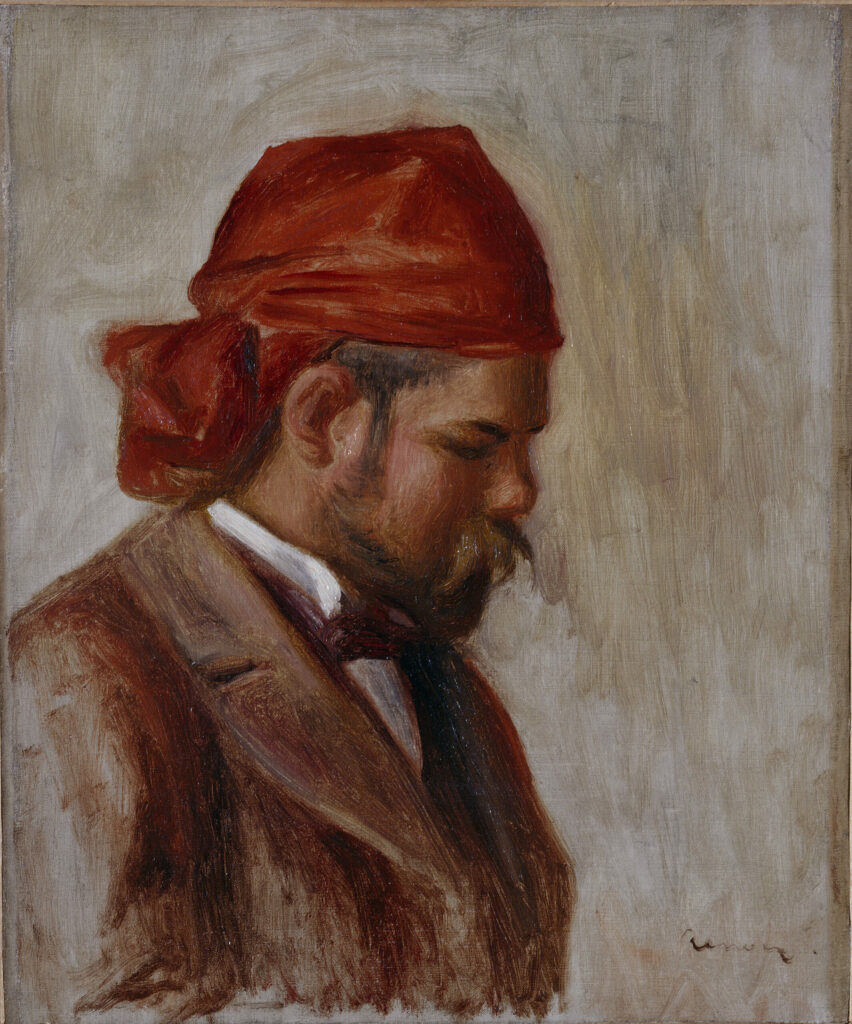
This portrait, painted by Renoir between 1899 and 1906, presents the meditative profile of Ambroise Vollard, the celebrated art dealer, wearing a brilliant red scarf that serves as the focal point of the composition.
The artist’s quick, vibrant brushwork, characteristic of the Impressionist period, lends a particular intensity to the portrait. Warm tones of browns and reds dominate the palette, creating an intimate and contemplative atmosphere.
The downcast gaze suggests a moment of introspection, captured with remarkable sensitivity by the artist. The pictorial technique, both free and controlled, manifests in expressive brushstrokes that model the volumes of the face and clothing.
This work demonstrates great modernity in its pictorial treatment, combining spontaneity of gesture with a deep understanding of the sitter’s psychology. It stands as a perfect example of the freedom of execution characteristic of late 19th-century avant-garde movements.
Further information
- Portrait of Ambroise Vollard with Red Scarf, Auguste Renoir, c. 1899-1906
- 30 x 25 cm
- Petit Palais, Musée des Beaux-Arts de la Ville de Paris, exhibited in Ground Floor Garden Room 08, Paris Musées
- https://www.parismuseescollections.paris.fr/fr/petit-palais/oeuvres/portrait-d-ambroise-vollard-au-foulard-rouge
Auguste Renoir (1841-1919) was a major figure of French Impressionism. Coming from a modest background, he began as a porcelain painter before dedicating himself to canvas painting. His artistic trajectory was marked by constant evolution, from his early Impressionist works characterized by their luminosity and spontaneity, to his more classical period focusing on nudes and portraits. His distinctive technique, made of light touches and shimmering colors, conveys an optimistic vision of life, celebrating beauty, scenes of daily life, and especially female figures.
A Dealer in Impressionist Light
Portrait of Ambroise Vollard with Red Scarf is one of the most intimate works Pierre-Auguste Renoir (Limoges, 1841 – Cagnes-sur-Mer, 1919) devoted to the celebrated art dealer. Far from the official portrait or the commissioned likeness, Renoir chose a small format and an atmosphere of closeness: Vollard is shown in profile, slightly turned, the bright red scarf around his neck providing the only strong chromatic accent in a harmony of warm browns and ochres. That square of red fabric functions as ribbons and scarves have functioned in Renoir’s portraits since the 1870s, as a center of light and energy that activates the whole composition.
Renoir and Vollard: A Founding Relationship
Ambroise Vollard (1866-1939) is one of the most important figures in the history of the modern art market. Established on the rue Laffitte in Paris, he organized Cézanne’s first solo exhibition in November 1895, then championed Gauguin, Picasso, and Matisse with the same acuity. His relationship with Renoir was longstanding and loyal: Vollard published a biography of the painter in 1919, testament to a friendship built over decades of mutual trust. This red-scarf portrait, painted in the years of Renoir’s full maturity, embodies that intimacy, there is no distance here between patron and artist, only the familiarity of a gaze returned to a well-known face. The Petit Palais holds it as one of the defining examples of Impressionist portraiture in turn-of-the-century Paris.