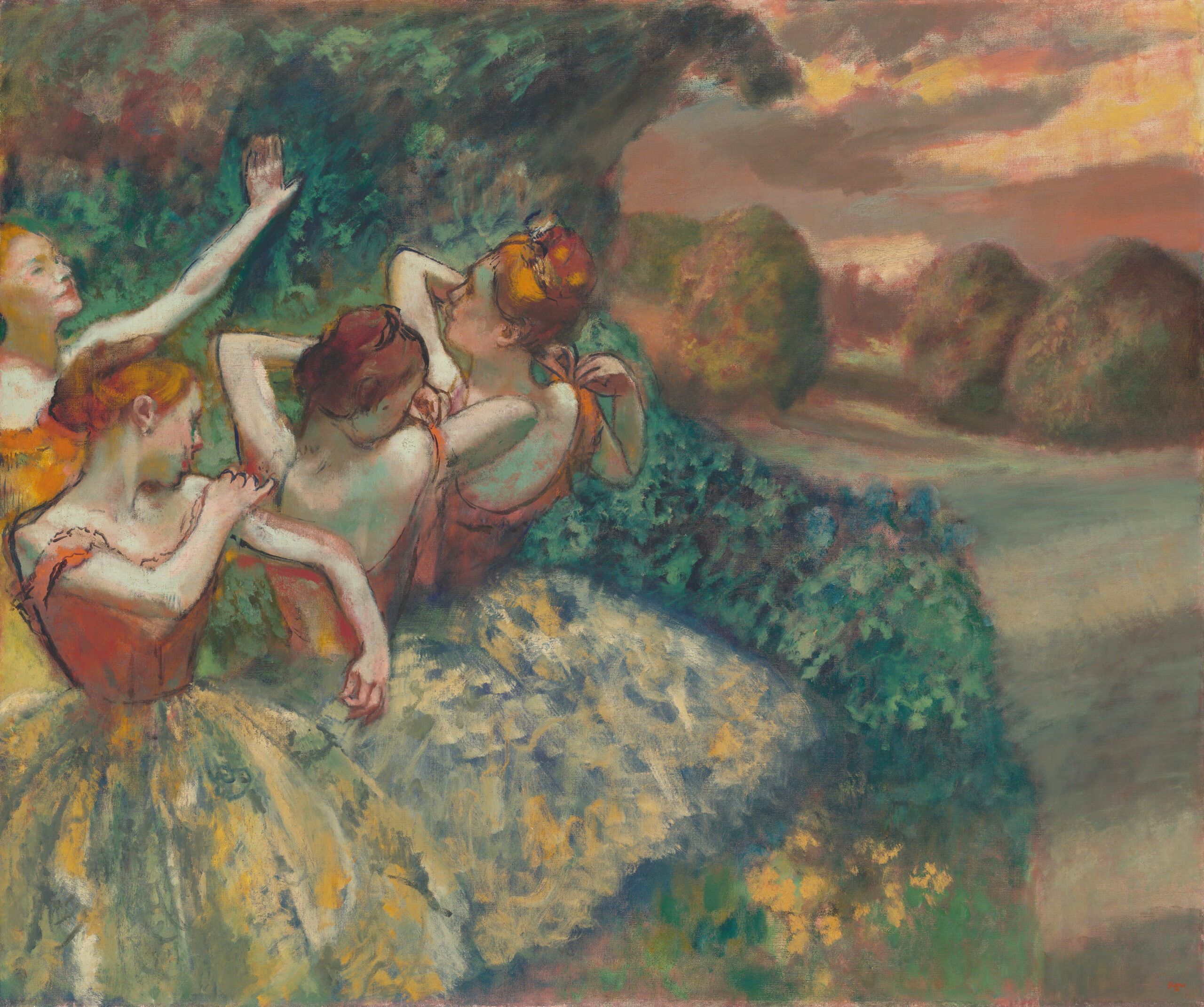
My eye on this work: in researching this canvas, what struck me most was the almost luxuriant setting, a verdant landscape bathed in what seems to be the light of a late summer’s day. Degas accustomed us to dancers caught in the chill of the Opera’s wings or mid-rehearsal; here, the atmosphere is altogether different, almost dreamlike, suspended. The gesture of the central dancer, adjusting her strap, is to my mind the heart of the painting: this concrete, almost trivial detail anchors in reality a scene that might otherwise drift into decorative reverie.
It is this tension between the swirl of the tutus and that intimate gesture that gives the composition, in my view, its full measure of humanity. I am also deeply drawn to the handling of color: those muted, almost felted tones, in quiet dialogue with one another, binding the whole together with a remarkable gentleness, far from the sharper contrasts found elsewhere in the artist’s work.
A suspended hand nearly brushes the foliage. Four dancers adjust their straps in a clearing gilded by the setting sun.
Formal and Technical Analysis
Edgar Degas builds his composition through the repetition of a single gesture, declined four times over. Arms rise, cross, fall away. Pastel and oil merge in muted touches of moss green, ochre, faded pink. No contour ever fully closes. The tutus absorb the evening light like sponges of color. This visible pentimento, characteristic of Degas’s late years, allows the layers of the work to surface.
Historical and Artistic Significance
By around 1899, Degas had long abandoned the urban scenes of his early Impressionist years. His eyesight was failing, his hand growing broader, freer. The ballet motif, which he had explored for thirty years, here shifts into something else: a mental landscape as much as an observed scene. The haystacks on the horizon, the dramatic sky, belong less to the Opera than to an open-air reverie.
Edgar Degas (1834–1917), French painter and sculptor associated with Impressionism, devoted a major part of his oeuvre to dancers, without ever being confined by them.
Degas in the News
In April 2026, the Comité Edgar Degas announced the authentication of a previously unknown drawing, presented as a preparatory study for the portrait of Diego Martelli, made by Degas in 1879. The work, black pencil heightened with white, was submitted to the Committee in December 2025 by its owner, a descendant of the art dealer who had acquired it in 1934 at the sale of the Jeanne Fèvre collection, the artist’s niece; on its verso bore the stamp of the Degas studio, applied after his death in 1917. Following an inquiry comparing its dimensions and provenance with the 1934 sale catalogue, the committee of experts unanimously authenticated it as a study by Degas’s own hand, a reminder that works of this significance continue to surface more than a century after the artist’s death.
Source: www.comiteedgardegas.com
A Question for You
💭 What if these four silhouettes were not four women, but one, captured across four instants of the same gesture?
About This Work
- Four Dancers
- Edgar Degas
- c. 1899
- Oil on canvas
- 151.1 x 180.2 cm
- National Gallery of Art, Washington D.C.
- https://www.nga.gov/artworks/46597-four-dancers