Rome, c. 1640. Two men appear in the opening of an empty tomb. Their breath is short, their gestures suspended. Something impossible has just taken place.
Light as Revelation
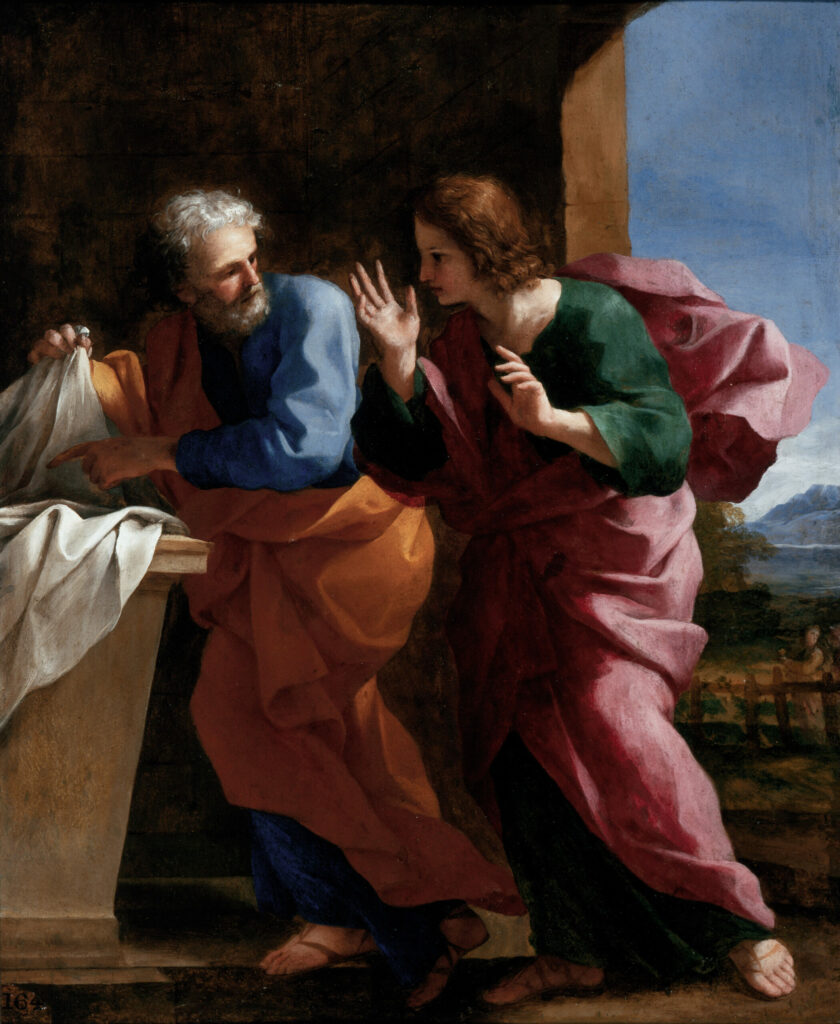
In this small silvered copper by Romanelli, two figures confront each other gently. Peter, white-haired, in blue and orange, holds the crumpled shroud. John, younger, wrapped in pink and green, raises his hand. His gesture questions. His gaze searches. Painting on copper offers exceptional luminosity. The colours vibrate, dense and warm. The dark background intensifies the brilliance of the drapery. In the distance, an open landscape, light, sky, depth.
A Suspended Scriptural Moment
The scene is drawn from the Gospel of John (20:1–10). Mary Magdalene has delivered the news: the tomb is empty. The two apostles run toward it. John arrives first and hesitates. Peter enters and looks at the linen cloths. This is the beginning of faith. In the 1640s, the Counter-Reformation demanded images that were clear, moving, and theologically sound. Romanelli answers this spiritual and visual commission perfectly.
Giovanni Francesco Romanelli
Born in Viterbo, Romanelli (1610–1662) trained under Pietro da Cortona in Rome. He painted for the Barberini and worked in France for Mazarin. His Baroque style combines classical clarity with emotional sensitivity. Equally admired in Rome and Paris, he was among the rare Italian artists of the seventeenth century to have radiated influence beyond the Alps. This oil on copper distils his full mastery of sacred narrative.
A Question for You
💭 On such a small support, Romanelli manages to render each fold of drapery almost tangible. Which technical detail strikes you most in this oil on copper?
About this work
- St. John and St. Peter at Christ’s Tomb
- Giovanni Francesco Romanelli
- c. 1640
- Oil on silvered copper
- 46.67 × 38.42 cm
- Los Angeles County Museum of Art (LACMA)
- https://collections.lacma.org/node/246533
Silvered Copper as a Vehicle of Light
St. John and St. Peter at Christ’s Tomb draws much of its pictorial power from its unusual support: silvered copper reflects light from within, giving the colours a vibration and density that canvas or wood panel cannot achieve. This technique, practised in Roman 17th-century circles for small private devotional works, transforms each layer of paint into stained glass: the blues and oranges of Peter’s cloak, the pinks and greens of John’s tunic, glow from the metallic ground as if the figures carry their own light source. The scene is drawn from the Gospel of John (20:1-10): the two apostles discover the empty tomb, Peter holding the crumpled shroud, John raising his hand in a questioning gesture. The open landscape extending behind them, golden light over distant hills, transforms amazement into hope.
Romanelli between Rome and Paris: An Artist of Two Capitals
Giovanni Francesco Romanelli (1610-1662), born in Viterbo and trained in the studio of Pietro da Cortona, the most influential painter of the Roman Baroque, became one of the few 17th-century Italian artists to sustain a double career between Italy and France. After his Roman beginnings, which included the decoration of the Palazzo Barberini alongside his master, Romanelli made two decisive stays in Paris: from 1646 to 1648, and again from 1655 to 1657, under the patronage of Cardinal Mazarin. There he decorated the Galerie Mazarine and the Queen’s apartments at the Louvre, introducing the vocabulary of the Roman Baroque to Paris and exerting a direct influence on French painters including Charles Le Brun. Appointed a knight of the Order of Saint Michael by Louis XIV, he returned to Viterbo where he died in 1662. St. John and St. Peter at Christ’s Tomb belongs to his mature Roman period, in which Romanelli synthesised the classical clarity inherited from Cortona with the emotional sensitivity demanded by Counter-Reformation painting.
A Johannine Scene: Faith as Process
The choice of the Johannine episode of the empty tomb is not incidental in the Counter-Reformation context. John 20:1-10 describes two distinct reactions to the same discovery: Peter enters the tomb and observes the burial cloths lying flat without understanding; John “saw and believed.” Romanelli renders this difference in the attitudes of the two figures, the perplexity of one, the questioning that is already reaching toward an answer in the other, and gives the scene a psychological nuance that goes beyond simple Gospel illustration. Faith is represented here not as a given certainty but as a process, an interrogation moving toward the light of the landscape.