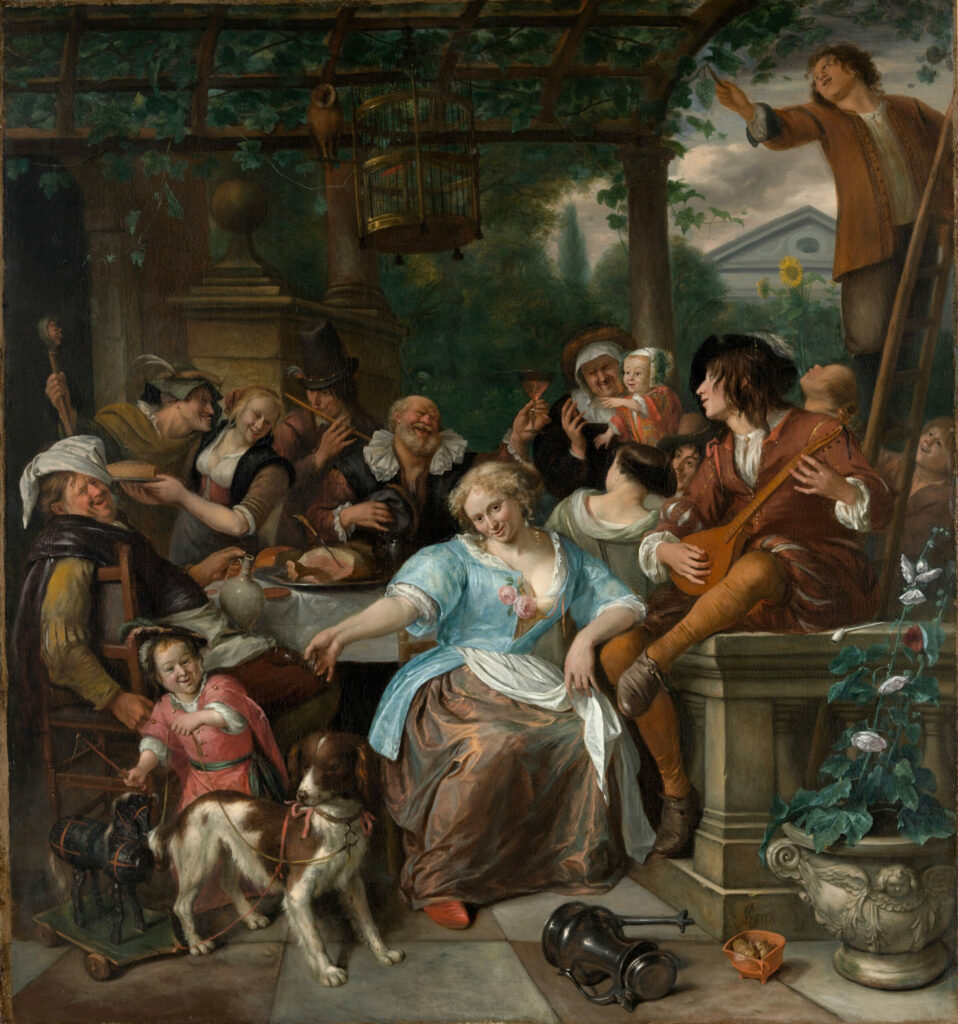
Leiden, ca. 1670. Jan Steen orchestrates a noisy and joyful celebration on a shaded terrace. Musicians, drinkers, children, and dog bustle about in a carefully orchestrated disorder. The painter transforms his own family life into a comic spectacle.
A Scene of Controlled Domestic Chaos
At the center, a woman in a blue dress looks at us, empty glass in hand, a knowing smile on her lips. This is Grietje, Steen’s wife. Around her, everything comes alive. A lutenist charms his neighbor. A red-faced man wears a ridiculous hat. A child plays with a dog. A sausage hangs from a headdress. Warm tones dominate: ochres, browns, touches of red. Steen masterfully controls the light that sculpts faces and makes fabrics shine. Every detail matters: the overturned pitcher, the abandoned pipe, the suspended birdcage.
Humor as an Art of Living
In the 17th-century United Provinces, genre scenes enjoy immense success. Steen excels at mixing social observation with popular theater. He depicts himself on the left, grotesque hat on his head, face reddened by wine. Beside him appears Hans Worst, a comic character from Dutch theater. Behind the apparent chaos lies a rigorous composition, a moral commentary on pleasures and their excesses. The expression “a Jan Steen household” is still used in the Netherlands today as a synonym for joyful disorder.
Jan Steen, a Master of Painted Comedy
Jan Steen (1626-1679) runs a brewery while painting. This double life nourishes his art. He observes taverns, family celebrations, disordered interiors. His style combines technical virtuosity with a keen sense of visual narrative.
Think about it
💭 And you, do you prefer impeccable homes or those lively disorders that Steen celebrates with such tenderness?
About This Work
- Merry Company on a Terrace
- Jan Steen
- ca. 1670
- Oil on canvas
- 141 x 131.4 cm
- The Metropolitan Museum of Art, New York
- https://www.metmuseum.org/art/collection/search/437749