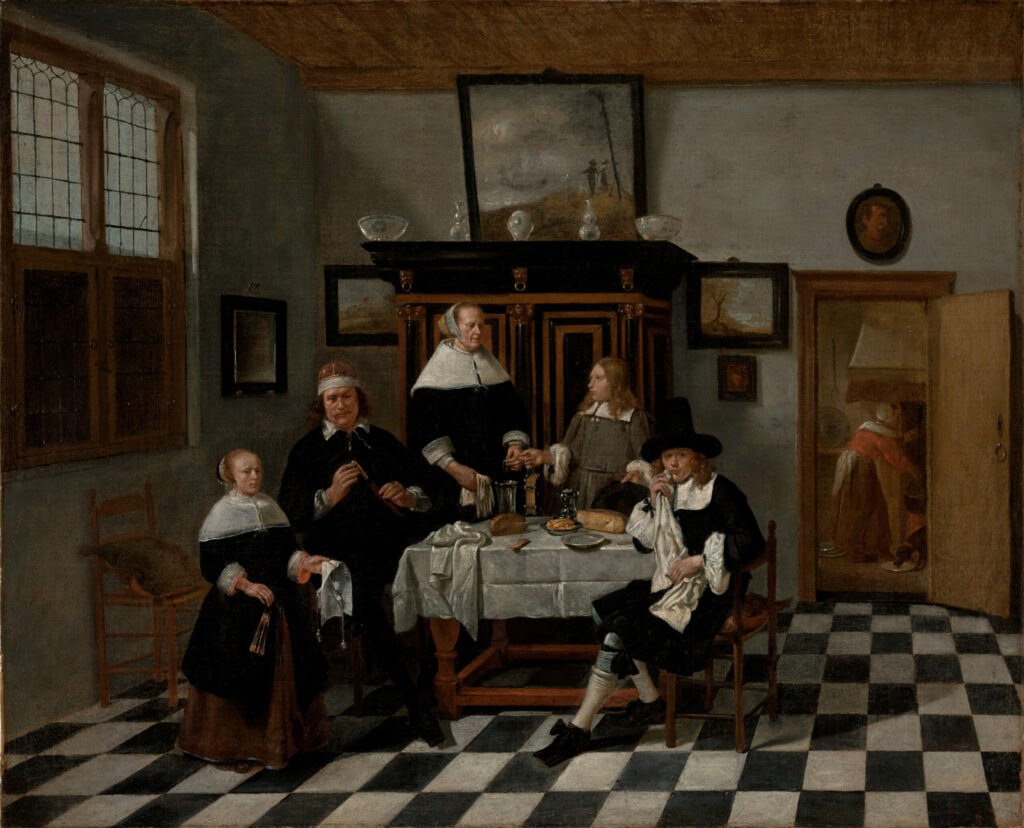
Leiden, c. 1658. In the golden light of a Sunday, a prosperous family has just finished their meal. The mother hands a prayer book to her son. The spiritual journey begins again.
A Light That Speaks
Look closely at this scene. The black-and-white chequered floor structures the space. The white tablecloth illuminates the centre of the composition. Around the table, five figures are arranged. The little girl holds her starched cap and her fan. The father, seated, watches with a pensive eye. Van Brekelenkam commands the Dutch touch: diffused light, materials rendered with precision, a sober palette dominated by blacks, whites, and warm browns. Every detail counts, the bread, the carafe, the objects set upon the sideboard.
A Message Painted into the Canvas
Van Brekelenkam combines family portrait and genre scene with clear moral intent. Above the sideboard, a painting within the painting depicts a couple facing a ship beneath a sky pierced by a ray of light. This framed landscape is not decorative. It is a reminder that life is an uncertain crossing, and that only faith lights the way. In the seventeenth-century Dutch Republic, genre painting frequently carried this kind of message, rooted in Calvinist morality.
Quiringh Gerritsz. van Brekelenkam
Active in Leiden between 1648 and 1668, Van Brekelenkam (after 1622 – c. 1669) excelled in bourgeois domestic interiors. A probable pupil of Gerrit Dou, he inherited the tradition of the fijnschilders: meticulous precision, intimate scenes, masterful light. This painting perfectly illustrates his ability to unite social portraiture with symbolic narrative.
Think about it
💭 Can you think of other works from the Dutch Golden Age in which a hidden painting carries the entire moral meaning of the scene?
About this work
- Family Group in an Interior
- Quiringh Gerritsz. van Brekelenkam
- c. 1658–1660
- Oil on canvas
- 59.7 × 73.3 cm
- The J. Paul Getty Museum, Los Angeles – Ref. 70.PA.20
- https://www.getty.edu/art/collection/object/103RAH
Leiden, the Fijnschilders, and the Devout Interior
Family Group in an Interior belongs to the tradition of the fijnschilders (“fine painters”) of Leiden, that 17th-century Dutch current defined by meticulous execution, precision in rendering materials, and mastery of a soft, even light. Quiringh van Brekelenkam (born c. 1622/1629 in Zwammerdam, died c. 1669/1679 in Leiden) most likely trained under Gerard Dou, Rembrandt’s pupil and founder of the Leiden fijnschilder school. From this tradition, Brekelenkam inherited the layered glazing technique that gives surfaces, white tablecloths, checkered floors, dark fabrics, an incomparable depth and velvety quality. The composition assembles five figures of a prosperous household in a moment of spiritual recollection after the meal, the mother extending a prayer book to her son, a gesture that signals the priority of religious education in the Calvinist bourgeoisie of Leiden.
A Painting within the Painting: Allegory of the Christian Life
What distinguishes Family Group in an Interior from simple genre painting is the presence, above the sideboard, of a framed landscape depicting a couple, a ship, and a celestial light. This small painting within the painting, a recurring motif in Dutch art, functions as a moral commentary on the main scene: the life of a Christian is an uncertain voyage on sometimes troubled waters, guided by divine light. The black-and-white checkered floor that structures the space, the white tablecloth illuminating the centre of the composition, and the palette of blacks, whites, and warm browns create a sober tonal unity in which light becomes the painting’s true subject. In Brekelenkam, as in his contemporaries Jan Steen or Pieter de Hooch, the domestic interior is never merely domestic, it is the stage for a collective moral.