Paris, 1717. The young Jean Restout, aged twenty-five, must convince the Royal Academy of Painting. His weapon: a blazing mythological scene in which Venus descends into the forge of Vulcan.
A Blaze of Flesh and Metal
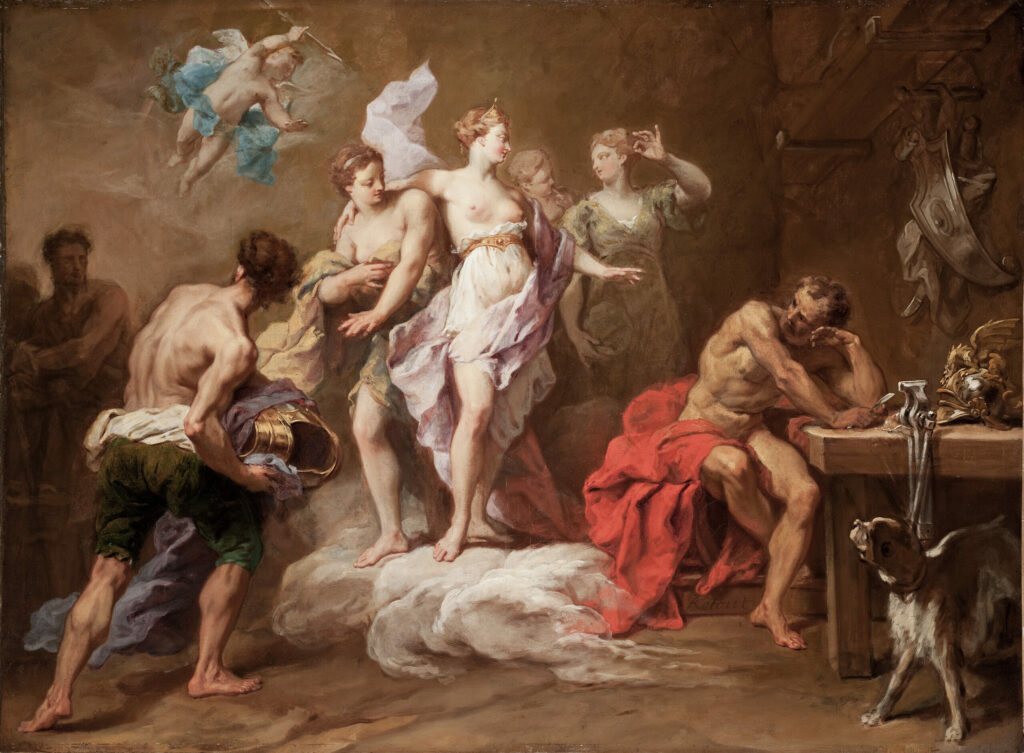
At the centre, Venus appears in a vaporous cloud, draped in translucent veils. Her pearlescent skin radiates light. She extends her hand toward Vulcan, seated on the right. On the left, a figure holds a gleaming shield. A putto twirls in the upper corner. The nymphs attending the goddess observe the scene with curiosity. Restout handles oil on canvas with rare virtuosity. The flesh tones are luminous. The draperies create a striking chromatic rhythm. The theatrical, frieze-like composition guides the eye from one edge to the other.
A Passport to the Academy
This painting is no ordinary commission. It is the morceau d’agrément — the reception piece — that Restout presented to the Royal Academy, the first step toward his admission as a full member. The subject, drawn from Book VIII of Virgil’s Aeneid, is a staple of the academic repertoire. Venus asks her husband Vulcan to forge divine arms for their son Aeneas. By choosing this scene, Restout demonstrates his command of history painting, the most exalted genre in the academic hierarchy. The gamble paid off. The Academy recognised his talent.
Jean Restout
Nephew of the celebrated Jean Jouvenet, Restout (1692–1768) would become one of the most esteemed French painters of the eighteenth century. Renowned for his religious compositions, he also excelled in mythology. His refined palette and elegance won admirers in France and abroad.
A Question for You
💭 To secure his place at the Academy, Restout staked everything on seduction. What detail in this canvas won you over first?
About This Work
- Venus Requesting Arms from Vulcan for Aeneas
- Jean Restout
- 1717
- Oil on canvas
- 102.87 × 138.43 cm
- Los Angeles County Museum of Art (LACMA)
- https://collections.lacma.org/node/220212