Seville, circa 1617. In Pacheco’s workshop, the young Velázquez paints a tavern scene that defies any single interpretation. Three musicians, a watching monkey, and the viewer becomes an accomplice.
A Scene Vibrant with Light and Shadow
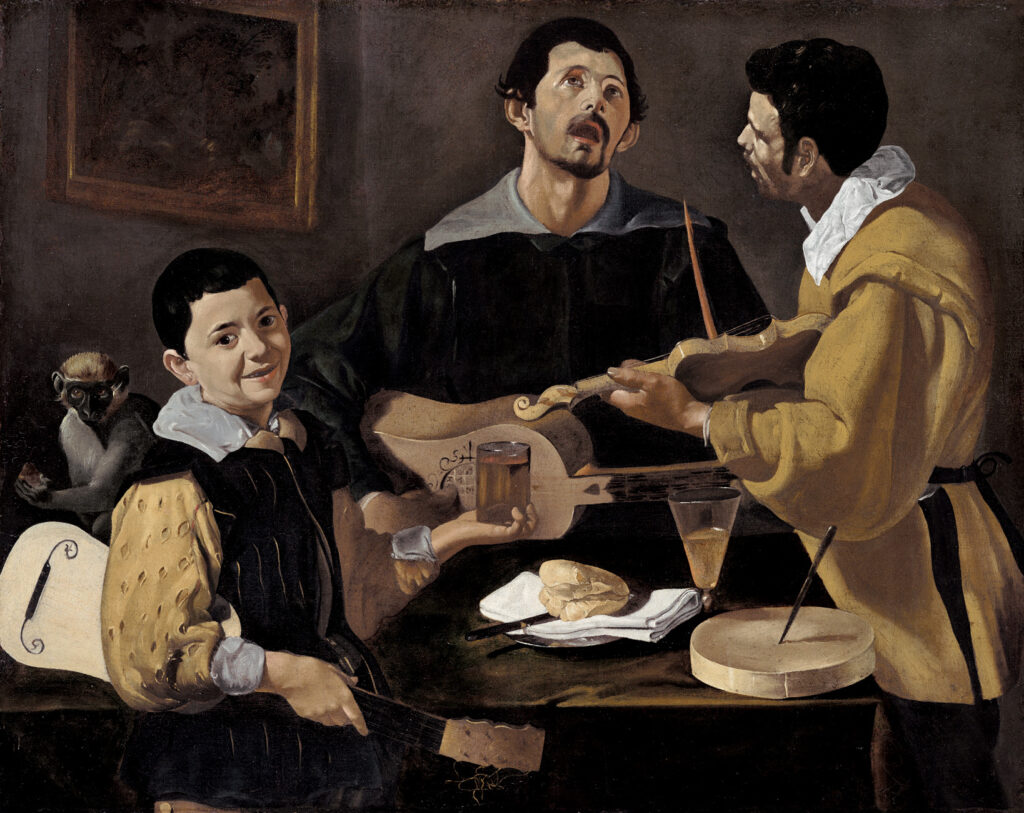
Observe these three young men gathered in a dark room. Their faces emerge from the gray background through a masterful play of chiaroscuro. The boy in the foreground stares at us, glass raised, smile complicit. Behind him, the singer opens his mouth wide, guitar in hand. The violinist attempts to imitate him. Velázquez captures each expression with disturbing precision. On the table, a meticulous still life: crusty bread on a white napkin, knives carefully arranged. A small crouching monkey completes this theatrical composition, gaze turned toward us.
Between Realism and Allegory
Before his appointment to the court in Madrid, Velázquez excelled in these genre scenes called “bodegones.” This painting invites multiple readings: a popular tavern or a well-appointed interior? The framed landscape on the wall suggests sight, the music solicits hearing, the objects evoke touch, the bread and wine appeal to taste and smell. A possible allegory of the five senses. The monkey symbolizes primal instincts. Does the musicians’ intoxication invite morality or entertainment?
Velázquez, Young Sevillian Prodigy
Diego Velázquez (1599-1660) created this work between the ages of 16 and 18, still in training. Its uneven lighting and spatial composition reflect this creative youth. Seven years later, he would become painter to King Philip IV. This bodegón already demonstrates his technical mastery and his ability to transcend conventions.
Think about it
💭 Does this scene speak to you of guilty pleasure or shared joy? Which reading do you favor?
About this Work
- The Three Musicians
- Diego Velázquez
- circa 1616-1618
- Oil on canvas
- 90.4 × 113.2 cm
- Staatliche Museen zu Berlin, Gemäldegalerie
A Bodegón from His Youth
The Three Musicians belongs to the genre of the “bodegón,” the Spanish term for a genre scene combining figures and still-life objects, which Velázquez practised intensively during his years of training in Seville under the direction of Francisco Pacheco. The painting is dated to around 1616-1618, at a time when Velázquez was between 17 and 19 years old. These Sevillian bodegones now constitute one of the most studied bodies of work within the Velázquez corpus, because they reveal a genius still in formation, exploring problems of light, texture, and the human figure with a freedom and curiosity that the major royal commissions in Madrid would later constrain. The still life in the foreground (crusty bread on a white cloth, arranged knives) rivals the figures in quality.
The Allegory of the Five Senses
The composition has been interpreted as an allegory of the five senses: music solicits hearing; bread and wine, taste and smell; the objects in the foreground, touch; and the framed landscape in the background, sight. The crouching monkey, a traditional symbol of primal instincts in European iconography, introduces a morally ambiguous note: is this a warning against excess, or simply a picturesque detail? This openness to multiple readings is characteristic of Velázquez’s bodegones, which resist a single interpretation.
From Seville to Berlin
The Three Musicians is held at the Gemäldegalerie in Berlin, one of the great collections of European painting in the world, which also holds several other major works by Velázquez. The painting measures 90.4 × 113.2 cm, an ambitious format for a painter still in training. Seven years after completing this work, Velázquez would be appointed painter to King Philip IV, the beginning of a career at the Spanish court that would make him one of the most influential artists in the history of Western painting.