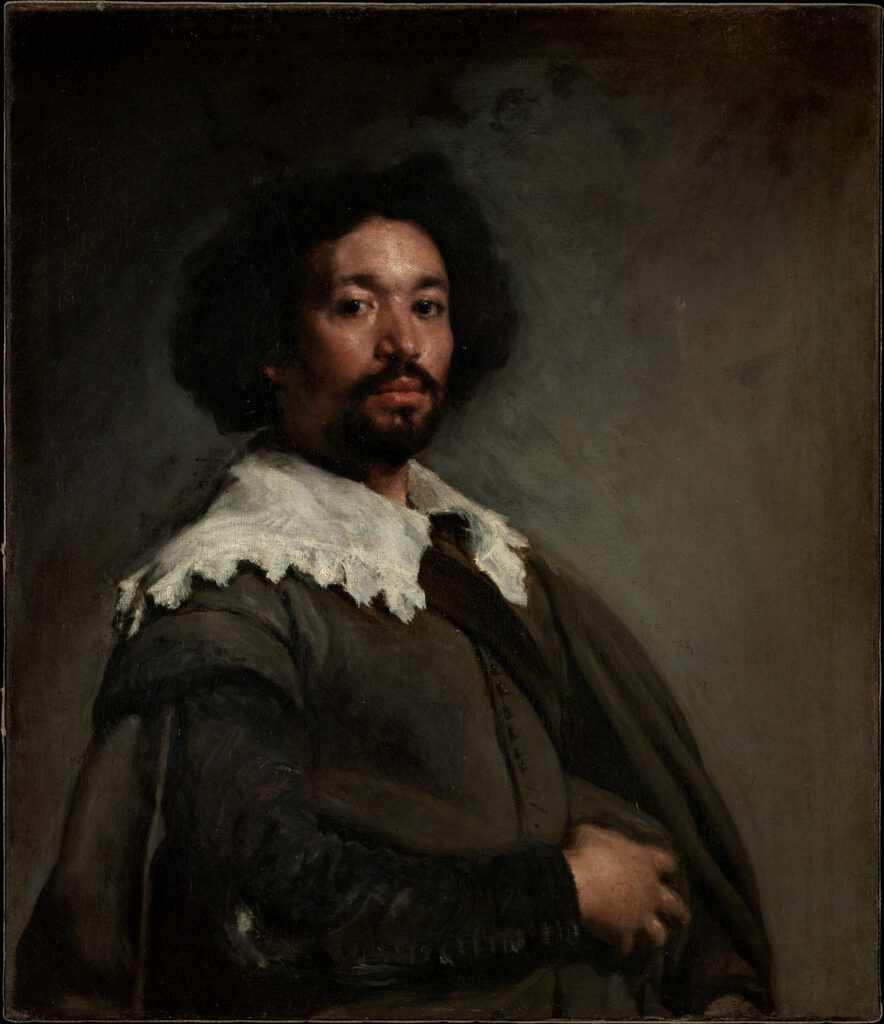
In this striking portrait, considered one of his masterpieces, Velázquez transcends the conventions of his era to deliver an image of profound humanity of his assistant Juan de Pareja.
The three-quarter pose, direct and proud gaze, and brilliant lace collar against dark clothing confer upon the subject an extraordinary dignity and presence.
The painterly technique, of dazzling virtuosity, manifests in the treatment of light that models the face with infinite subtlety, in the reflections of the undulating hair, and in the rendering of different textures, from the matte fabric of the doublet to the transparency of the lace. The palette, sober yet rich in nuances, dominated by grays and browns, heightens the intensity of the gaze and the living flesh tones of the face.
Further Context
- Portrait of Juan de Pareja, Diego Velázquez, 1650
- 32 x 27 1/2 in. (81.3 x 69.9 cm)
- The Metropolitan Museum of Art, Fifth Avenue, New York, exhibited in Gallery 625
- https://www.metmuseum.org/art/collection/search/437869
Diego Velázquez (1599-1660) is considered one of the greatest masters of Spanish Golden Age painting. Official painter to the court of Philip IV, he revolutionized portraiture through his ability to capture not only physical appearance but also the psychological essence of his subjects. This portrait of Juan de Pareja, created during his second stay in Rome, marks the pinnacle of his art and testifies to his modernity: by representing his assistant with such dignity, he transcends the prejudices of his time and affirms the equal humanity of all beings, beyond social conditions.
A Portrait Painted in Rome as a Practice for the Pope
Portrait of Juan de Pareja arose from a practical constraint that produced one of the seventeenth century’s greatest paintings. Velázquez (Seville, 1599 – Madrid, 1660) was in Rome in 1649-1650, sent by King Philip IV of Spain to acquire works of art and paint the portrait of Pope Innocent X. Before facing the Pope, a notoriously impatient sitter with a complexion famously difficult to render, he practised on a subject he had known for years: Juan de Pareja (c. 1610-1670), a man of Moorish origin born in Antequera, Andalusia, who had long served in Velázquez’s household and workshop in the legal status of a slave. The portrait was most likely painted in a single session, as practice studies always are. It was exhibited on March 19, 1650 at Santa Maria dei Miracoli near the Vatican, alongside works by many contemporary masters.
“The Others Were Art; This Alone Was Truth”
The Roman public’s response was extraordinary. Visitors declared that while the other pictures in the exhibition were “art,” this one alone was “truth.” The assessment captures something real: the freedom of Velázquez’s brushwork, the luminous vibration of the lace collar, and above all the absolute psychological presence of Pareja himself, his direct, steady gaze refusing any posture of subordination, produce an intensity that seventeenth-century portraiture rarely achieves. Velázquez freed Pareja in 1654 during a second Roman visit; liberated, Pareja became a painter in his own right and exhibited his own work. Their relationship, master and enslaved person, then master and freed artist, is one of the most remarkable in all art history.
From the Radnor Collection to the Metropolitan
The painting vanished from the record for more than a century before reappearing in the collection of the Radnor family around 1811. On November 27, 1970, Christie’s offered it at auction in London: it sold for £2,310,000, becoming the first painting in history to exceed £1 million at public sale. The Metropolitan Museum acquired it in 1971 through the Fletcher Fund, describing it as “among the most important acquisitions in the Museum’s history”, a judgement few have disputed.