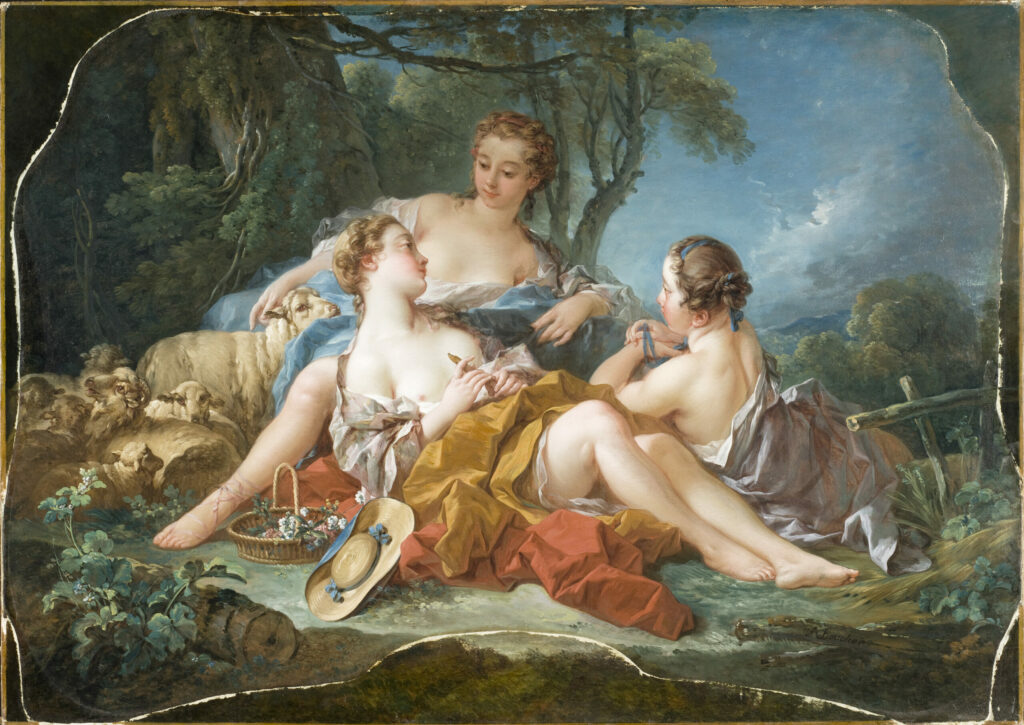
Paris, 1745. In his studio on Rue de Richelieu, François Boucher composes a gallant scene that embodies the very essence of the Rocaille style. Three young women share a moment of pastoral intimacy, surrounded by peaceful sheep and delicate flowers. One of them whispers a secret, creating this pastoral confidence that gives the work its title.
A Mastered Sensuality
Boucher deploys all his virtuosity in rendering fabrics. The draperies of white and golden yellow satin capture light with remarkable fluidity. Pearly flesh tones contrast with the deep blues of the sky and dark greens of the foliage. Every detail counts: the straw hat, the woven basket, the ribbons. The touch is light, almost vaporous, typical of the painter. The pyramidal composition is skillfully orchestrated; each gesture guides the eye toward the center of the canvas.
The Gallant Universe of Louis XV
This work reflects the tastes of the French aristocracy under Louis XV. The pastoral genre, which idealizes rural life, enjoyed immense success at the time. Courtiers dreamed of a fantasized countryside, far from the constraints of Versailles. Boucher, appointed first painter to the king in 1765, excelled in these scenes where aristocratic shepherdesses play at simplicity. His compositions adorned boudoirs, screens, and tapestry manufactories.
François Boucher
François Boucher (1703-1770) dominated French Rococo painting. Student of François Lemoyne, Prix de Rome winner at twenty, he became the favorite painter of Madame de Pompadour. His sensual and decorative style influenced an entire generation of artists and defined an aesthetic of 18th-century France.
Think about it
💭 How does Boucher here reconcile the rigor of classical composition with the unbridled sensuality of Rococo?
About This Work
- Les Confidences Pastorales (The Pastoral Confidences)
- François Boucher
- circa 1745
- Oil on canvas
- 93.98 × 132.08 cm (37 × 52 in.)
- Los Angeles County Museum of Art (LACMA)
- https://collections.lacma.org/node/229324
The Pastoral Genre and Its Social Function
Les Confidences Pastorales is one of the most characteristic expressions of a genre that defined French painting under Louis XV: the pastoral scene, which stages an imaginary countryside populated by elegant shepherdesses and placid flocks, bearing no relation to actual rural life. Three young women share an intimate moment, one whispering a secret, the others smiling or listening, in a softly lit landscape of flowers and sheep. The pyramidal composition flows easily around the white and gold-yellow satin of the central figure, whose fabric Boucher renders with a fluency that amounts to virtuosity. Straw hat, woven basket, trailing ribbons: every accessory receives the attentive treatment of a painter who takes genuine pleasure in the visual wealth of things.
Boucher, Pompadour, and the Aesthetics of a Reign
The 1740s were the decade in which the rococo style of François Boucher (Paris, 1703 – Paris, 1770) reached its full flowering. His friendship with Madame de Pompadour, the most influential artistic patron at Versailles, who commissioned works from him for her private apartments and introduced him to the king, placed him at the centre of French visual culture. He would be named Premier peintre du Roi in 1765; but the paintings of the 1740s, including this one, are what Diderot later attacked as frivolous and what posterity has come to love as some of the most accomplished works of eighteenth-century France. The gossamer touch, the pearlescent skin tones against deep blues and greens, the apparently effortless sense of compositional ease: Les Confidences Pastorales shows why Boucher’s work, for all its lightness, has never been easy to dismiss.