Key facts
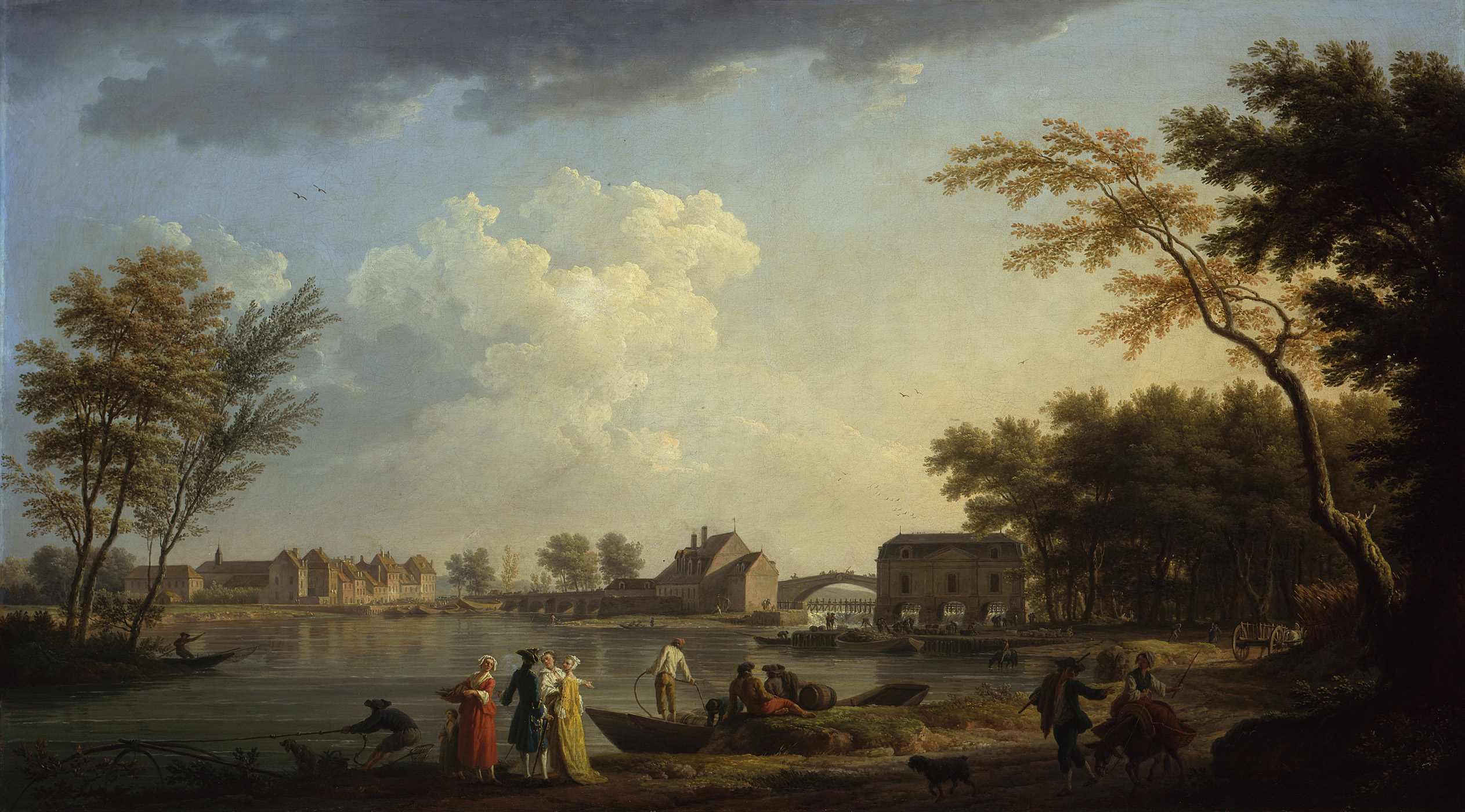
Painted by Joseph Vernet in 1764, the View of the Seine at Nogent-sur-Seine exemplifies eighteenth-century French landscape painting, poised between topographical observation and classical composition. Commissioned by Jean de Boullongne to document his industrial estate, the canvas combines a faithful rendering of the site with picturesque staging, a tension characteristic of Vernet’s work, trained in Rome and later celebrated for the royal commission of the Ports of France. Shown at the Paris Salon in 1765, it is today held at the Gemäldegalerie in Berlin, one of Europe’s great collections of Old Master painting. It confirms Vernet’s standing among the leading landscape painters of his time.
I find this painting to be an embellished vision of a real landscape. Its composition between two clusters of trees, the presence of figures and boats, the colours of the morning light, all contribute, to my mind, to this impression. It certainly documents the site, as the patron required, but Vernet does not refrain from adding a degree of staging: the stillness of the water, the softness of the sky, the way each element seems to fall into place compose something closer to a theatrical scene than a mere topographical record. Looking at it full screen, I notice a great many details testifying to a busy life along the Seine: figures at work on the bank, boats crossing paths, reflections shifting gently from one shore to the other. It is this blend of factual accuracy and quiet invention that, to my mind, gives the canvas its charm.
What you notice first looing at the View of the Seine at Nogent-sur-Seine
A rope stretches across the water, almost invisible. A man hauls it from the bank, bent forward, a dog at his feet. Feel the morning chill first, before you even see the river. Now look up. Behind him, a fisherwoman in red, an officer, a lady in yellow linger by the water. The sky, heavy with white clouds, dominates the whole scene. A raking light brushes across every face.
The story behind the painting
Vernet works in oil on an elongated canvas, 76 by 135.5 centimetres. The light comes from the right, raking, almost matutinal. It slides across the water, the foliage, the brick façades in the distance. Pale glazes soften every plane, from the foreground figures to the horizon. In 1763, Jean de Boullongne, a former Controller-General of Finances, establishes a hosiery manufactory at Nogent-sur-Seine. He commissions Vernet to paint several views of his estate. The painter stays on site in November 1764. The finished canvas is shown at the Paris Salon in 1765. Across the river, one can make out the machine house of the weir, a stone bridge, several buildings in a row. Near the bridge, bargemen unload barrels. A little further off, horses wait, a cart is being loaded. In the foreground, time seems suspended. Further away, it goes on passing, in the noise of labour and falling water. The foreground figures close, in silhouette, the painting’s imagined oval composition.
Claude Joseph Vernet and his time
Claude Joseph Vernet is born in Avignon in 1714. Often known simply as Joseph Vernet, he learns his craft under Vialy, then Sauvan. In 1734, he leaves to train in Rome. He remains there for nearly twenty years, studying Italian light, ruins, the sea. His reputation grows quickly across Europe. Returning to France in 1753, he receives the royal commission for the Ports of France. Fifteen views are completed within ten years. Settled in Paris from 1762, he becomes the landscape painter sought after by leading financiers and nobles. Boullongne approaches him two years later. By 1767, Diderot is already praising the speed of his execution. Vernet dies in Paris in 1789, in his lodgings at the Louvre.
Current relevance
Joseph Vernet remains an artist regularly highlighted in French art-history teaching today. His painting The Town and Roadstead of Toulon, Second View: The Port of Toulon, Seen from Mont Faron (1756, Musée du Louvre) featured on the national curriculum for the baccalauréat specialist track in visual arts for the 2026 session, under the theme “Documenting or Enhancing Reality,” alongside artists as Andreas Gursky. This continued presence on the syllabus reflects Vernet’s lasting place in the canon of art history taught in France.
Source: Bulletin officiel de l’Éducation nationale
A question for you
If one were to compare this canvas with the port views of Claude Lorrain, whom Vernet studied closely in Rome, what would the two painters be found to share?
About this work
- View of the Seine at Nogent-sur-Seine
- Claude-Joseph Vernet
- 1764
- Oil on canvas
- 76 x 135.5 cm
- Gemäldegalerie, Berlin
- https://search.smb.museum/object/obj-865463