Vernet (Claude-Joseph)
Claude-Joseph Vernet: France’s Master of Marine Painting
Regarded as the greatest French marine painter of the 18th century, Claude-Joseph Vernet (1714–1789) devoted his art to depicting ports, storms and Mediterranean calms. Trained in Italy over twenty years, he forged a pictorial language in which light, atmosphere and the movement of the sea take precedence over narrative detail. This page brings together detailed analyses of his paintings; to follow the story of his life, see Claude-Joseph Vernet’s complete biography.
Vernet’s Style: Theatricality and Atmospheric Truth
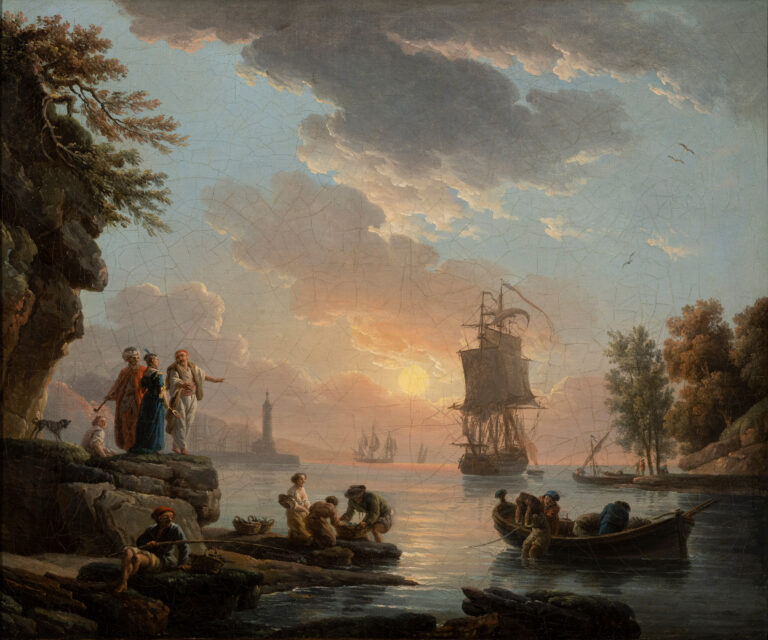
Vernet’s strength lies in his ability to stage a dramatic narrative within a rigorously balanced composition. Heir to Claude Lorrain for light and to the Dutch tradition for maritime observation, he builds each canvas like a scene: an animated foreground of fishermen and sailors, a port or coastline as backdrop, and a sky rendered in glazes that unifies the whole. His chromatic palette systematically opposes two registers, the golden ochres of calm and the deep greens of the storm, a device he theorised himself by painting pendant pairs (calm / storm).
The Ports of France, a Major Series
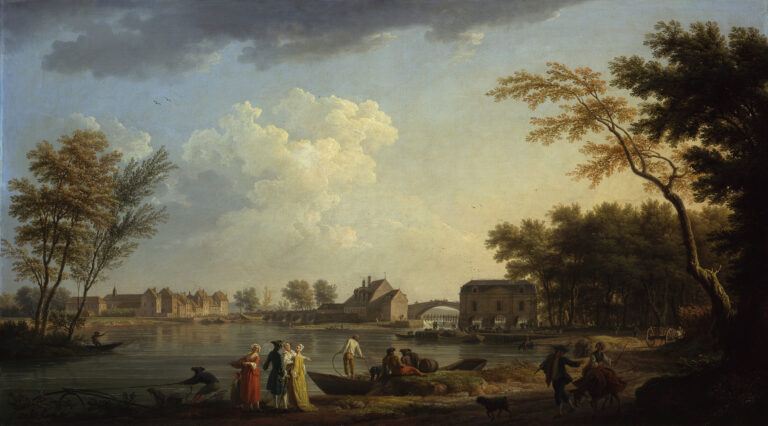
In 1753, Louis XV commissioned Vernet to produce a series of large topographical views celebrating the maritime power of the kingdom: the Ports of France. This undertaking, which occupied the artist for over a decade, required him to combine documentary accuracy, each port had to be recognisable, with a picturesque sense of human staging. This series remains the reference point for understanding Vernet’s ambition: to elevate marine painting into a noble genre, worthy of the great royal commissions.
Key Themes: Storms, Calms and Mediterranean Ports
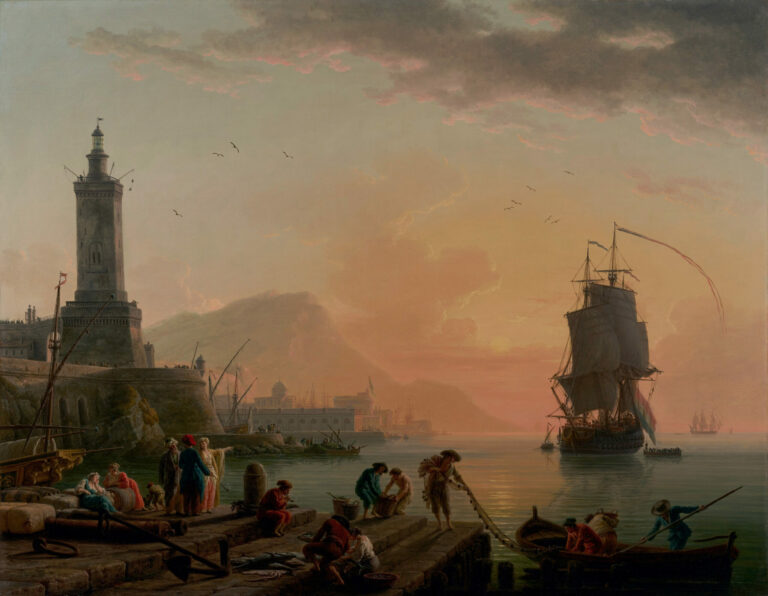
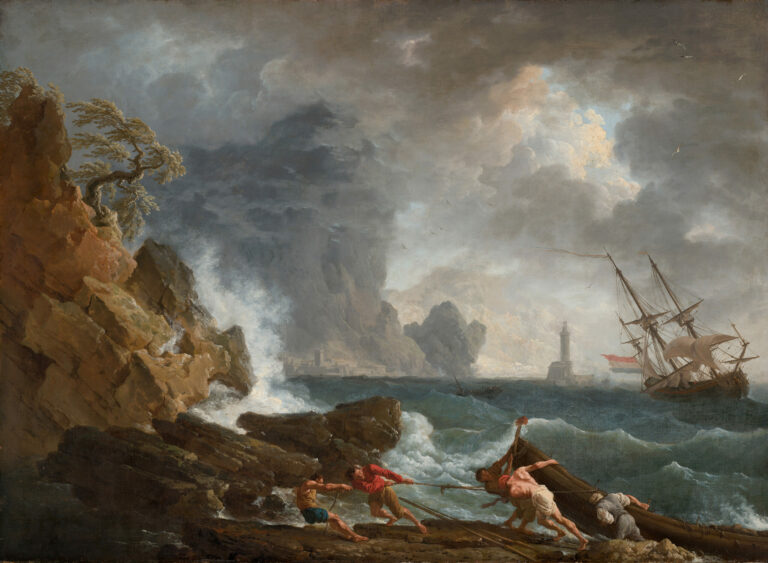
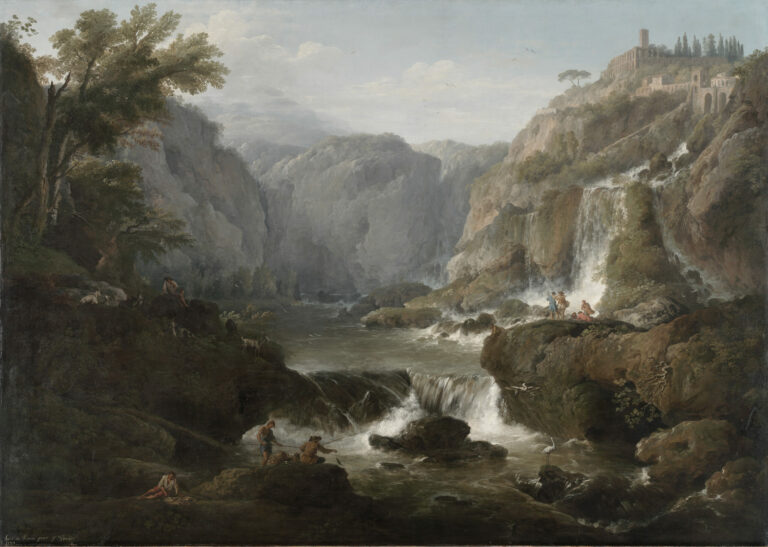
Vernet’s work is structured around a handful of recurring motifs he explored tirelessly. The storm, first, where shipwrecks and rescues illustrate humankind’s struggle against the elements. The calm harbour, by contrast, capturing the light of dusk on the quays and the bustle of fishing life. Italianate landscapes, inherited from his years in Rome, blend antique ruins with cascading water, as in The Waterfalls at Tivoli. Finally, Mediterranean port scenes, such as A Calm at a Mediterranean Port or An Italian Port in Stormy Weather, reveal the full range of his register, from serenity to fury.
Vernet, a Dynasty and a Legacy
Claude-Joseph Vernet was not an isolated case: he founded a genuine dynasty of painters, with his son Carle Vernet and grandson Horace Vernet each extending his reputation in their own way, into different genres (horses, military scenes). His influence reached far beyond France: his seascapes nourished English landscape painting, from Richard Wilson to William Turner, who openly admired him. In France, he anticipated the attention to atmosphere and light that Romantic, and later Impressionist, painters would develop a century on.