Key facts
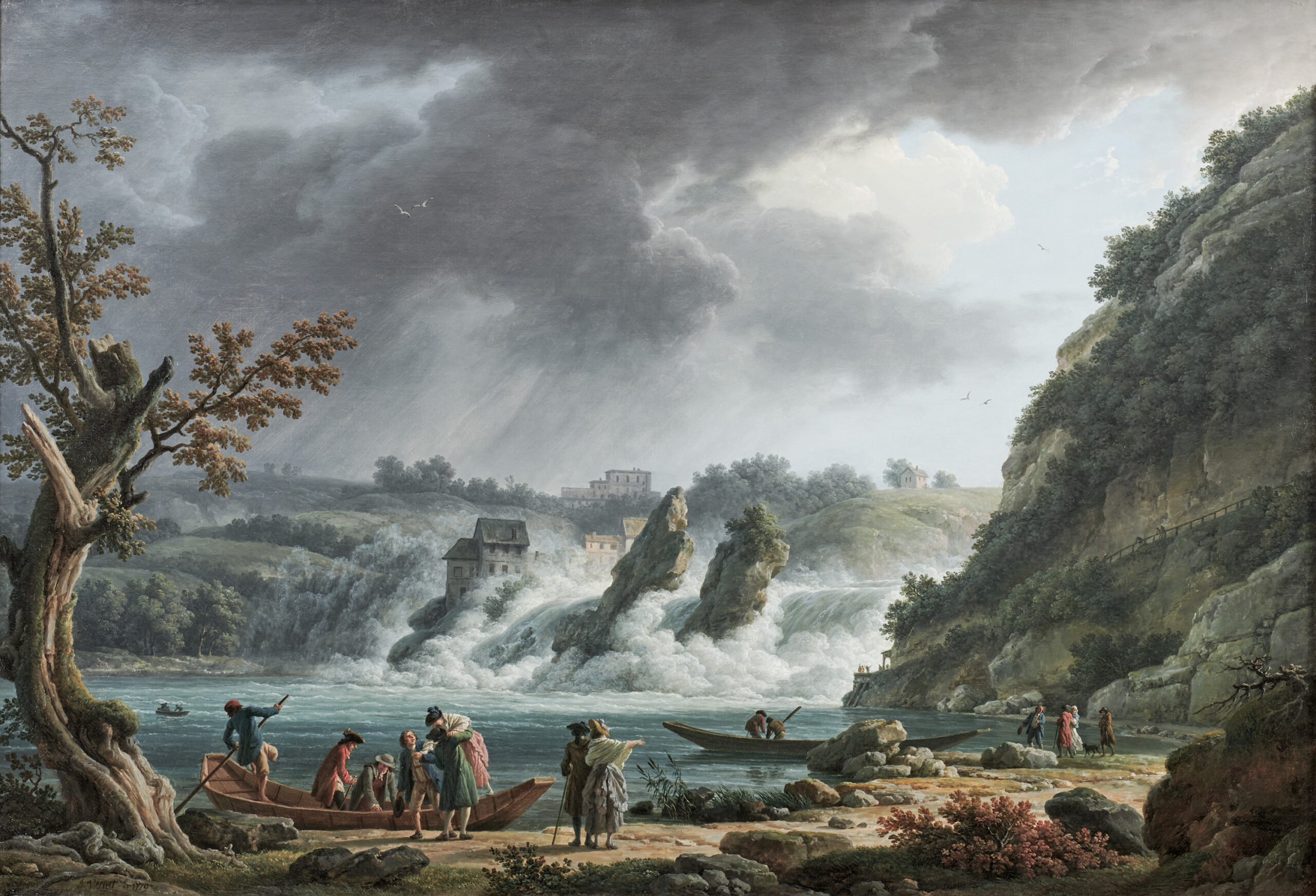
Painted in 1779 by Claude-Joseph Vernet (Avignon, 1714; Paris, 1789), Rhine Falls, near Schaffhausen, Switzerland depicts Switzerland’s most famous waterfall beneath a stormy sky, with visitors in the foreground who have come to admire the site. Executed late in the painter’s career, this oil on canvas belongs to eighteenth-century French landscape painting and to the aesthetic of the sublime that shaped the Age of Enlightenment. Known for his harbours and storms, Vernet turns here to an inland natural spectacle, one also painted by Wüest, Loutherbourg and Turner. The painting is held at the Clark Art Institute in Williamstown, Massachusetts.
Here is a painting by Vernet that portrays the Rhine Falls at Schaffhausen. As is his habit, the painter pairs a grandiose landscape with small figures that bring the canvas to life. To my eye, these figures are of secondary interest, yet they matter: without them, we could not grasp the scale of the falls. Vernet plays on this contrast between the force of the water and the fragility of the human silhouettes, typical of the aesthetic of the sublime that fascinated his century: we admire nature as much as it overwhelms us. It is also a documentary work, showing visitors coming to the riverbank to take in the spectacle, some pausing, others pointing at the falls. I see in it a kind of tourism before its time, and it is amusing to think that in 1779 people were already travelling to “see the Rhine Falls,” just as we still do today, minus the smartphone. Painted late in his career, this picture shows Vernet stepping away from his harbours and Mediterranean storms to take on another natural spectacle, and I find he succeeds just as well.
An outstretched hand. On the bank, a woman in a pale shawl points toward the water. Follow her gesture. It leads you straight to the foam of the falls, between two rocks rising like teeth. A curtain of rain streaks the sky. You can almost feel the damp rising from the river.
The Rhine Falls at Schaffhausen: water, stone, sky
Look first at the top of the canvas. The clouds cover nearly half the surface. Leaden grey on the left, they open on the right onto a washed-out blue. In the sky, the brushwork stays smooth, almost invisible. The foam, by contrast, looks denser, as if whipped up with the brush. Observe the two rocks in the centre. Their mossy green stands out against the liquid white. A grey building seems perched on the edge of the chasm. On the right, a wooden staircase climbs the cliff. Tiny figures are making their way up. At the foot of the rock, other onlookers crowd onto a small viewing platform. The cold, the noise, the wet smell: everything comes through the eye.
Move closer to the lower left corner. On a stone, almost blending into the ochre earth, you can read the signature: “J. Vernet 1779.” Just above, an old broken oak twists its russet branches. Its leaves catch an autumnal light. In the centre, the costumes ring out in small bright notes: a red coat, a green jacket, a pink skirt. These touches of colour hold the eye in the foreground. Birds glide beneath the clouds. They give a sense of the void.
Vernet is not alone before this site. In 1772, the Zurich painter Johann Heinrich Wüest had already painted the falls on a small wooden panel. Philippe-Jacques de Loutherbourg made a canvas of them, exhibited at the Royal Academy in London in 1788. Turner took them on in turn in 1806. Each seeks the roar of the water. Vernet chooses the riverbank, the boats, the conversations. The thunder stays in the background. In front, people step ashore, lend each other a shoulder, chat. A ferryman leans on his pole. A dog trots off to the right. Roaring nature becomes the backdrop for a Sunday outing.
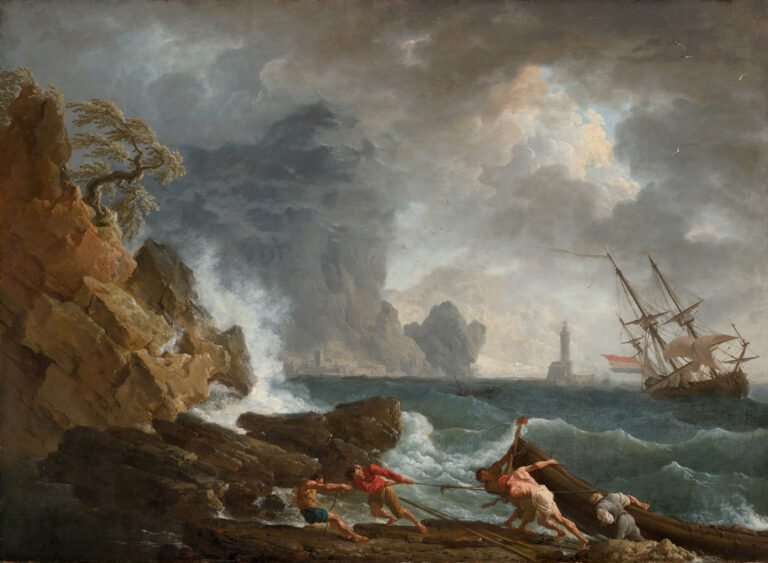
Comparing these versions teaches one thing. The same site can carry opposing stories. In Vernet’s version, the water roars but swallows no one. The boats stay moored on calm, turquoise water. We see the spectacle up close, in safety. For anyone who knows the painter’s turbulent seascapes, the effect is disconcerting. Here, no shipwreck, no broken mast.
Claude-Joseph Vernet, an Enlightenment painter before the torrent
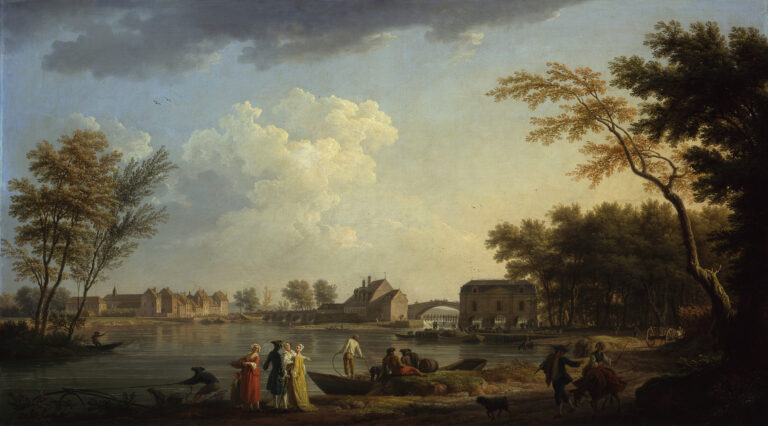
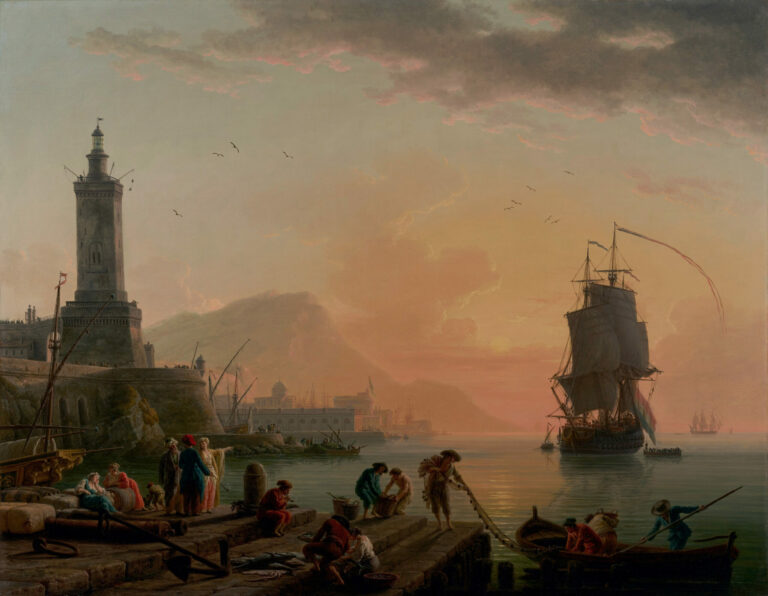
Claude-Joseph Vernet was born in Avignon in 1714. He trained in Rome, where he built his reputation as a landscape painter. Louis XV later entrusted him with an ambitious commission: to paint the ports of the kingdom. In 1767, Diderot devoted a long “Promenade Vernet” to his seven paintings at the Salon. The philosopher describes the canvases as real places, explored on foot. Only at the end does he admit that the walk is imaginary. This reading suits our 1779 landscape. We enter it as we would a place for a stroll. Yet the storm rumbles overhead. No one looks up. A faithful view, or a site recomposed in the studio? The canvas does not decide. Vernet died in Paris in 1789. This oil on canvas is now held at the Clark Art Institute in Williamstown, Massachusetts.
Vernet in the spotlight in 2026
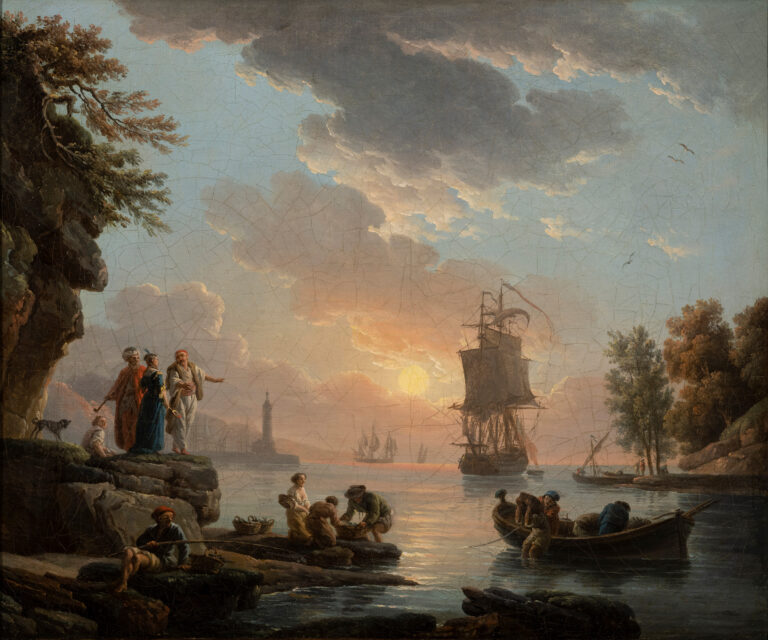
Joseph Vernet was celebrated in Paris this year. To mark the 400th anniversary of the French Navy, the Musée national de la Marine at the Palais de Chaillot devoted a major exhibition, from 13 May to 2 August 2026, to the painters who documented French maritime history from the seventeenth to the twentieth century. Titled La Marine et les peintres (“The Navy and the Painters”), it brought together nearly 150 works by more than 90 artists, from Claude Lorrain to Signac, by way of Vernet and Manet. On the research side, knowledge of his work continues to grow: the University of Passau, under the direction of Jörg Trempler, is leading a digital catalogue raisonné project to update Vernet’s corpus.
Source: Musée national de la Marine.
A question for you
In the eighteenth century, travelling to the Rhine Falls took days on the road. Would you make such a journey for a photo?
About this work
- Rhine Falls, near Schaffhausen, Switzerland
- Claude-Joseph Vernet
- 1779
- Oil on canvas
- 84.1 × 129.7 cm (33 1/8 × 51 1/16 in.)
- Clark Art Institute, Williamstown (Massachusetts)
- https://www.clarkart.edu/ArtPiece/Detail/Thine-Falls,-near-Schaffhausen,-Switzerland