In summary
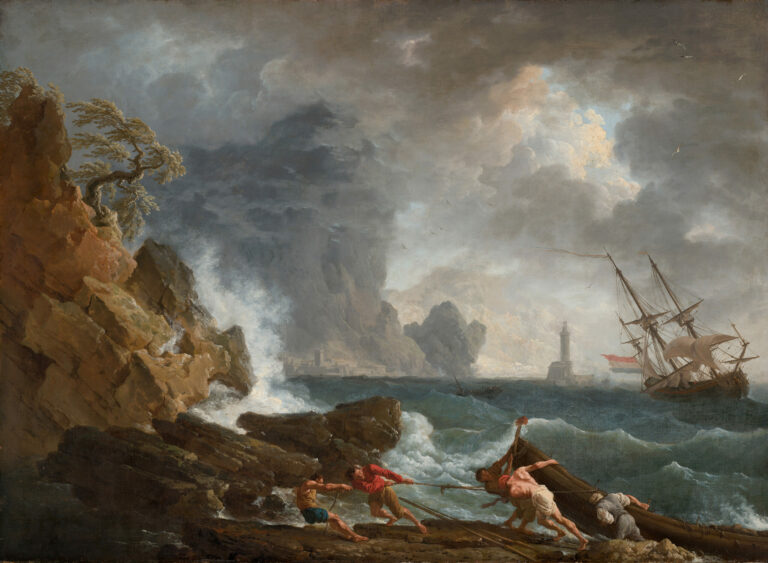
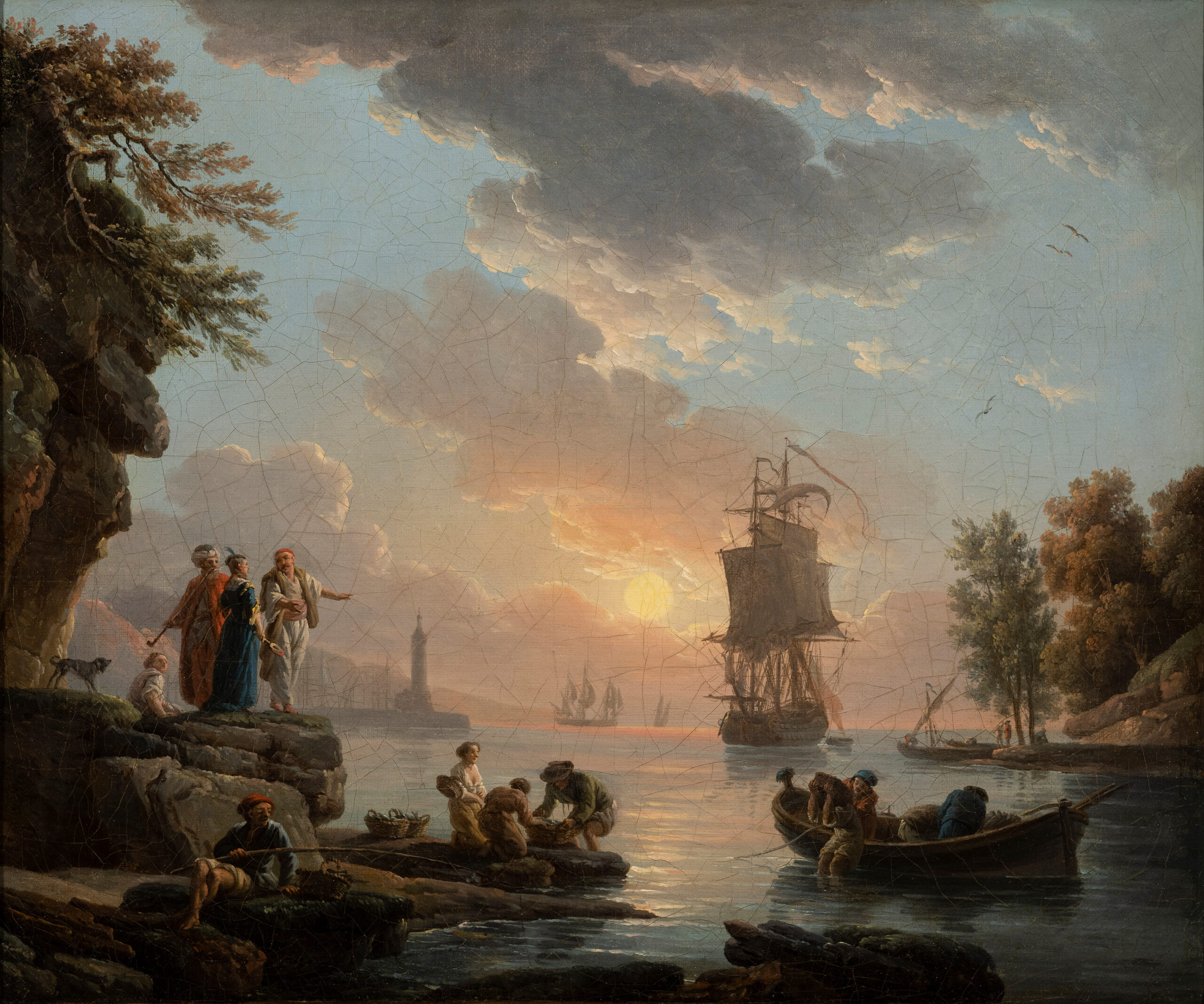
Marine is an oil on canvas attributed to Claude-Joseph Vernet, a French painter born in Avignon in 1714 and died in Paris in 1789. Painted around 1750, it depicts a Mediterranean port at dusk, animated by fishermen and sailing vessels. Vernet established himself in the eighteenth century as one of the foremost exponents of French marine painting, working at the crossroads of topographical observation and the poetic staging inherited from Claude Lorrain. Admitted to the Académie Royale in 1746, he later received the royal commission for the great ports of France. The painting, held at the Musée des Beaux-Arts de Reims, exemplifies the taste for animated harbour scenes that secured his reputation across Europe.
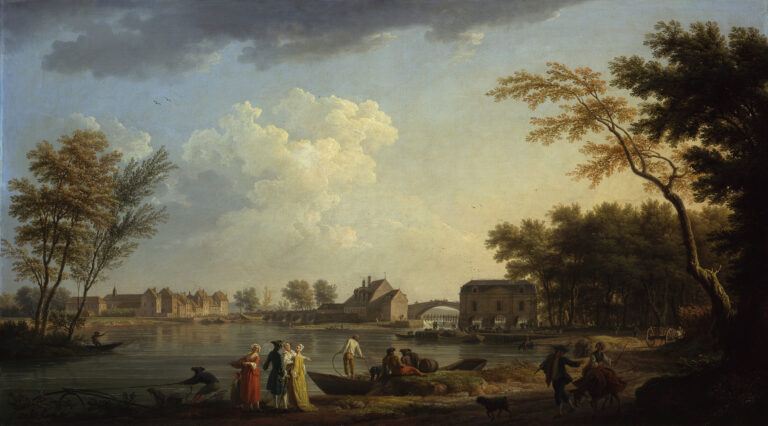
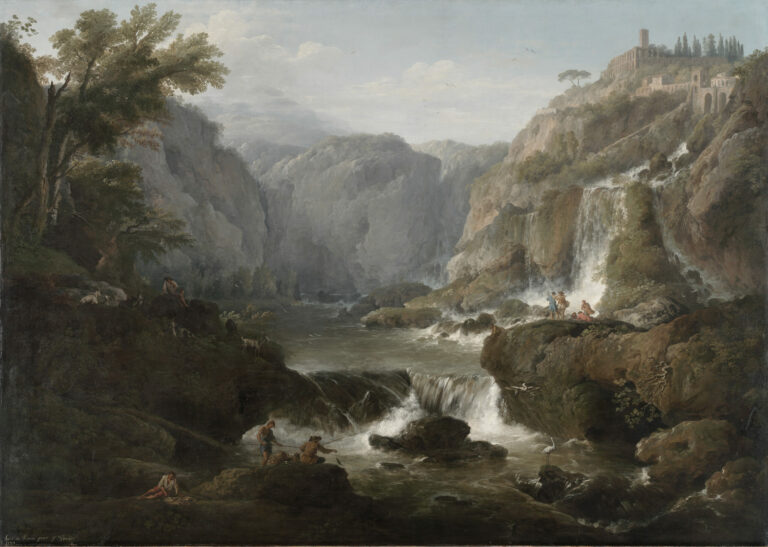
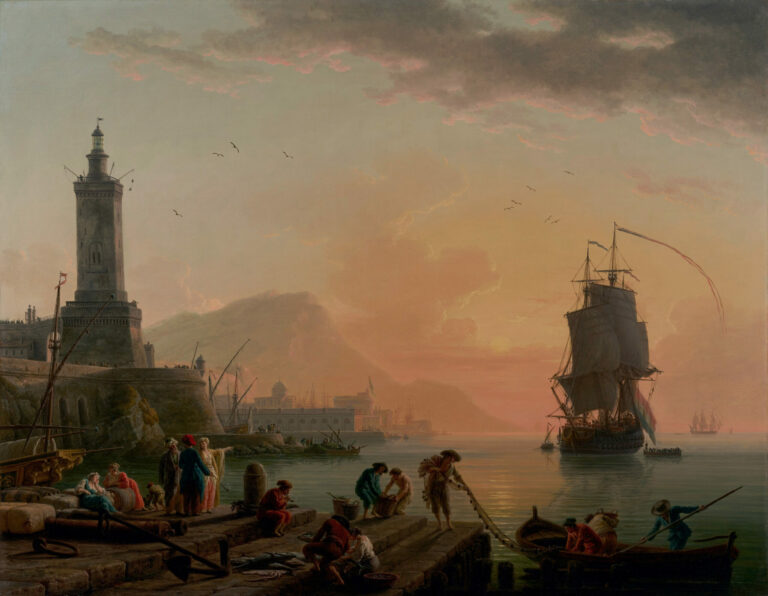
Everything about this painting recalls Claude-Joseph Vernet to me. It is a marine, and the summer season we find ourselves in, which so often draws us toward the sea, no doubt guided my choice today. I am particularly drawn to the warm hues of this setting sun, the calm, almost still sea, upon which a sailing ship glides with all canvas set. I also find here that distinctly human atmosphere so characteristic of Vernet’s canvases. He liked to populate his marines with figures absorbed in their daily activities, rather than settle for a mere landscape: a lively record of maritime life at the time, always rewarding to study in detail. This work also invites comparison with another Vernet canvas, the View of the Seine at Nogent-sur-Seine, which I featured recently on VMuseum.
A pipe smoulders between the fingers of a man in a turban. Smoke rises, faint, into the evening air. Before him stretches the sea, calm and gilded by a sun setting behind a lighthouse. A three-master glides across the water, its sails barely filled. Nearby, a dog dozes on the rocks, indifferent to the ship’s departure.
What lies beneath the surface
Vernet painted this canvas in a small format, barely forty centimetres across, far removed from the monumental commissions of the Ports of France. Layered glazes lend the water its amber transparency, characteristic of his depictions of day’s end. The brushwork remains fine, almost imperceptible beneath the craquelure that runs across the entire surface. In the foreground, three figures in turbans and oriental dress gaze out to sea, costume that appealed to Grand Tour connoisseurs of the period. Below, on the rocks, fishermen unload their catch into woven baskets: a woman bends down, a man sorts the fish, a child looks on. In the distance, a lighthouse marks the entrance to an imagined port, poised between the real Mediterranean and a studio-composed setting. This raking light derives from Claude Lorrain, structuring the whole composition, from the dark outcrop of rock to the descending sun. The shoreline pursues its own bustle beneath the sea’s apparent stillness, a contrast between human activity and the immobility of the sky that remains the painting’s true tension. The varnish, yellowed with age, further heightens the warm tonality of the sunset. The canvas bears an attribution, never a confirmed signature. To this day, no one has settled the question with certainty.
Claude-Joseph Vernet and his time
Claude-Joseph Vernet was born in Avignon in 1714, the son of a decorative painter. Trained under his father and then under the history painter Philippe Sauvan, he left for Rome in 1734. There he studied landscape painting under Claude Lorrain, and also frequented local marine painters Bernardino Fergioni and Adrien Manglard. Admitted to the Académie Royale in 1746, he exhibited at the Salon and became one of the most sought-after marine painters in Europe. Louis XV commissioned from him a series depicting the great ports of France, a project that occupied him for over a decade, between 1753 and 1765. His work left a lasting mark on French marine painting, poised between exact observation and poetic staging.
Current news
Currently closed for extensive rebuilding, the Musée des Beaux-Arts de Reims is not expected to reopen until 2027, following a thirteen-month delay caused by archaeological excavations on site. In the meantime, its collections are travelling: several works are on view in other French and international institutions while the new building is completed. This Marine, attributed to Claude-Joseph Vernet, belongs to a body of work still very much alive in French art history teaching: another marine by the painter, The City and Roadstead of Toulon, remains on the 2026 baccalaureate syllabus for the visual arts specialism.
Source: Musée des Beaux-Arts de Reims
A question for you
Does this raking light owe less to the Mediterranean than to the canvases of Claude Lorrain, seen and retained in Rome twenty years earlier?
About this work
- Marine
- attributed to Claude-Joseph Vernet
- c. 1750
- Reims, Musée des Beaux-Arts (inv. 913.7.2), Photo: Corentin Le Goff
- Oil on canvas
- 40.7 x 48.9 cm
- https://musees-reims.fr/oeuvre/marine-266587848216717605