Key facts
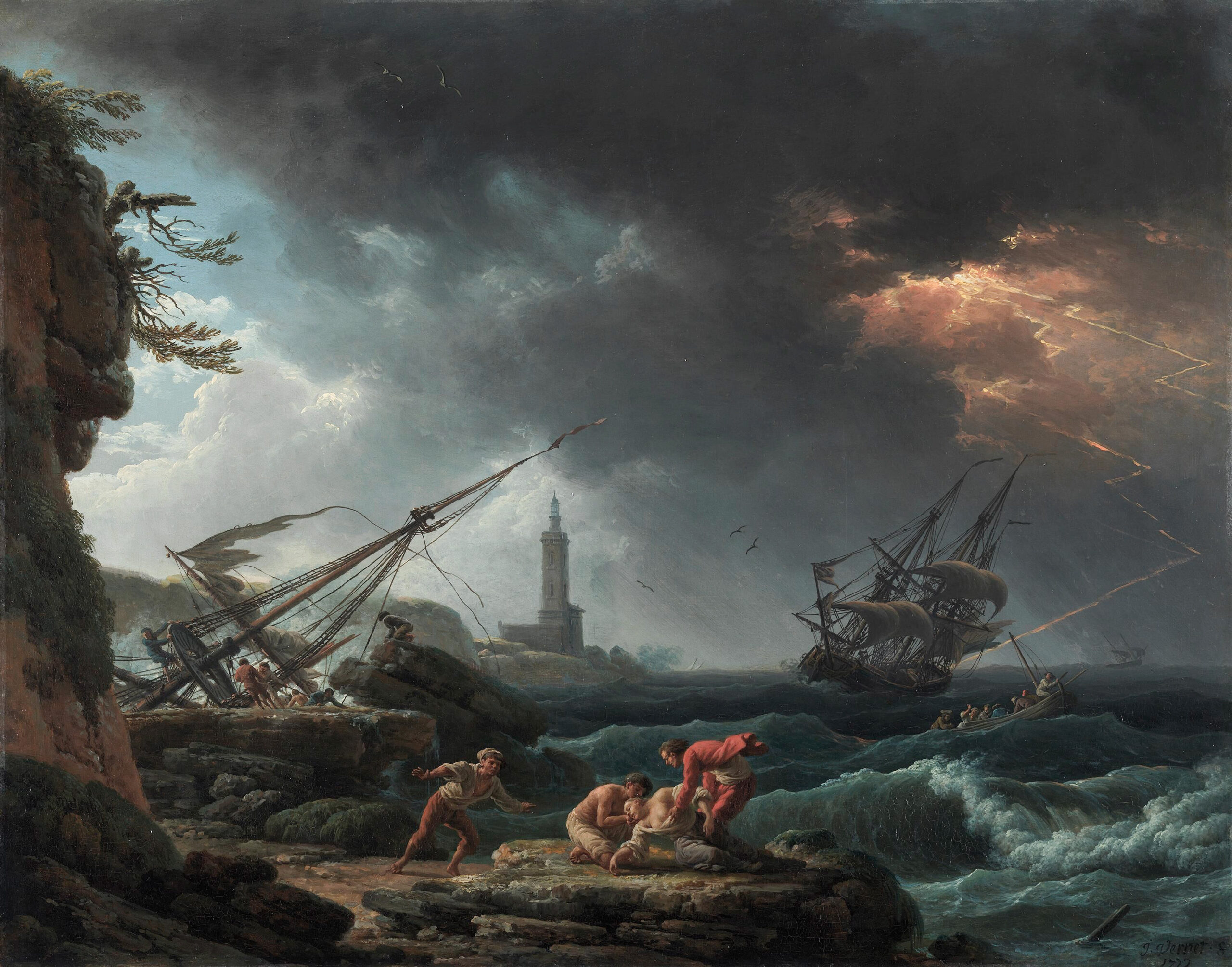
Painted in 1772 by Claude-Joseph Vernet (1714–1789), Storm at Sea: The Dangers of the Sea belongs to eighteenth-century French painting, in the age of the Enlightenment. This oil on metal depicts a shipwreck at the foot of a rocky coast dominated by a lighthouse, under a stormy sky torn by lightning. In the foreground, rescuers come to the aid of a shipwrecked woman. A leading specialist in marine painting, Vernet owed his European reputation to his seaports and his storms. Diderot praised them in his Salon of 1767. The painting entered the Bavarian collections in 1799 from the Zweibrücken gallery and is held at the Alte Pinakothek in Munich.
I never tire of Claude-Joseph Vernet. His seascapes are varied, sometimes calm under a setting sun, sometimes unleashed, but always full of detail and great precision. Today I’d like to share a more dramatic work, one that depicts the dangers of the sea. The scene shows a storm at sea and ships in distress: one has run aground on the rocks, while the other is caught in the swell as lightning seems to strike it.
I love the way Vernet captures the surge of a sea whipped up by the storm. Standing before this painting, I hear the thunder rumble and feel the sea spray. You can sense the crash of the waves breaking on the rocks. The sky, heavy with dark clouds, is torn open by lightning, and this harsh light pulls every detail out of the gloom. It’s easy to see why Diderot, in his Salons, admired Vernet so much: before his storms, the viewer feels that mixture of terror and fascination which the age called the “sublime.”
And as always, Vernet adds figures who humanize the scene and draw us into it. Here, some are rescuing the shipwrecked and hauling them as best they can onto the shore, while others have stayed aboard the ship. Are they there to save the cargo or to loot it? The painter is careful not to say, and the question remains open. That’s another thing I love about him: behind the spectacle of nature, there is always a small human story to guess at.
One last detail that moves me: the painting is on metal rather than canvas. This support gives the paint a smooth surface and a particular sheen, which make the lightning and the foam all the more striking. If you’re ever in Munich, take the time to see it up close. It is currently on display.
Look first: a young woman has just been pulled from the waves. Two men hold her up, one clasping her to him. A third rushes over, arms outstretched, barefoot on the slippery rock. All around them, everything roars. Here, in the foreground, life hangs by a breath.
A Closer Look at Storm at Sea
Come closer. The sky splits into two worlds. On the left, a patch of blue and clouds still white. On the right, an inky mass shot through with an orange glow. Lightning draws a broken thread across it, laid down with a very fine brush. It falls toward the three-master struggling in the swell, its sails in tatters.
Look at the foam. Vernet lays it on in thick, pale strokes over bottle-green waves. You can almost taste the salt on your lips. On the left, the wreck lies on the rocks. Figures cling to the rigging; others clamber over the boulders. The composition follows a diagonal. It runs down from the broken mast to the wave breaking on the right. Your eye slides along with it, without rest. On the cliff, the wind flattens the shrubs. Their twisted branches all stream to the right, in the direction of the storm. Seabirds battle against the gusts.
Much of this vividness comes from the support. The painting is executed in oil on metal. Unlike canvas, a metal plate has no weave and no grain. The paint stays on the surface instead of being absorbed. The glazes, those thin transparent layers, keep their depth. Light passes through the colour and bounces back off the smooth ground. Hence the enamel-like brilliance of the sky and the water. This support also allows a miniaturist’s precision. Count the ropes, the shrouds, the oarsmen in the longboat.
And yet, at the centre, a lighthouse rises. Tall, upright, intact. It should guide sailors to safety. It watches the shipwreck without preventing anything.
Claude-Joseph Vernet, Painter of Ports and Storms
Claude-Joseph Vernet was born in Avignon in 1714. At around twenty, he left for Rome. He stayed in Italy for nearly twenty years, studying Mediterranean light. Back in France, Louis XV commissioned him to paint the Ports of France. The sea became his signature. Moonlit nights, bustling harbours, shipwrecks: he varied the hours and the moods. His reputation spread across Europe. Commissions came from England, Germany, Poland and Sweden.
In 1767, Diderot devoted a long passage of his Salon to him, known as the “Promenade Vernet.” In it, he describes the paintings as landscapes explored on foot. Vernet’s storms are often linked to the aesthetics of the sublime, so dear to the Enlightenment. The viewer savours a danger from which he knows himself to be safe.
Our storm dates from 1772. It entered the Bavarian collections in 1799, from the Zweibrücken gallery. Its frame is probably a Zweibrücken gallery frame, attributed to Étienne-Louis Infroit in Paris. The painting hangs in the Alte Pinakothek in Munich, on the ground floor, in Room XI.
News: French Painting in the Spotlight in Munich
The Alte Pinakothek, which in 2026 celebrated the 200th anniversary of the laying of its foundation stone, is holding its very first major exhibition devoted to its French collections, from 26 November 2026 to 4 April 2027: “Liaisons françaises: French Art in Bavaria from Claude Lorrain to François Boucher.” It is a chance to rediscover the Wittelsbachs’ taste for French painting, which Vernet’s Storm at Sea also reflects. In France, the painter was in the spotlight this summer at the Musée national de la Marine (National Maritime Museum) in the exhibition “The Navy and the Painters: Four Centuries of Art and Power,” held to mark the French Navy’s 400th anniversary.
Source: Alte Pinakothek.
A Question for You
In the eighteenth century, the “sublime” meant the pleasure of contemplating a danger from a place of safety. Standing before this shipwreck, do you feel more terror or fascination?
About this work
- Storm at Sea: The Dangers of the Sea
- Claude-Joseph Vernet
- 1772
- Oil on metal
- 51.2 x 65 cm
- Alte Pinakothek, Munich (inv. 961)
- https://www.sammlung.pinakothek.de/de/artwork/gR4k3Xg4Ee/claude-joseph-vernet/seesturm-die-gefahren-des-meeres