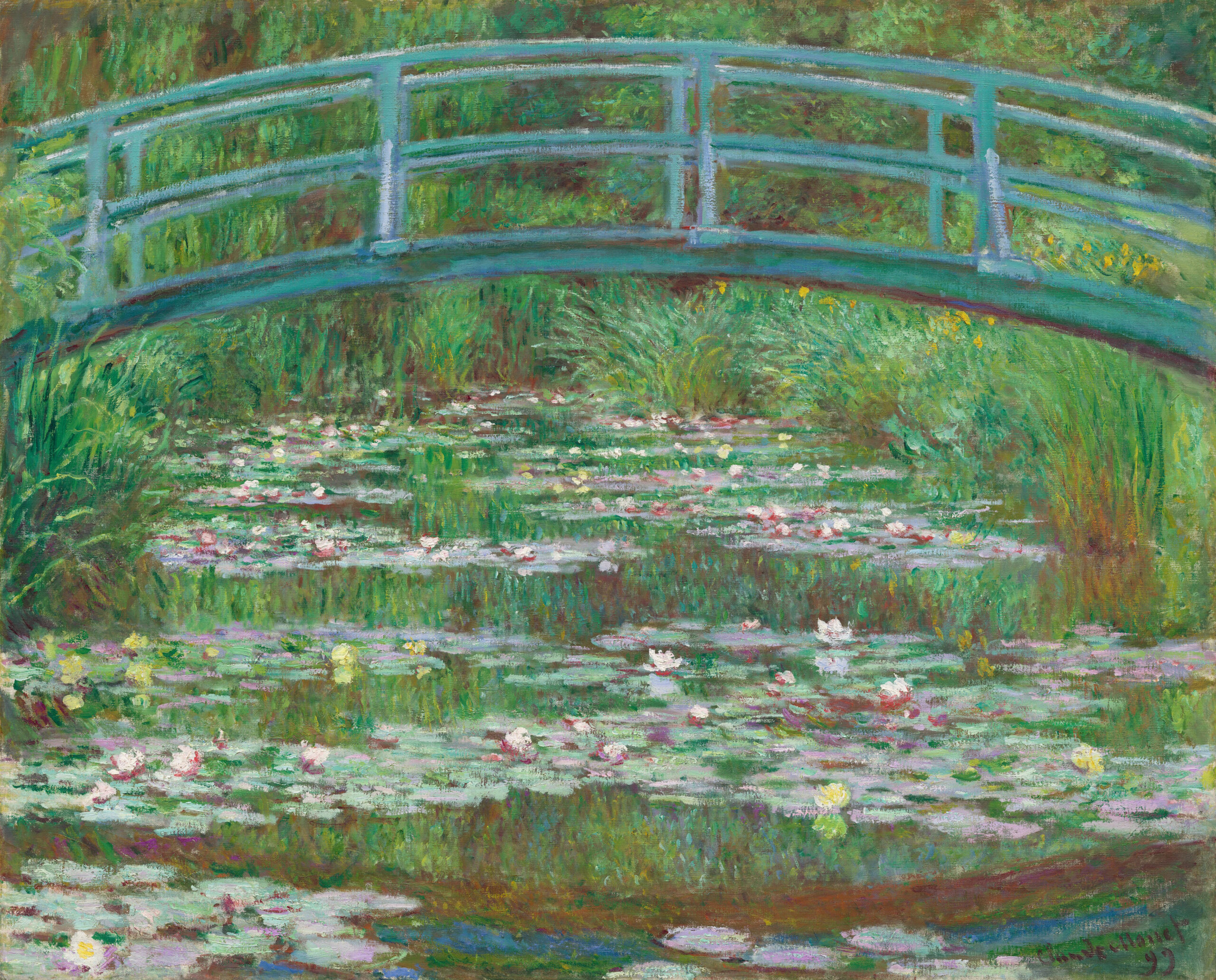
Giverny, 1899. Claude Monet takes up his position at the edge of his pond. Brush in hand, he contemplates the garden he himself has shaped. He paints not what nature offers him, but what he willed it to be.
A microcosm of light and color
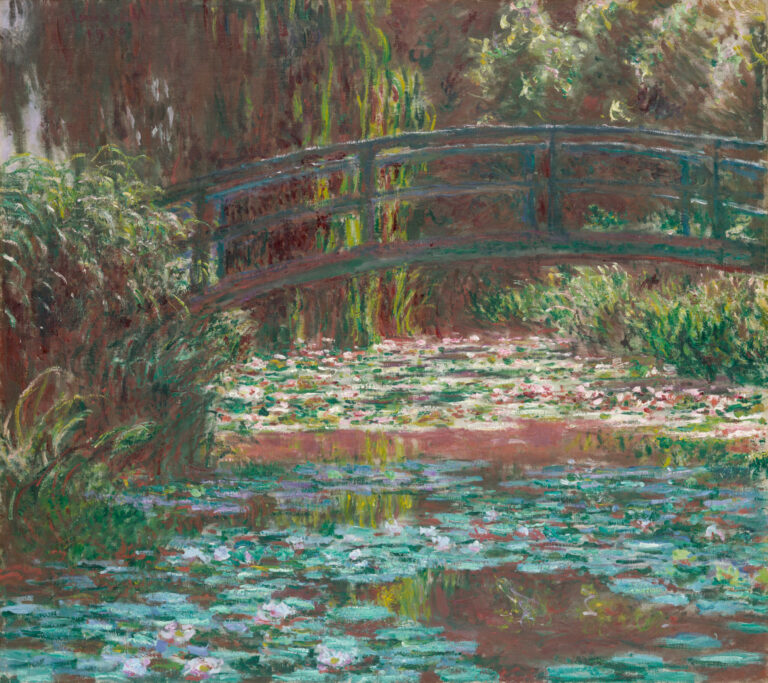
Look at that blue-green arch cutting across the top of the canvas. Below it, the water disappears beneath the water lilies. Short, vibrant, layered brushstrokes. Green dominates — deep and dense. Flashes of white and pink pierce the surface. No opening toward the horizon. Monet works in the divided touch characteristic of Impressionism. Each brushstroke catches a tremor of light. The whole thing vibrates, breathes.
A garden conceived as a work of art
In 1893, Monet acquired a marshy plot of land adjoining his property at Giverny. He diverted a stream, dug a pond, planted water lilies. He had this footbridge built, inspired by Japanese woodblock prints. In 1899, he painted the series from a single fixed viewpoint: twelve canvases, one sole obsession. Exhibited at the Galerie Durand-Ruel in 1900, the paintings made a strong impression on critics. Gustave Geffroy described “a calm pond, motionless, rigid and deep as a mirror.” The hermetic enclosure of vegetation evokes the medieval hortus conclusus as much as the Symbolist reverie dear to Mallarmé.
Claude Monet
Claude Monet (1840–1926) co-founded the Impressionist movement alongside Renoir and Pissarro. A devoted chronicler of fleeting light and immediate sensation, he devoted his final decades to Giverny. His garden became his open-air studio and the laboratory of an increasingly meditative painting practice.
A question for you
💭 Before Warhol, before Conceptual Art, Monet tirelessly repeated the same motif. Is the series already a more important idea than the individual painting itself?
About this work
- The Japanese Footbridge
- Claude Monet
- 1899
- Oil on canvas
- 81.3 × 101.6 cm
- National Gallery of Art, Washington
- https://www.nga.gov/artworks/74796-japanese-footbridge