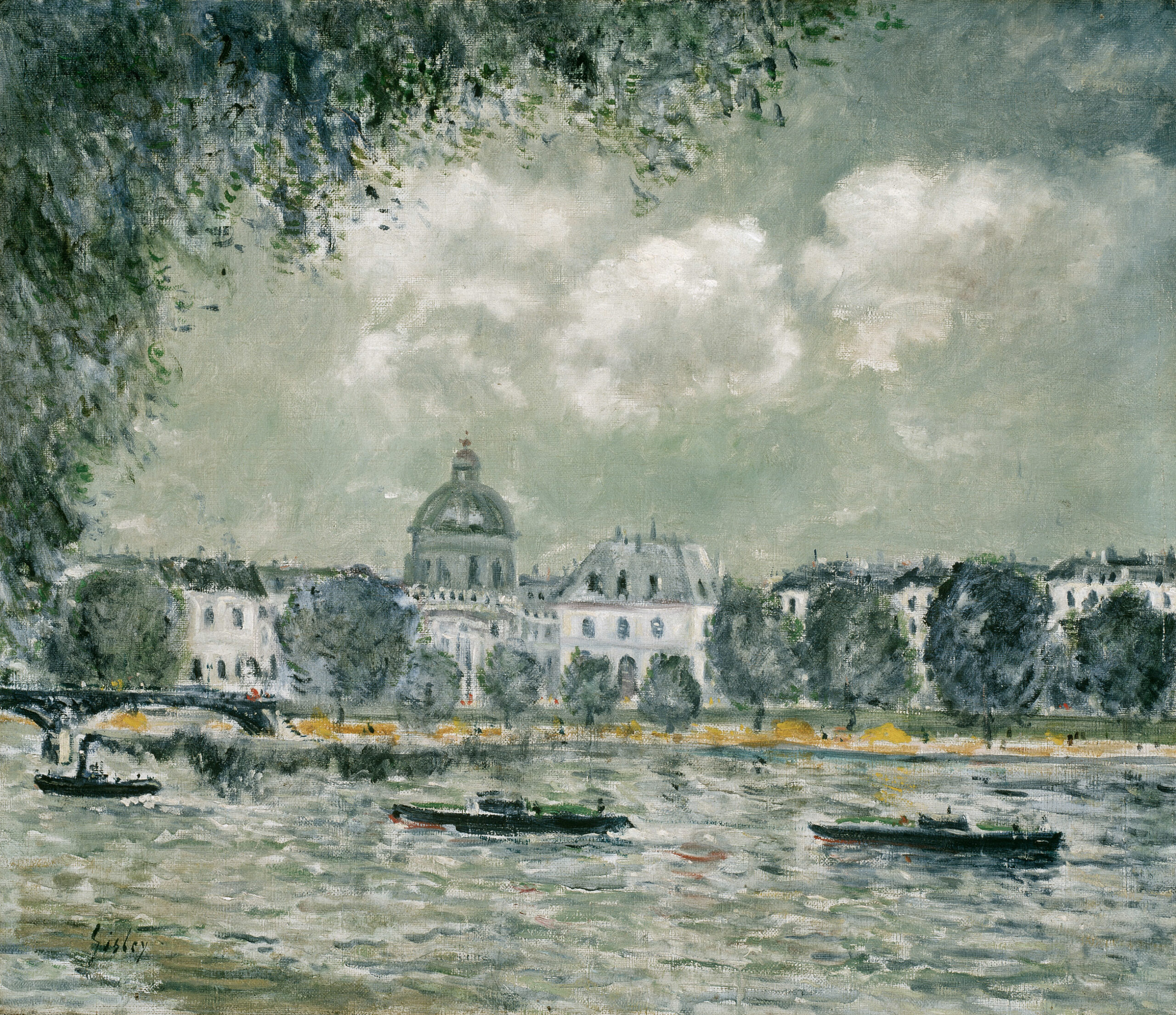
Alfred Sisley takes up his position on the right bank of the Seine in Paris. Before him, the majestic dome of the Institut de France emerges from the haze. The Pont des Arts cuts across the horizon. He picks up his brush.
A pearlescent light on the water
Look at this sky: dense, shifting, almost alive. Sisley works in rapid, nervous brushstrokes. The greys take on tints of green, off-white, steel blue. The Seine shimmers, restless. Barges glide slowly past. On the banks, warm ochre patches cut against the cool palette. The trees, sketched in deep green, frame the scene like stage wings. The fragmented Impressionist touch gives the painting a constant vibration. You can almost feel the wind on the river.
Paris immortalised by Impressionism
In 1875, the Impressionist movement is still searching for legitimacy. The group’s first exhibition is barely a year old. Sisley chooses Paris as his subject, a bold move. The Haussmann capital is transforming at speed. To paint the Seine and its monuments is to fix a Paris in the midst of change. The Institut de France, symbol of academic learning, presides in the background of a resolutely modern painting. A subtle tension, almost ironic, runs through the work.
Alfred Sisley
Born in Paris to British parents, Sisley (1839–1899) spent his entire life in the shadow of Monet and Renoir. Yet his Impressionist work possesses a rare coherence. He excels in skies and water. This Parisian landscape perfectly illustrates his ability to capture the atmospheric instant.
A question for you
💭 The Institut de France, temple of academicism, presides in the background of an Impressionist painting, a movement it roundly rejected. Was Sisley amused by the irony, or was he still seeking its recognition?
About this work
- Landscape along the Seine with the Institut de France and the Pont des Arts in Paris
- Alfred Sisley
- c. 1875
- Oil on canvas
- 53.3 × 62.2 cm
- The Art Institute of Chicago
- https://www.artic.edu/artworks/58984/landscape-along-the-seine-with-the-institut-de-france-and-the-pont-des-arts
A Briton at the Heart of French Impressionism
Landscape along the Seine with the Institut de France and the Pont des Arts in Paris was painted during one of the most intense periods of Alfred Sisley’s artistic life, and one of the most paradoxical in his biography. Born in Paris to English parents and trained in the atelier of Marc-Charles-Gabriel Gleyre from 1862, where he met Monet, Renoir, and Bazille, Sisley was the only major Impressionist to remain a British national throughout his life: he would submit two applications for French citizenship in 1898, both rejected, and die of cancer in January 1899 without ever having obtained the nationality of the country where he had lived and painted for forty years. This fate of remaining a foreigner in the nation he loved gives a particular tone to his Parisian landscapes: an attentiveness to topographical detail that perhaps expresses a belonging sought, claimed through the gaze if not through papers.
The Institut and the Pont des Arts: Tradition against Modernity
The composition Sisley chose is not neutral. The dome of the Institut de France, seat of the five great academies, including the Académie des beaux-arts that had long kept the Impressionists outside its walls, emerges through the atmospheric haze in the background, while the Pont des Arts cuts across the horizon. Treating such a monument in the Impressionist idiom, with fragmented touches and grey-green tones that dissolve contours, creates a tension that contemporaries could read as a quiet provocation: the institution that guaranteed academic tradition, painted in a language that same tradition repudiated. The Seine animated by barges, the ochre-toned riverbanks, and the light flickering on the water make the painting an atmospheric poem as much as an urban view.