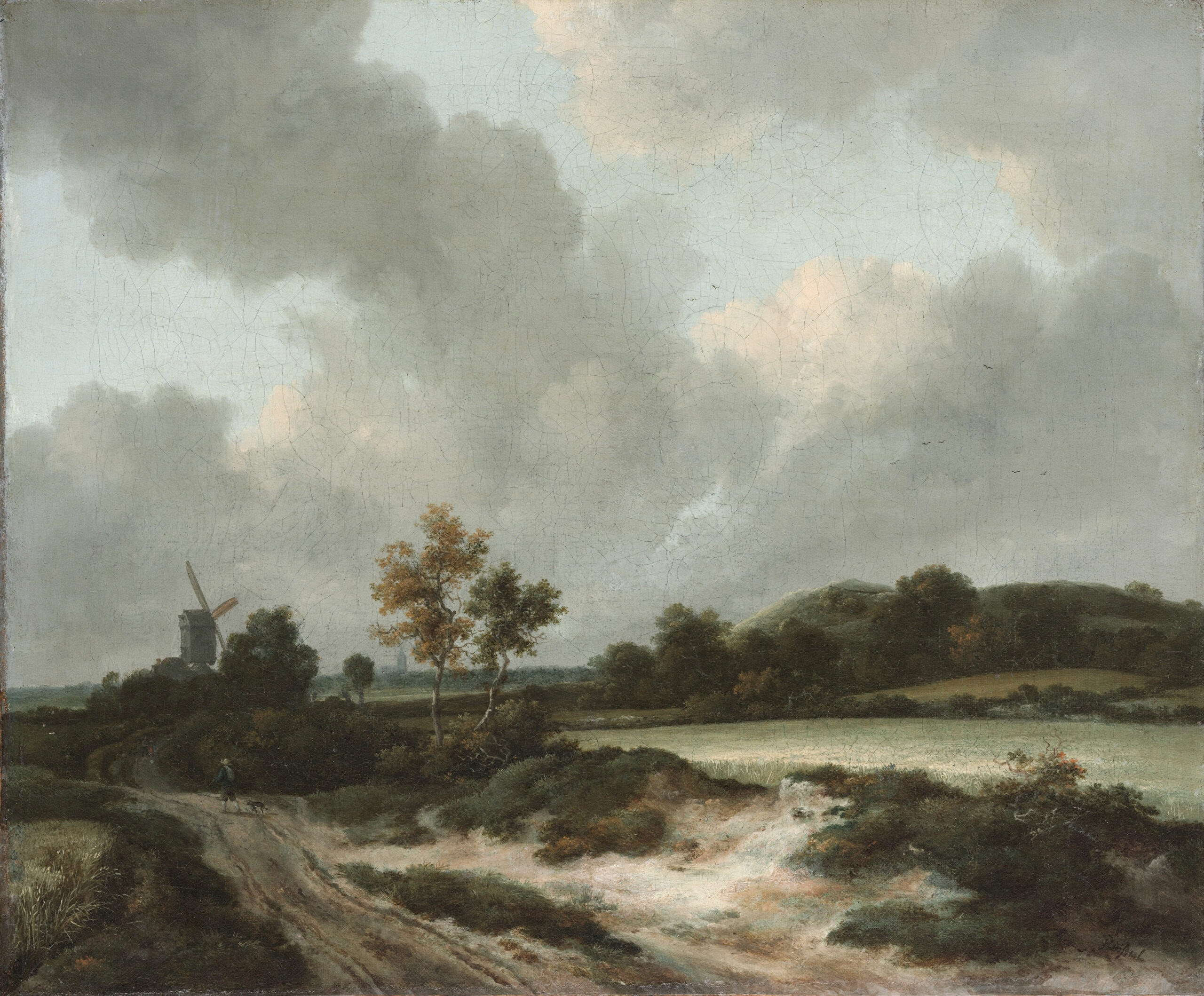
I must confess a long-standing fascination with Ruisdael’s landscapes. His skies move me in an almost intimate way, they call to mind the skies of my childhood in northern France, those vast grey and luminous expanses that press gently down on the horizon. This is perhaps no coincidence: Ruisdael painted the Netherlands, a flat country where the sky holds two thirds of the view and structures every composition.
What strikes me most here is the symbolic coherence of the whole. Ruisdael does not paint a landscape by chance: he stages a complete cycle, the one that feeds mankind. The grain field calls for rain, the sky delivers it, and the mill visible to the left will grind the wheat into flour. From sowing to bread, everything is contained within a single image, a reading that any seventeenth-century viewer would have made instinctively, in an age when Providence made itself known through the seasons. This painting, modest in scale, carries a quiet ambition I deeply admire.
The first thing you notice is the light breaking through. A cloud shifts, slightly, to the right. A pale streak of sky cuts across the prevailing grey. Look: it is the only warm passage in the entire canvas. Everything else is held back, almost muted. The sandy path in the foreground draws the eye toward the distance, toward a mill barely discernible, toward a church the depth of field nearly erases. Jacob van Ruisdael places a man and his dog on the road. Two tiny figures. They make you feel the scale of the space.
Beneath the surface
The oil on canvas is handled with uncommon mastery for such a contained format, just 47 x 57.2 cm. Van Ruisdael builds the grain fields through successive glazes, achieving a dense, luminous quality on the right. The sky, by contrast, is constructed in broad, blended strokes. The craquelure visible today was not there. The canvas breathed differently. This landscape from the mid-to-late 1660s belongs to a series: Ruisdael painted grain fields the way others painted portraits. With persistence. With intent. The Metropolitan Museum of Art records that the painting was owned by the English painter Sir Joshua Reynolds from 1756 until his death in 1792. A painter collecting a painter. That is not incidental.
Ruisdael and the Dutch landscape
Jacob van Ruisdael was born in Haarlem around 1628, the son and nephew of painters. Landscape painting was then a rapidly expanding genre in the Dutch Republic, still new, freed from the academic hierarchies of Italian tradition. Ruisdael became its undisputed master. He settled in Amsterdam around 1657. His only known pupil was Meindert Hobbema. His influence would reach Constable, Turner, and later Van Gogh.
Now at the Met
The Metropolitan Museum of Art, permanent home to Ruisdael’s Grainfields, is presenting an exceptional season. Through June 28, 2026, the museum hosts Raphael: Sublime Poetry, the first major American retrospective of the Renaissance master, bringing together more than 200 works. A compelling reason to walk through the Met’s doors, and to find Ruisdael again, in the European paintings galleries.
Source: metmuseum.org
A question for you
Somewhere in your earliest memories, there is a landscape that keeps returning. Which one is it?
About this work
- Grainfields
- Jacob van Ruisdael
- mid-to-late 1660s
- Oil on canvas
- 47 x 57.2 cm
- The Metropolitan Museum of Art, New York
- https://www.metmuseum.org/art/collection/search/437547