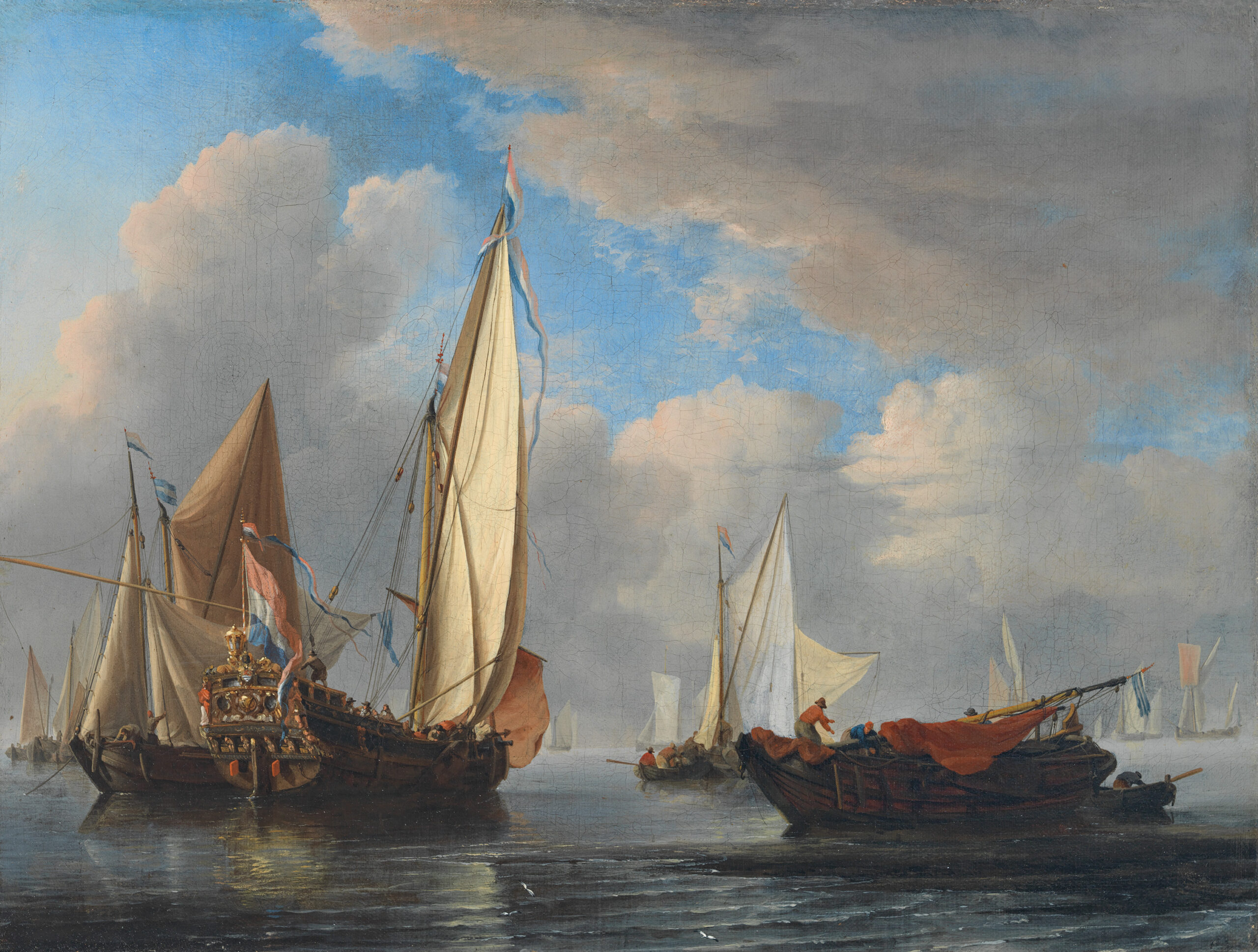
A breath of maritime freshness with this oil on canvas, which draws me in first through its value as historical testimony. We are in 1671, at the height of the Dutch Golden Age of seafaring, and Van de Velde II places us at the heart of a busy anchorage, somewhere between estuary and open water. The yacht in the foreground, most likely a vessel of distinction, perhaps of official function, sits alongside more modest craft whose furled sails signal a fleet at rest. Sailors go about their work on board, tiny figures that give the composition its scale and its life.
What holds my attention above all is the mastery of raking light across still water. Van de Velde II excels at capturing these suspended moments between manoeuvres, where the sea becomes a mirror and the sky, rendered in pearlescent greys, casts a light that is unmistakably northern. It is precisely this calm that makes the work so historically valuable. One can read the rigging, the ensigns, the profiles of the hulls with near-documentary precision, the work of a painter who knew how to look at ships the way a sailor does.
I am as drawn to this quietude as I am to the tension in the same artist’s storm scenes. Yet it is in these glassy waters that Van de Velde best reveals his command of detail and his eye as a close observer of a maritime power at its zenith.
What you notice first is light. Not a vessel. A milky clarity descending from a pearlescent sky, settling on the water like an open hand. Beneath it, brown hulls, white sails barely filled, and the palpable silence of a flat calm holding its breath.
Beneath the surface
Look at the large vessel to the left. Its gilded stern carries a coat of arms. Its mast flies the Dutch tricolour and the seal of the VOC, the Dutch East India Company. This is a yacht. Not a pleasure craft: an instrument of war and commerce. These nimble vessels navigated the rivers of Southeast Asia. They were used for raids, for forced negotiations, for the seizure of persons. Willem van de Velde II paints their beauty with a cartographer’s precision. Rigging, ensigns, reflections on the water: everything reads as documentary record. Yet the violence these hulls carried remains invisible. That is the defining tension of this canvas: a surface serenity masking a fleet built for empire.
The artist and his time
Willem van de Velde II was born in Leiden in 1633. The son of a marine draughtsman embedded with combat fleets, he inherited a sailor’s eye. He worked in the family studio in Amsterdam before settling in England in 1672. Charles II took him into royal service, and he became the official painter of the Crown’s maritime events. His oil technique, at once precise and atmospheric, established him as the undisputed master of the genre.
In the news: LACMA
This seascape is held at LACMA, which inaugurated its new David Geffen Galleries on 19 April 2026, designed by architect Peter Zumthor. The inaugural hang is organised around the world’s great oceans, a framework that resonates deeply with Van de Velde II and a sea that was, above all, a highway.
Source: unframed.lacma.org
A question for you
💭 Turner acknowledged his debt to Van de Velde II in forming his own vision of the sea. What might he have taken from this water, so perfectly still?
About this work
- A Yacht and Other Vessels in a Calm
- Willem van de Velde II
- 1671
- Oil on canvas
- 33.34 × 43.5 cm
- Los Angeles County Museum of Art (LACMA)
- https://collections.lacma.org/object/133047