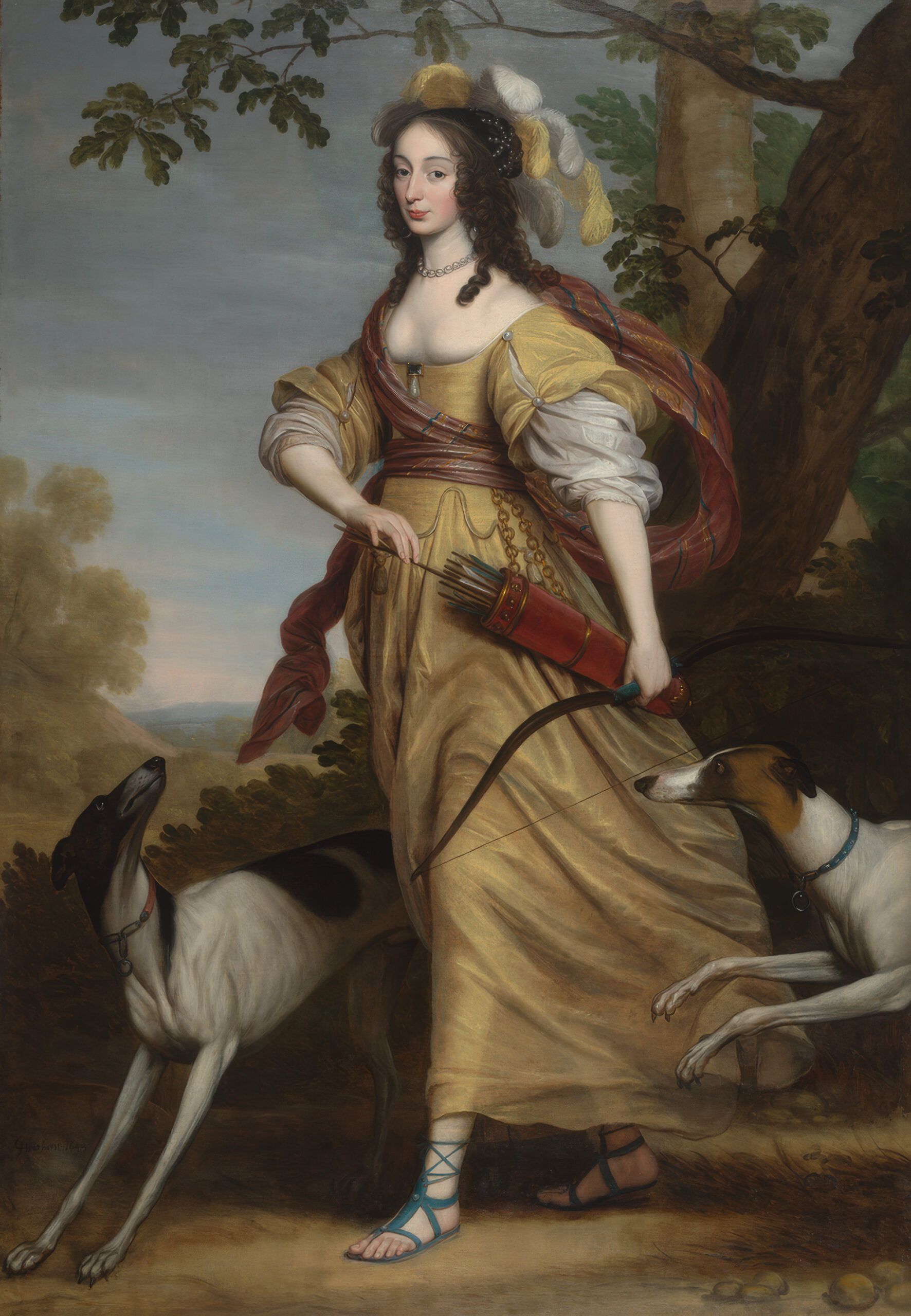
What strikes me in this portrait is the subtle balance Van Honthorst manages to hold between two contradictory demands: flattering the princess and making the goddess convincing. The bow, the arrows, the hunting dogs, all of Diana’s attributes are present, arranged as iconographic codes that a seventeenth-century viewer would have read instantly.
Much of that symbolic literacy has since been lost, and perhaps that is what makes the work more accessible today: one sees first a fine aristocratic portrait, luminous and serene, before looking for the huntress.
That is precisely where its interest lies. Louise Hollandine remains a princess. Her posture, her gaze, the quality of her complexion speak more of palatine bearing than of divine fury. Van Honthorst is not trying to persuade. He is trying to magnify.
This tradition of the portrait historié, in which a real sitter is depicted in the guise of a mythological or allegorical figure, has carried remarkable vitality across the centuries. From court painting to the pictorialist photographic studies of the nineteenth century, to the editorial shoots of today in which celebrities slip into antique roles, the gesture remains the same: borrow from myth to elevate the sitter. Van Honthorst is among its most elegant practitioners.
Look first at the right hand. It holds the bow with an almost distracted ease. Not the grip of a huntress. That of a princess who is posing.
Beneath the surface
Gerrit van Honthorst painted this portrait in 1643. His sitter, Louise Hollandine of the Palatinate, was his own pupil. She had received lessons in his The Hague studio, where the Nassau court in exile had settled. Daughter of King Frederick V and Elizabeth Stuart, she lived far from any throne. Honthorst depicts her as Diana, the Roman goddess of the hunt. The bow, the arrows, the two greyhounds, the golden dress, the crimson quiver: each element is a sign. The seventeenth-century viewer read these attributes like an alphabet. Diana stands for virginity and chastity. This is a message as much as a portrait. Yet look again. The complexion is soft. The gaze, calm. The canvas stands over two metres tall. The painter magnifies. He does not narrate.
The artist and his time
Gerrit van Honthorst was born in Utrecht in 1592. He left early for Italy and absorbed the chiaroscuro of Caravaggio. Rome gave him a nickname: Gherardo delle Notti, master of nocturnal scenes. Back in the Dutch Republic, he became hofschilder, court painter to the royal households of Europe. His contemporary Rembrandt followed his own path. Honthorst listened to his patrons. That was his strength, and perhaps also his limit.
Now in Utrecht: Honthorst and Rembrandt
In 2026, the Centraal Museum in Utrecht presents the first major retrospective devoted to Gerrit van Honthorst, on view until 13 September. The exhibition Gerard van Honthorst — In alles anders dan Rembrandt brings together more than sixty paintings from the Louvre, the Royal Collection and the Galleria Borghese. The Portrait of Louise Hollandine as Diana belongs to the museum’s permanent collection.
Source: centraalmuseum.nl
A question for you
💭 If you were to commission your own portrait historié today, which mythological figure would you choose and what would you want it to say about you?
About this work
- Portrait of Princess Louise Hollandine of the Palatinate (1622-1709) as Diana
- Gerrit van Honthorst
- 1643
- Oil on canvas
- 207.7 x 144.5 cm
- Centraal Museum, Utrecht
- https://collectie.centraalmuseum.nl/details/collection/1021