A wealthy man paid to be painted as a glorious soldier. Rembrandt (1606–1669) took the commission and painted the man beneath the costume. He is forty-eight in 1654: his glory behind him, his ruin ahead. Two years later he will indeed be declared insolvent, forced to sell his house and his own collection. This is no longer the painter who flatters.
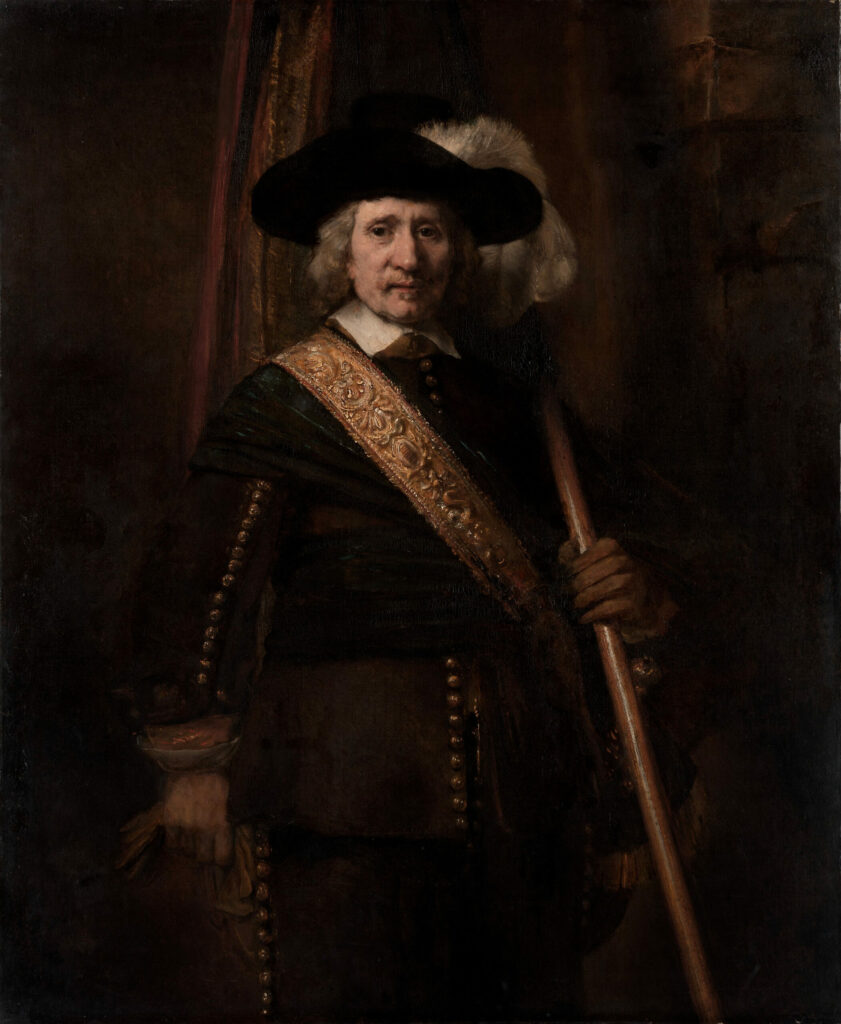
The man posing was probably never a soldier: he is Floris Soop, a wealthy bachelor, a collector of a hundred and forty paintings, who likely never carried a standard anywhere but here, this one day. He wants to be fixed for good in the ceremonial dress of a civic-guard ensign, the great flag, the plume in the hat, the tooled leather baldric across his chest. It is a costume of prestige, a role one buys for oneself. We are no longer even entirely sure it is him: the identification is now disputed, which makes the man more elusive still. And Rembrandt, at this point in his life, no longer paints surfaces. He paints what lies beneath.
So look at the gap. The costume is sumptuous, rendered with dazzling virtuosity: hair you feel you could touch, the worked leather, the fabric catching the light. But the face doesn’t “play” the soldier: it is heavy, tired, human, somewhere else. The light doesn’t glorify it, it scrutinizes it. And that is where the canvas reaches us: you feel the distance between the image a man wants to give of himself and the truth a painter, if he is great, cannot help but see. We recognize the need to be seen as other than we are and the clear-eyed gaze, a little cruel, a little tender, of the one who sees through it.
Twenty-four years earlier, in Leiden, this same Rembrandt was painting himself, a young man studying his own face on a copper plate barely larger than a postcard. All his life he will have asked the same question: who decides the face we show? Here, paid to manufacture someone else’s, he could not lie.
Think about it
💭 Between the image this man wanted to project and the one Rembrandt chose to reveal, which one are we truly contemplating?
About This Artwork
- The Standard-Bearer (probably Floris Soop, 1604–1657)
- Rembrandt van Rijn, 1654
- Oil on canvas
- 140.3 × 114.9 cm (55 1/4 × 45 1/4 in.)
- The Metropolitan Museum of Art, New York
- https://www.metmuseum.org/art/collection/search/437395