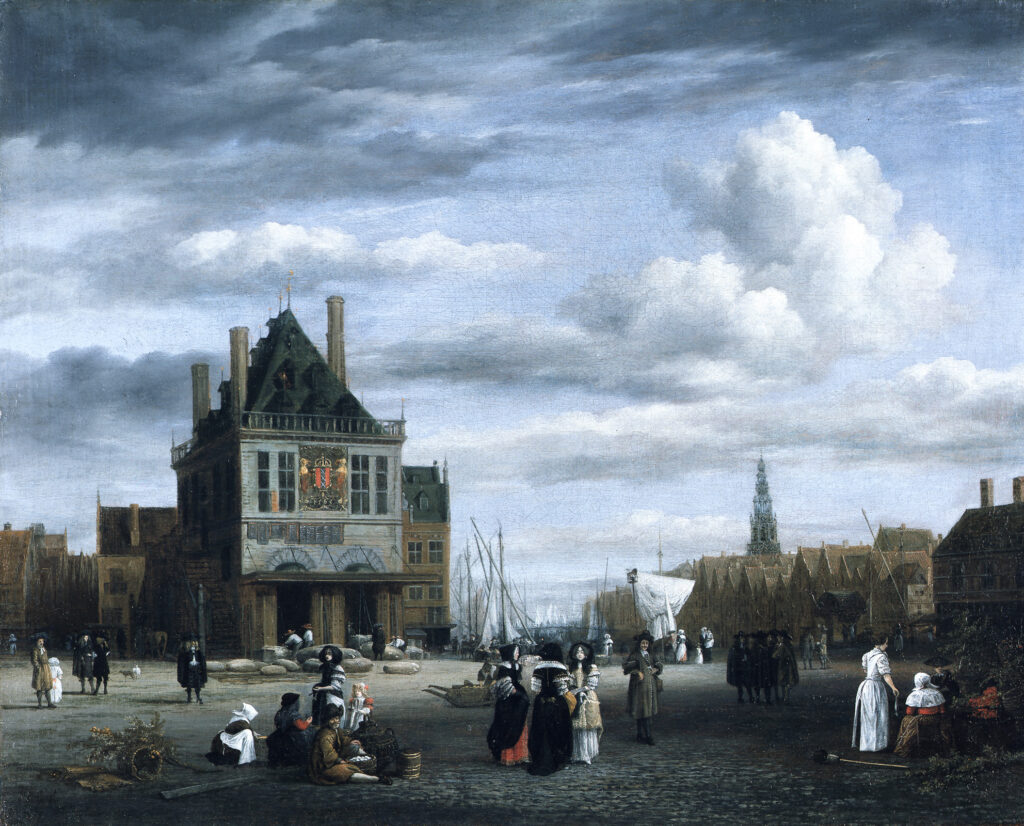
Amsterdam, circa 1675. Jacob van Ruisdael paints the Dam Square bustling with activity. Merchants negotiate, elegant ladies converse, commercial life thrives in the nerve center of the merchant city.
A Masterfully Orchestrated Urban Scene
Look at the Weigh House that dominates the composition. Its massive structure stands out in cold grey-blue. Amsterdam’s coat of arms gleams on its façade. Bales of merchandise await weighing on the great scale. To the right, the Damrak opens up: sailboats, gabled warehouses, crowded houses. The bell tower of the Oude Kerk rises toward a sky laden with luminous clouds. Ruisdael works with a precision that does not exclude freedom. The proportions are modified, the play of shadows reversed from his preparatory drawings.
A Poetic Portrait of the Golden Age
This urban view is not a simple topographical representation. Ruisdael elevates the scene to the rank of a poetic work of the spirit. He captures the atmosphere of Amsterdam at its commercial zenith, when the city dominated world trade. The figures, probably painted by a specialized collaborator, magnificently animate the architectural space. Every detail evokes 17th-century Dutch prosperity.
Jacob van Ruisdael
Jacob Isaacksz. van Ruisdael (1628-1682) left Haarlem for Amsterdam in 1657. He settled near the Dam, then on the square itself in 1670. A master landscape painter, he came to urban views late, applying to them the same atmospheric approach as to his famous natural landscapes.
Think about it
💭 How does this painting illustrate Ruisdael’s transition from naturalistic landscape to urban view orchestrated as a dramatic composition?
About This Work
- The Dam Square in Amsterdam
- Jacob Isaacksz. van Ruisdael
- circa 1675
- Oil on canvas
- 54.2 × 66.3 cm
- Gemäldegalerie, Staatliche Museen zu Berlin
- https://recherche.smb.museum/detail/868906/der-damplatz-zu-amsterdam
A Landscape Painter Confronts the City: Ruisdael’s Late Conversion
The Dam Square in Amsterdam belongs to the late phase of Jacob van Ruisdael’s career (1628/1629-1682), one of the uncontested masters of 17th-century Dutch landscape painting. Ruisdael, who trained first in Haarlem, entering the Guild of Saint Luke around 1648, devoted the greater part of his career to Dutch countryside scenes, forests and windmills, wind-swept coasts. Only after settling in Amsterdam around 1657, and especially in the final years he spent close to the Dam, did he develop an interest in urban views. This late evolution is not a concession to market taste but rather the application to the city of an atmospheric sensibility acquired in the countryside: the sky, which frequently occupies two-thirds of his compositions, continues to dictate the scene’s mood.
The Public Weighhouse and Amsterdam’s Prosperity
The composition is structured around Amsterdam’s Weigh House (Waag), the building where goods were officially weighed before entering the city’s commercial circuits. Its cold grey-blue architecture anchors the scene in the topographical reality of the Dam, while to the right the Damrak opens with its moored sailboats, gabled warehouses, and the crowd of traders. Ruisdael does not simply record the city: he captures its economic and human atmosphere at the zenith of Amsterdam’s commercial power. As in his countryside landscapes, he freely modifies proportions and shadow effects relative to preparatory sketches, demonstrating that topographical accuracy is never his primary aim.
Collaboration with Figure Painters
One technical detail deserves attention: the figures animating the square and the quays are most likely not by Ruisdael’s own hand. It was common practice in 17th-century Dutch painting for landscape painters to entrust figures to specialists, and Ruisdael regularly collaborated with painters such as Adriaen van de Velde, Nicolaes Berchem, and Philips Wouwerman. This workshop collaboration in no way diminishes the painting: it reflects instead a rationalized professional organisation and a division of labour that allowed each artist to operate within his domain of excellence.