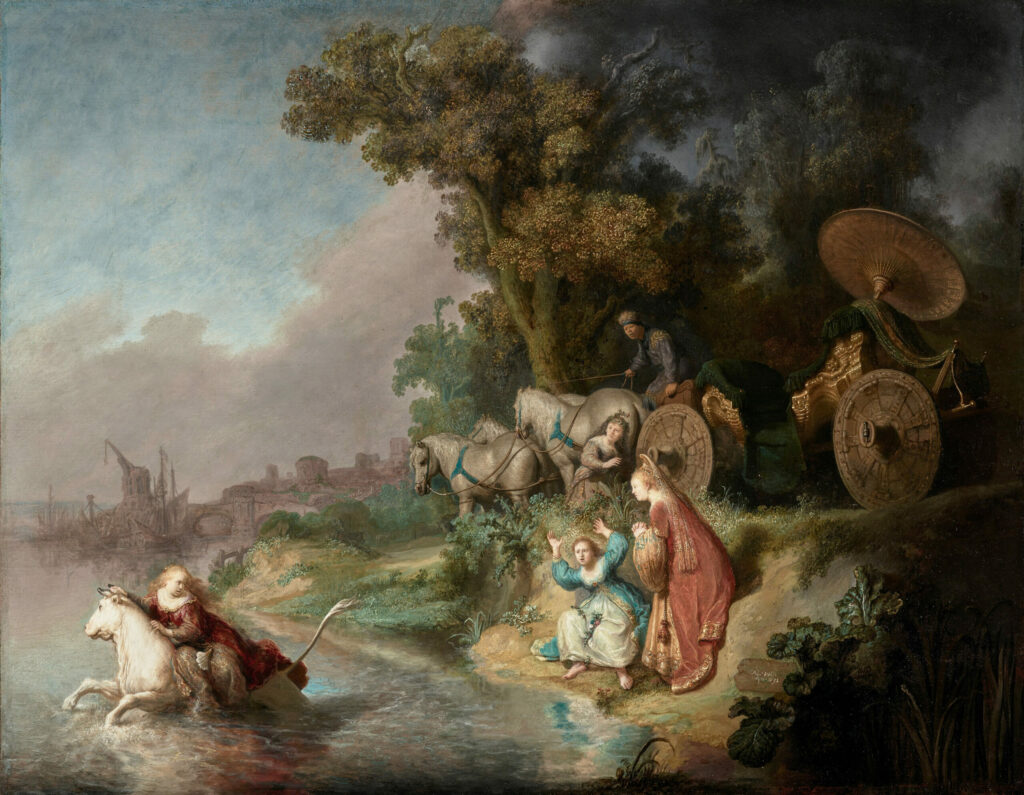
Amsterdam, 1632. Rembrandt van Rijn captures the moment when a mythological abduction tips into drama. Europa, princess of Tyre, clings desperately to the horn of the white bull carrying her toward the sea. This is no ordinary animal: it is Jupiter in disguise.
An Orchestrated Scene of Panic
Europa digs her fingers into the bull’s neck, her body twisting toward her companions left on the shore. A young woman collapses, arms raised in terror. Her friend, petrified, watches helplessly at the abduction. Higher up, the coachman stands, horrified. Rembrandt excels in contrasts: the cluster of dark trees on the right opposes the pink and blue nuances of the sea. Sunlight pierces the clouds, reflecting on the water, while a threatening sky darkens the background. The painting allows the Dutch master to work textures with precision: sumptuous costumes, golden reflections of the carriage, luminous coat of the bull.
Between Ancient Mythology and Dutch Reality
This work illustrates Ovid’s Metamorphoses, a foundational narrative of European culture. Rembrandt, unaccustomed to mythological subjects, transposes Antiquity here into his own universe. The misty city on the horizon evokes Tyre as much as his own Amsterdam. In the Dutch Golden Age, treating mythology allowed artists to demonstrate their erudition while exploring the human condition.
Rembrandt van Rijn
Rembrandt (1606-1669) dominates Dutch Baroque painting. Master of chiaroscuro and emotion, he excels in dramatic visual effects. This 1632 canvas, preserved at the J. Paul Getty Museum, illustrates his talent for transforming an ancient tale into a living and moving scene.
Think about it
💭 Faced with this disguised divine violence, how would you have reacted in the place of the powerless witnesses?
About This Work
- The Abduction of Europa
- Rembrandt van Rijn
- 1632
- Oil on oak panel
- 64.6 × 78.7 cm (25 7/16 × 31 in.)
- The J. Paul Getty Museum, Los Angeles
- https://www.getty.edu/art/collection/object/103QS8